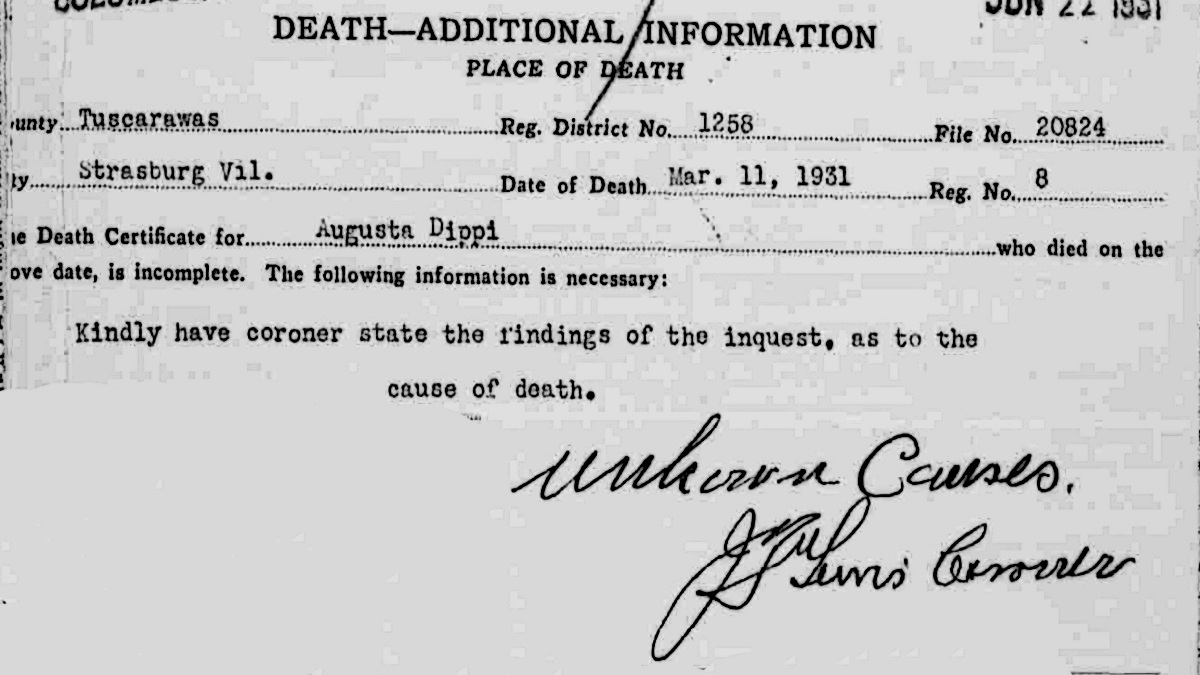
Was Augusta Dippi killed by roving serial predator or was she merely a victim of her own melancholy?
Content warning: This post contains references to suicide. If you or someone you know has a mental illness, is struggling emotionally, or has concerns about their mental health, there are ways to get help. Click here for resources to find help for you, a friend, or a family member.
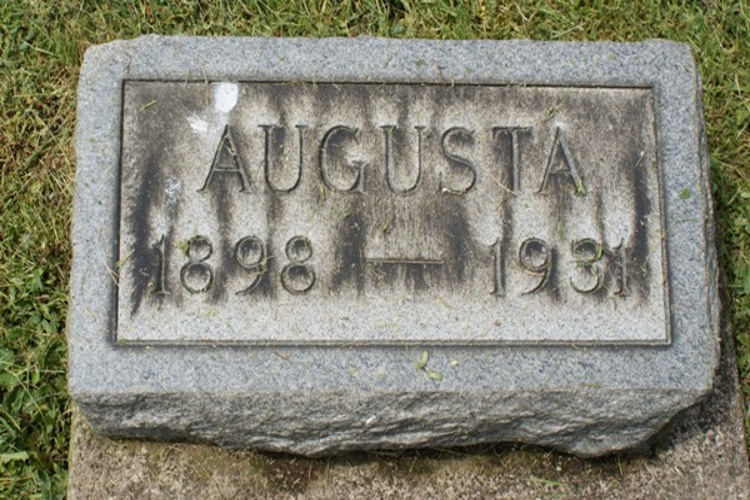
On the evening of Wednesday, March 11, 1931, the daughter-in-law of retired butcher Peter Miller entered his Strasburg home and discovered his housekeeper, Augusta Dippi (1898-1931), lying dead in her bed. The German immigrant, who had been dreading an upcoming examination for U.S. naturalization, was found clad in pajamas with an unsettling array of physical injuries. A four-foot strip torn from a bedsheet was tied loosely around her neck, both of her eyes were blackened, her temples were bruised, and shallow punctures from a bedside fork marked her left breast. Furthermore, severe blisters and burns covered her thighs and hips.
An autopsy performed by local doctors under the direction of the County Coroner revealed that Dippi’s death stemmed from a fist-sized contusion filled with blood near her right ear that caused fatal internal brain trauma without fracturing the skull. The investigation took a turn on the morning of Thursday, March 12, when violence erupted in New Philadelphia. A middle-aged transient forced his way into the kitchen of Mrs. Mary H. Morgan (1893-1965), demanding coffee before savagely choking her with his bare hands, beating her mouth and head against the hard floor until she lost consciousness, and stealing two dollars from her purse. Noting that the assailant had battered Mrs. Morgan’s head and throat in a manner eerily reminiscent of Dippi’s injuries, the coroner immediately initiated inquiries into whether the two attacks were linked.
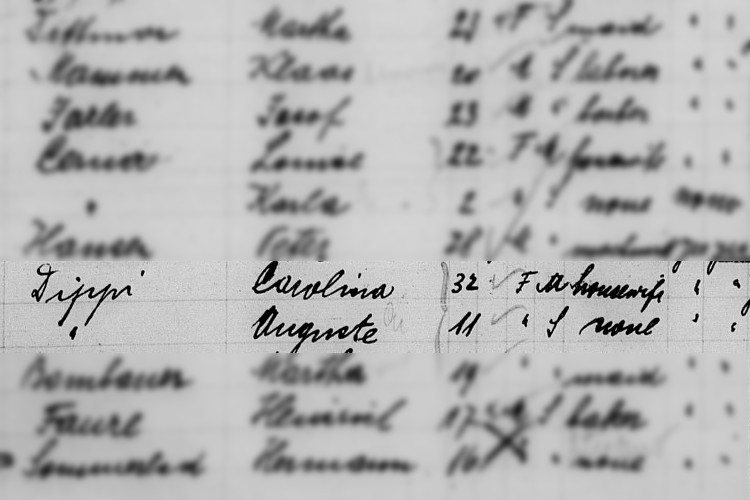
Augusta Dippi and her mother recorded on a 1910 ship’s list of passengers arriving in New York, May 1910. (Source: ancestry.com) 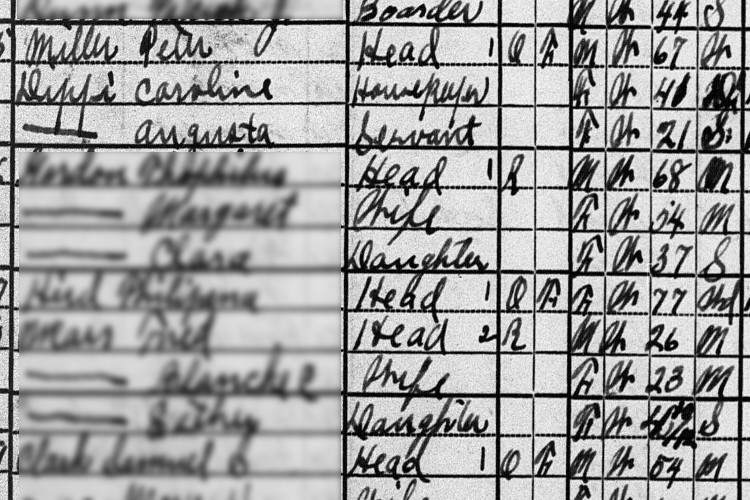
Augusta Dippi and her mother recorded on the 1920 census in the Strasburg, Ohio household of Peter Miller. (Source: familysearch.org) 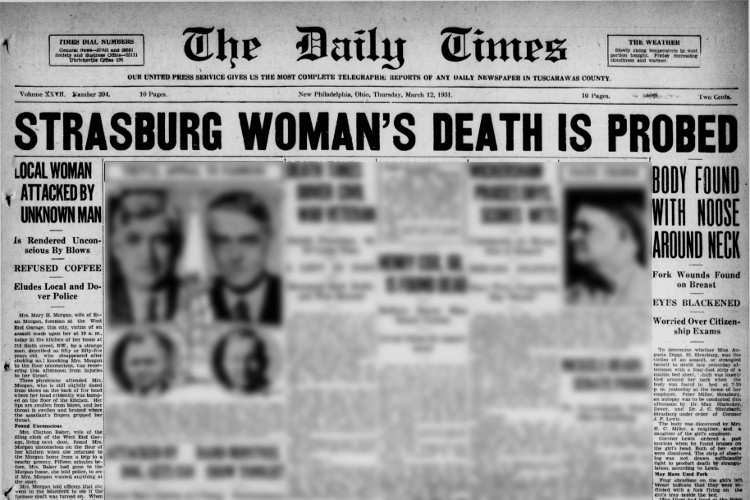
New Philadelphia, Ohio newspaper headline on the death of Augusta Dippi and an assault on another woman in Dover, Ohio, March 1931. (Source: newspapers.com)
Law enforcement officers mobilized across New Philadelphia and Dover to sweep rail yards, brick plants, and transient encampments along Sugar Creek and the Tuscarawas River. Several suspects were rounded up, including an Akron laborer arrested in Dover who was promptly cleared when Mrs. Morgan stated he was not her attacker, and another, who was dismissed because of his giant stature. However, any temporary relief was shattered on Friday afternoon, March 13, when the assailant struck again at the home of Ralph I. Toomey (1881-1965) on North Wooster Avenue in Dover. There, the live-in housekeeper answered a knock at the door and was met with a punch before managing to slam the door shut in the person’s face. One of the previous suspects was arrested a second time alongside another transient, but neither matched the attacker’s description or could be identified by the victim.

Confronted by the contradictory evidence in Strasburg, the coroner concluded his formal inquest into Augusta Dippi’s death on Friday afternoon by rendering a verdict of “death from causes unknown”. Although the local newspaper initially proclaimed her death was not believed to be suicide because of the massive contusion behind her ear, medical examiners remained baffled by the absence of a skull fracture and the bizarre burns and fork scratches. Finding no traces of poison and ruling out strangulation by the loose ligature as the sole cause of death, authorities decided against sending her organs to Cleveland for toxicological analysis. On Saturday, March 14, as Dippi was laid to rest in Strasburg, local newspapers and law enforcement officially christened the fugitive predator terrorizing county women “Jack the Choker”.
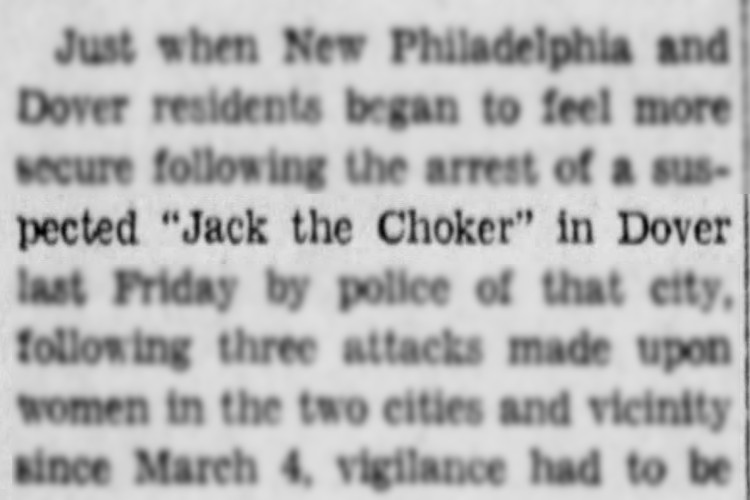
New Philadelphia, Ohio newspaper article about an attack by “Jack the Choker”, March 1931. Source: newspapers.com) 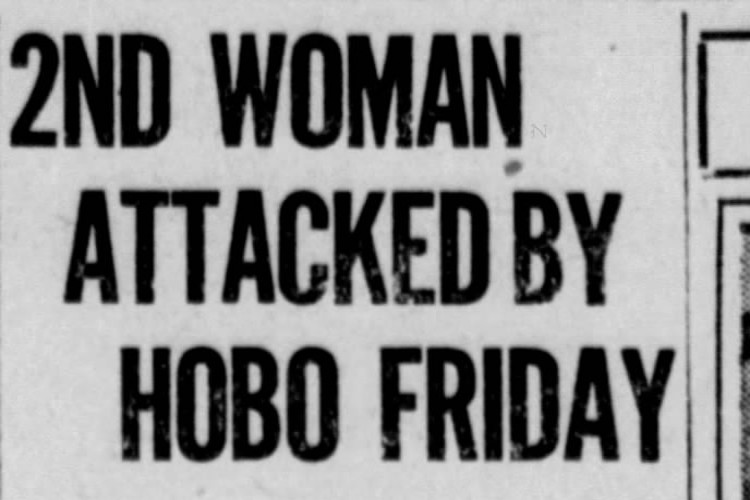
New Philadelphia, Ohio newspaper headline about a woman assaulted by “Jack the Choker”, March 1931. Source: newspapers.com) 
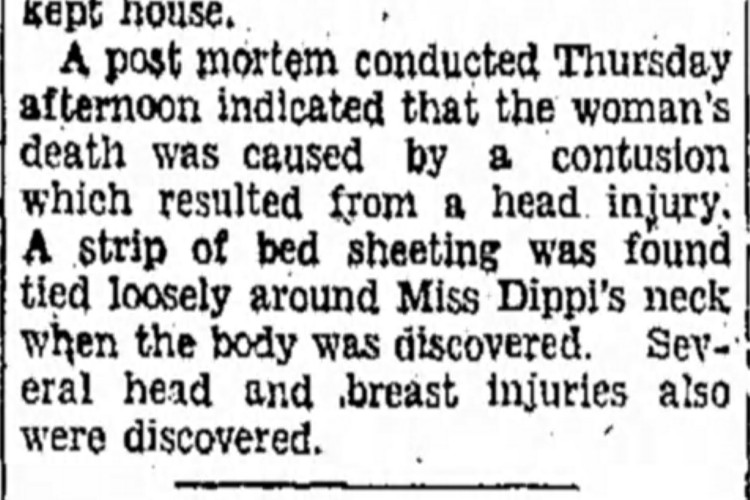
New Philadelphia, Ohio newspaper headline about a woman assaulted by “Jack the Choker”, March 1931. Source: newspapers.com)
The terror reached its height on Saturday night, March 14, when the predator carried out what newspapers reported as the fourth violent ambush against a local woman that month. At approximately 8:30 p.m., a woman stepped into her automobile in her driveway on Orchard Avenue NW in New Philadelphia to pick up her husband from work. Out of the shadows, a man lunged forward and physically dragged her away from the vehicle. The woman’s screams alerted her neighbor and startled her assailant into fleeing into the night, leaving her to collapse from shock.
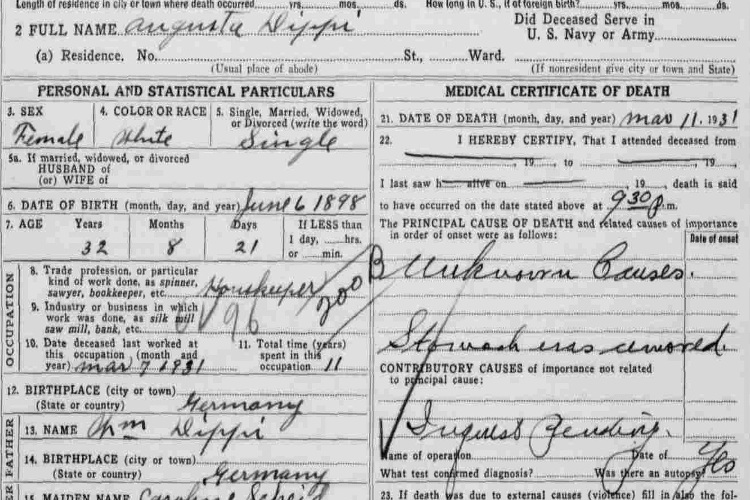
By Monday morning, March 16, police were forced to release all remaining suspects, leaving the true identity of “Jack the Choker” unsolved and the predator completely at large. The state government was not satisfied with the ambiguity surrounding Augusta’s death and, in June 1931, the Ohio Department of Health returned the death certificate demanding an explicit cause of death, but the coroner simply reaffirmed “Unknown Causes” on the form. To this day, the question of whether Augusta Dippi was the most tragic victim of the roving serial predator, or a despondent young woman whose fatal collapse coincided with an extraordinary crime wave, remains unresolved.
Enjoy the stories?

© Noel B. Poirier, 2026.

