
A tense standoff between a veteran sheriff’s deputy and an unstable Tuscarawas County farmer ended in deadly tragedy.
Martin L. Myers (1890-1940) was born in Harrisburg, Pennsylvania, the son of Victor E. Myers (?-1892) and Ella McBarnes Myers (1872-1943). After his father’s death in 1892, young Martin grew up in Dennison, Ohio, where he lived in an uncle’s home on Third Street along with his mother and sibling. By the time he was 19, Martin worked for the railroad, a line of work that would define his early life. He married Elizabeth Barnhill (1889-1970) in Tuscarawas County in 1912, by which time he worked as a boilermaker for the railroad. When Martin registered for the World War One draft in 1917, the couple had two children, and Myers was described as of medium build and height, with brown eyes, light brown hair, and a missing right index finger—a likely sign of the hazards of his line of work.
Martin was still employed as a railroad boilermaker into the 1920s while he and Elizabeth raised three children. After a labor strike, his career took a new direction and, in 1926, he was appointed Police Chief of Dennison, a position he held into the 1930s. Sometime before October 1933, Myers transitioned to the Tuscarawas County Sheriff’s Department as a deputy sheriff, a role he still held in 1940. At that time, the Martin family was living on North First Street in Dennison and Martin had developed the reputation as a competent, dedicated law enforcement officer. That same year Martin tragically crossed paths with a local farmer named Herbert Krebs (1893-1940).
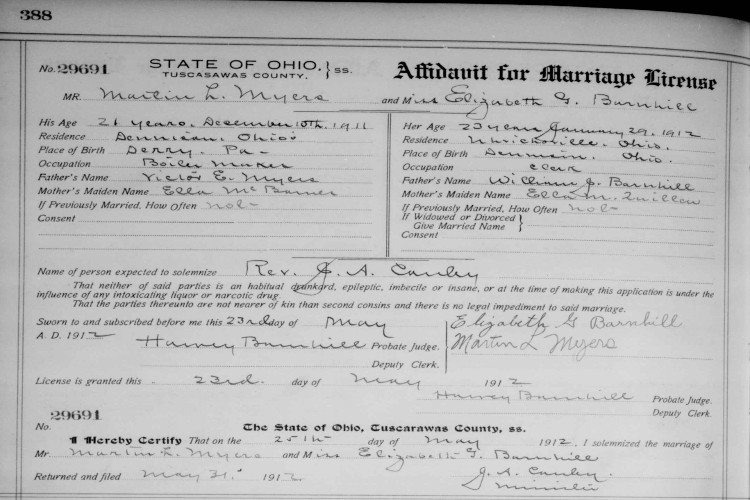
Marriage of Martin Myers and Elizabeth Barnhill recorded in the Tuscarawas County records, May 1912. (Source: familysearch.org) 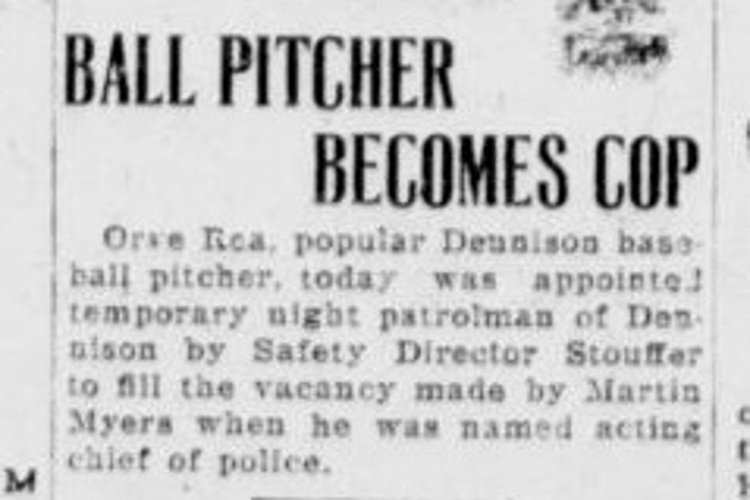
New Philadelphia, Ohio newspaper article referencing Martin Myers being made Chief of Police in Dennison, Ohio, February 1926. (Source: newspaperarchive.com) 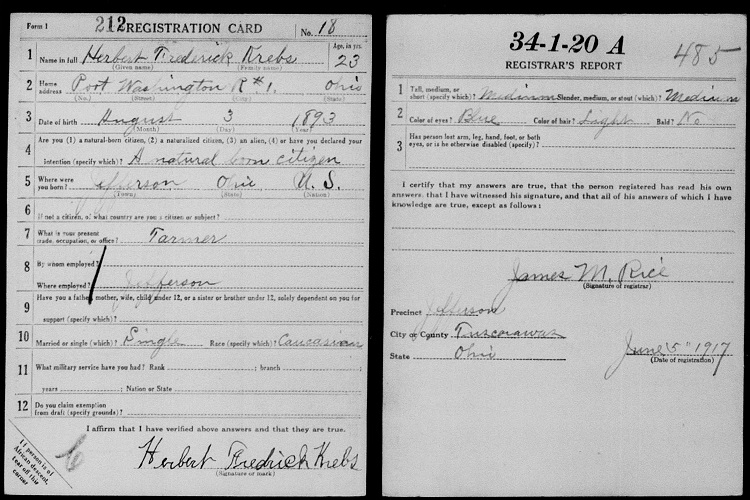
Herbert Krebs’ World War One draft registration card, June 1917. (Source: familysearch.org) 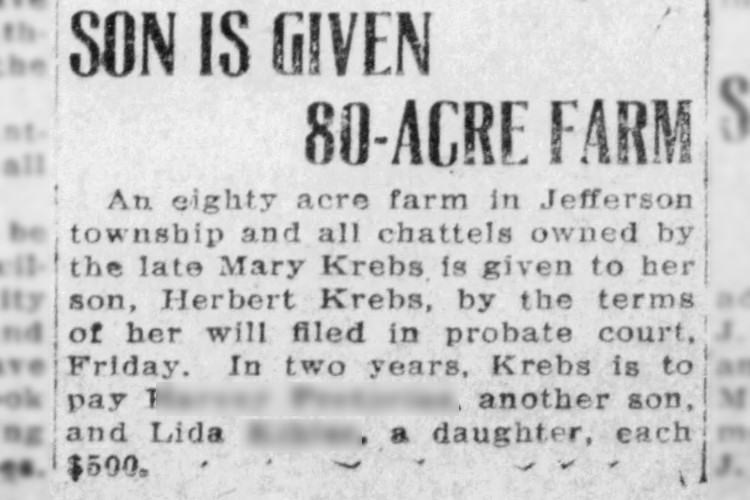
New Philadelphia, Ohio newspaper article referencing Herbert Krebs inheriting of Krebs family farm, July 1925. (Source: newspaperarchive.com)
Herbert F. Krebs was born in Jefferson Township, Tuscarawas County, Ohio, the son of Daniel Krebs (1848-1909) and Mary Gintz (1861-1923). Raised on the family farm, he spent his early life working the land alongside his parents and step-brother. After his father’s death in 1909, Herbert continued to live with and assist his mother, and remained on the farm. His World War I draft registration in 1917 described him as of medium height and build, with blue eyes and light-colored hair. After his mother died in 1925, Herbert inherited the family farm, where he lived and worked alone for the rest of his life. After the death of his mother, there were reports that his mental health suffered and family members even tried to convince authorities to confine Herbert on charges of “lunacy”. That did not happen, and the 1930 and 1940 census records placed him on the same Jefferson Township property, where he maintained the solitary farming life he had known since childhood.
The week of May 20, 1940 authorities received complaints from Herbert Krebs’s neighbors that he had threatened them with a gun and knives. Given his past, law enforcement thought best to approach the home cautiously and Martin Myer, along with Sheriff Wayne T. Host (1894-1940) and fellow Deputy John McIntosh (1901-1948), impersonated hoboes as they called for Herbert to come outside and give them directions. When he refused to come outside, the officers threw a tear gas canister into the home and Myers, despite warnings not to, approached the home. Krebs came out of a side door of the house and a shootout began. Krebs emptied his revolver at the deputy; three bullets hit Myers while a fourth lodged in a tear gas canister. Myers was mortally wounded and loaded into Sheriff Host’s car for the long ride to Union Hospital in Dover.
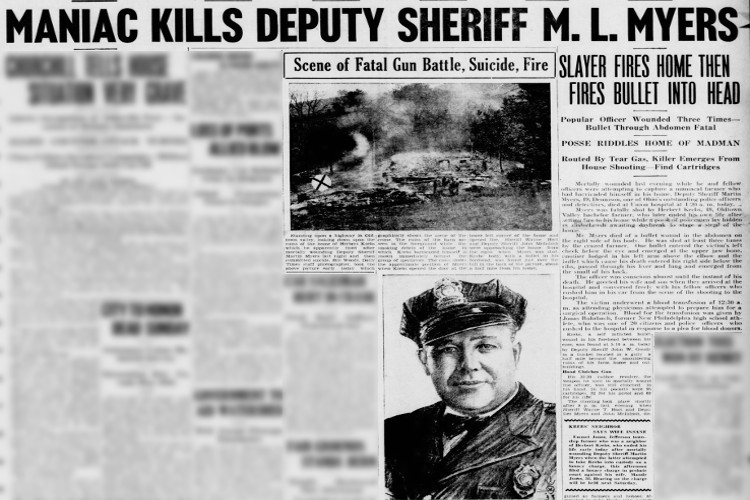
Front page of the New Philadelphia, Ohio newspaper with the story of the killing of Martin Myers, May 1940. (Source: newspapers.com) 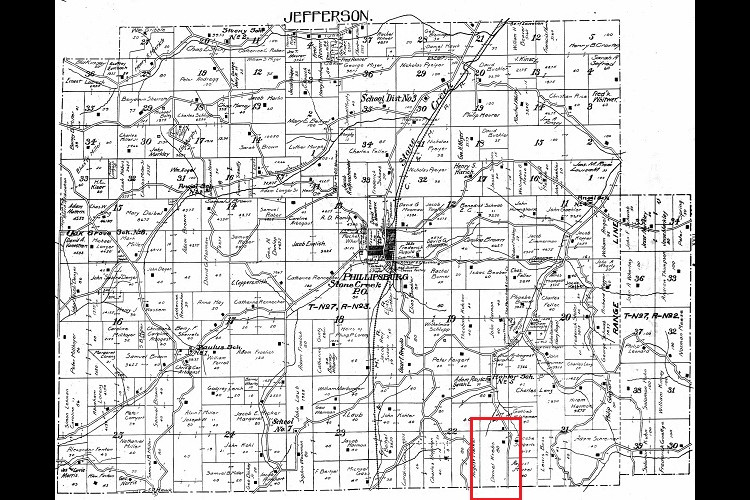
The location of the Krebs family farm on the 1908 Atlas of Tuscarawas County. (Source: ancestry.com) 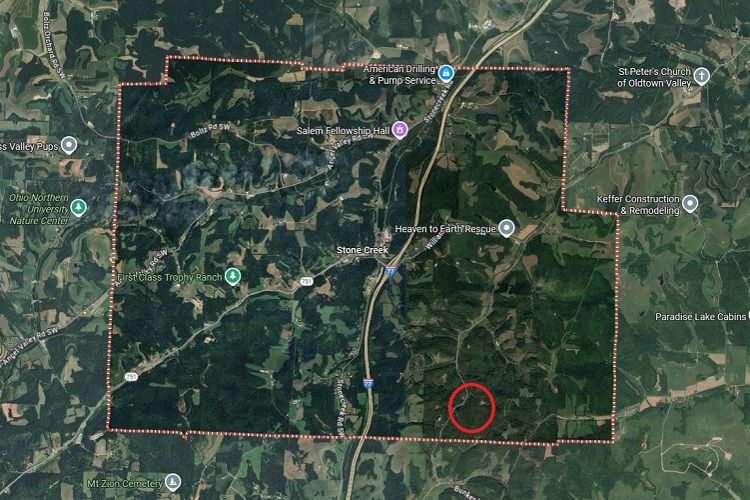
The general location of the Krebs farm shown on a modern map of Jefferson Township, Tuscarawas County, 2025. (Source: google.com)
As Myers was driven to the hospital, more law enforcement officers descended on the Krebs farm. When they arrived, the officers peppered the home with Thompson submachine gun and revolver fire until they noticed a flickering light from inside. Krebs had started a fire in the home, before sneaking out a back door, and the officers were unable to put it out before it spread and consumed the the entire homesite. Krebs’s body, with a self-inflicted gunshot wound to the head, was discovered shortly after in a ditch behind the home. Meanwhile, Myers succumbed to his injuries from the gunfight with Krebs the day before and died at Union Hospital at 4:20 am on Thursday, May 23, 1940.
Martin Myers’s funeral was held in the family home on North 1st Street in Dennison, Ohio on Saturday, May 25, 1940 and he was buried in Union Cemetery in Uhrichsville later that day. Herbert Krebs, meanwhile, was buried in Stone Creek Cemetery in Stone Creek on the same day. The violent confrontation between the two men shocked the Tuscarawas County community and was widely reported in newspapers across Ohio. Myers was remembered as a fearless and skilled lawman, while Krebs’s tragic decline into isolation and paranoia served as a grim cautionary tale.
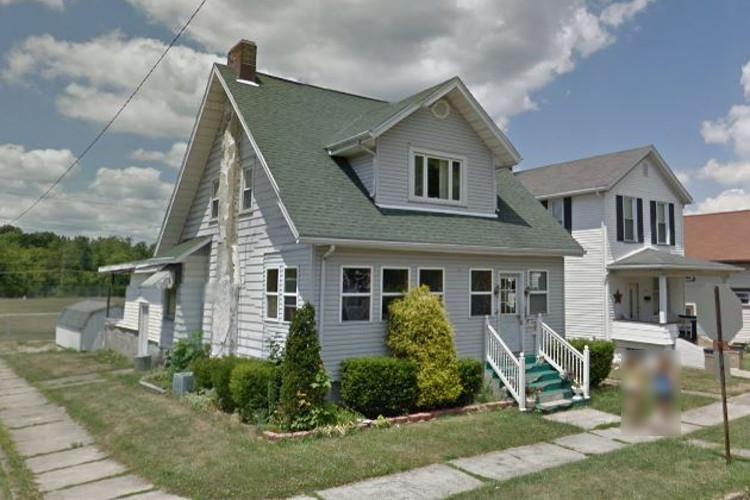
Modern view of the Myers Home on North 1st Street in Dennison, Ohio, 2012. (Source: google.com) 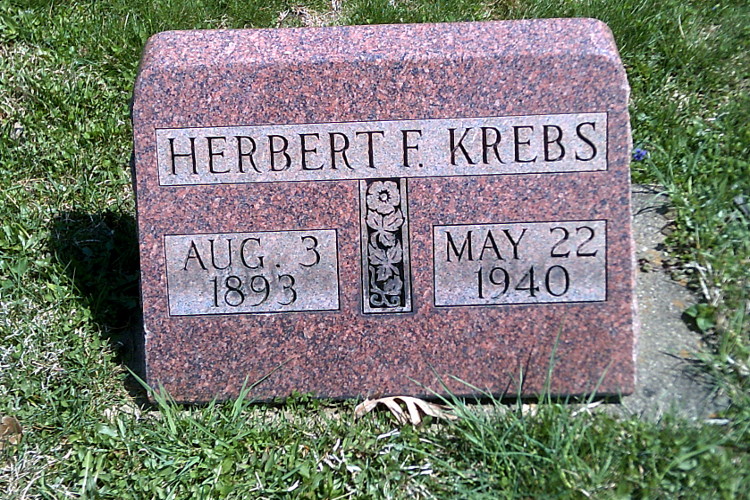
Herbert Krebs’s headstone in Stone Creek Cemetery in Stone Creek, Ohio, 2017. (Source: findagrave.com) 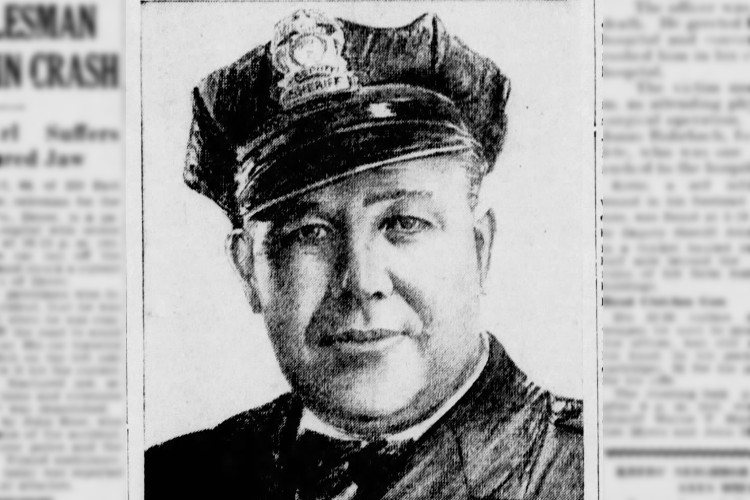
Portrait of Deputy Martin Myers that appeared in the New Philadelphia, Ohio newspaper, May 1940. (Source: newspapers.com)
Enjoy my stories?

© Noel B. Poirier, 2025.
 Tuscarawas County Stories