
A gathering of railroad workers in Somerdale ended in violence, culminating in the death of one man, the wounding of another, and a murder conviction that marked the end of one immigrant’s American dream.
Throughout Tuscarawas County’s history it has attracted people from elsewhere, at first to farm its fertile land, and later to work in its coal and clay mines, its manufactories, and along the railroads that connected the state. At the turn of the 20th century many of these people were arriving en masse from southern Europe, most notably Italy and what was then Austria-Hungary. They brought with them their languages, religions, and beliefs that added to the what it meant to be an American. They also brought with them their own prejudices against one another.
During the first decade of the 1900s, the Wheeling and Lake Erie Railroad employed many of these immigrants all along their tracks. The teams of hard-working men laid track, built bridges, dug culverts, anything the railroad needed to improve their ability to serve customers all along their line. Among this force was a mixed group of Italian and Romanian men working in the Somerdale community of Tuscarawas County, Ohio. Many of these men, by the time they arrived in Ohio, had already “Americanized” their names to better conform to their new homes.
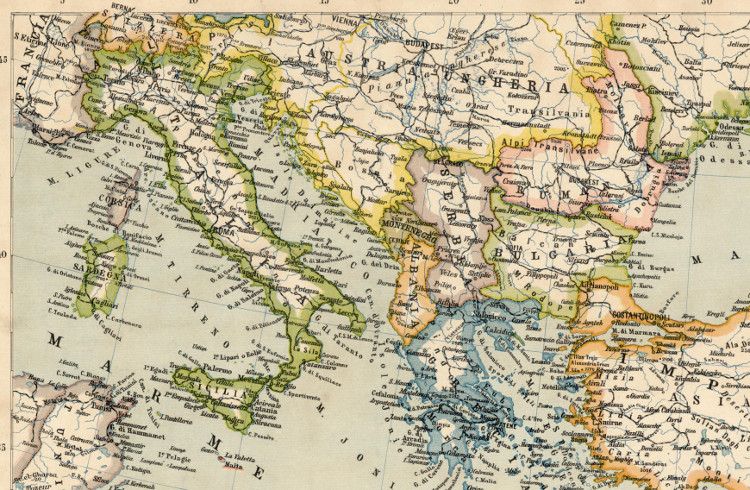
Detail from a map showing Southern Europe, including Italy and Austria- Hungary, 1890. (Source: loc.gov) 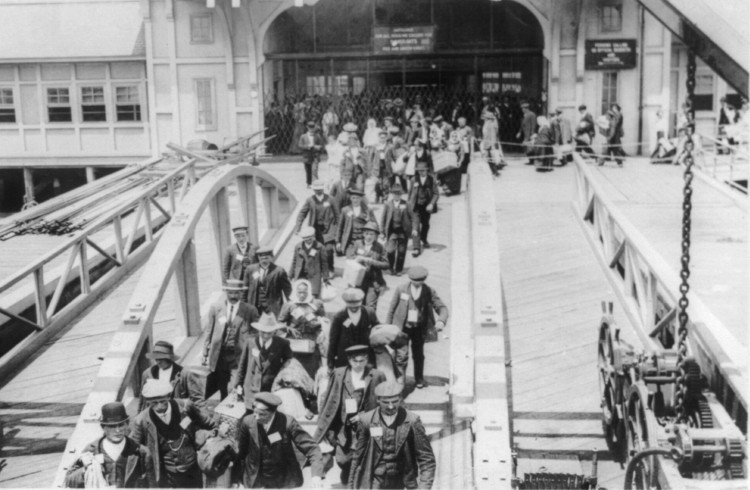
Recent immigrants leaving Ellis Island, New York, 1909. (Source: loc.gov) 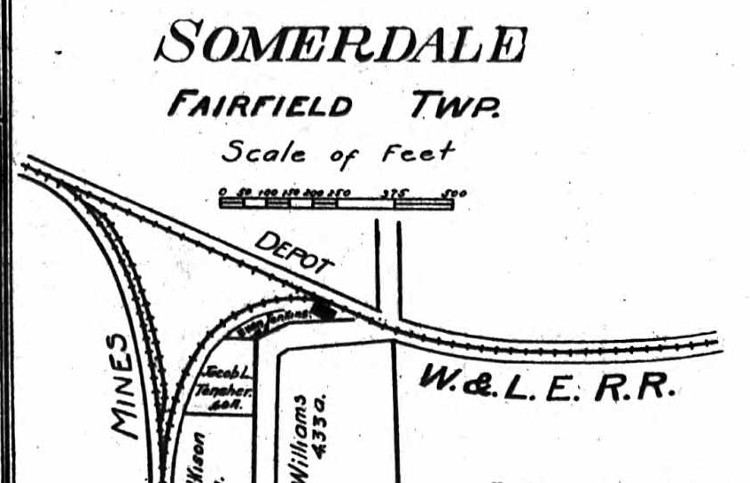
Detail from 1908 Tuscarawas Atlas map showing the depot and Wheeling and Lake Erie tracks in Somerdale, Ohio. (Source: ancestry.com) 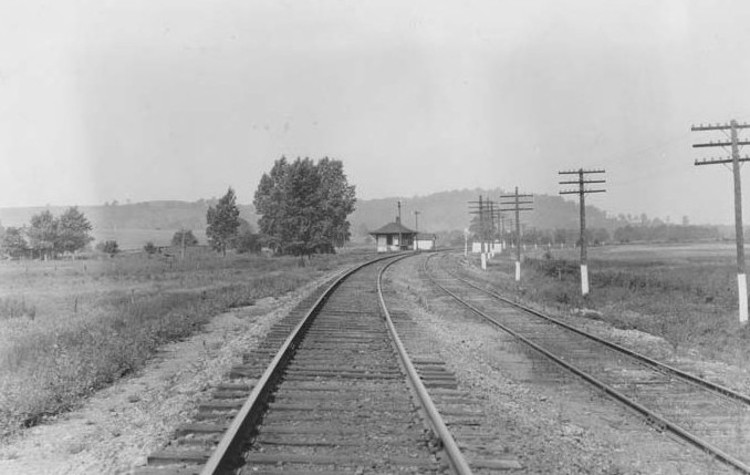
Early 20th century photograph of the Somerdale Depot and Wheeling and Lake Erie tracks, c. 1910. (Source: west2k.com)
On the evening of Saturday, August 12, 1906 a group of railroad laborers gathered in an empty boxcar at the end of a hard week’s work. The men, mostly from Italy and Romania, played cards and drank whiskey well into the evening. At some point, well after midnight, one of the Italian men on the crew named Valentine Cope, picked a fight with a Romanian man named Nick Stirp in the boxcar. The argument escalated quickly and, before anyone could stop it, grew into a full blown melee with the men from the different countries going at one another with shovels, hammers, and even razor blades.
That was when John “Dan” Stirp (1875-?), Nick’s brother, intervened. He drew a .38 caliber revolver and fired at Italian Tony Brand (1871-1906) killing him, then fired another round at a man named Charles Anthony that hit him in the mouth and jaw. Brand died at the scene and Anthony was taken, mortally wounded, to the County Infirmary. Dan Stirp was arrested and taken to the City of New Philadelphia where he was housed in the County Jail and taken in front of Mayor John Schell (1864-1929) for a preliminary hearing. Stirp claimed that he was merely protecting his brother and that during the melee one of the Italians attempted to steal money from his pocket, money intended for his family in Hungary, so he drew his gun.
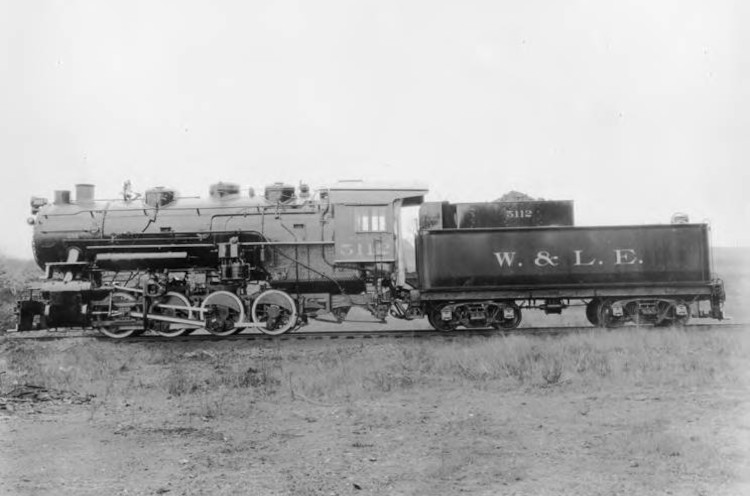
Locomotive No. 5112 0-8-0, Wheeling and Lake Erie Railroad, 1905. (Source: Cleveland State University. Michael Schwartz Library. Special Collections) 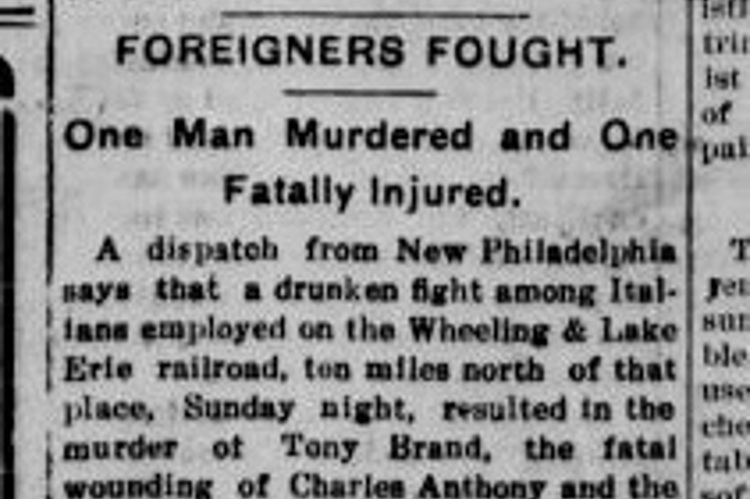
Massillon newspaper account of the murder of Tony Brand by Dan Stirp, August 1906. (Source: newspaperarchive.com) 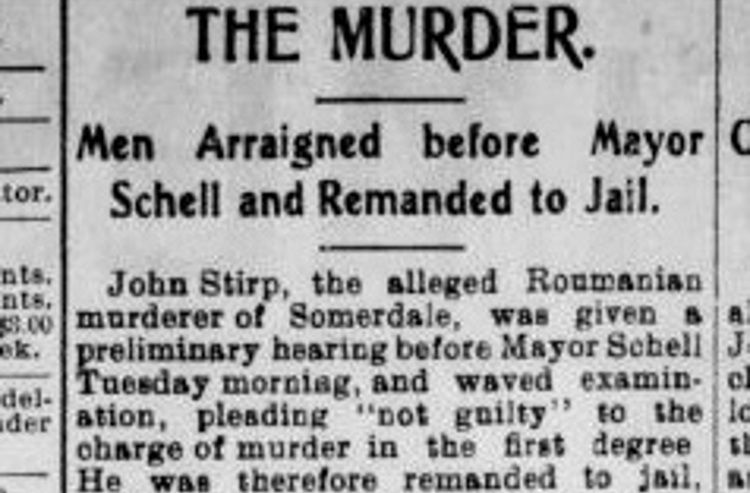
New Philadelphia newspaper account of the murder of Tony Brand by Dan Stirp, August 1906. (Source: newspaperarchive.com) 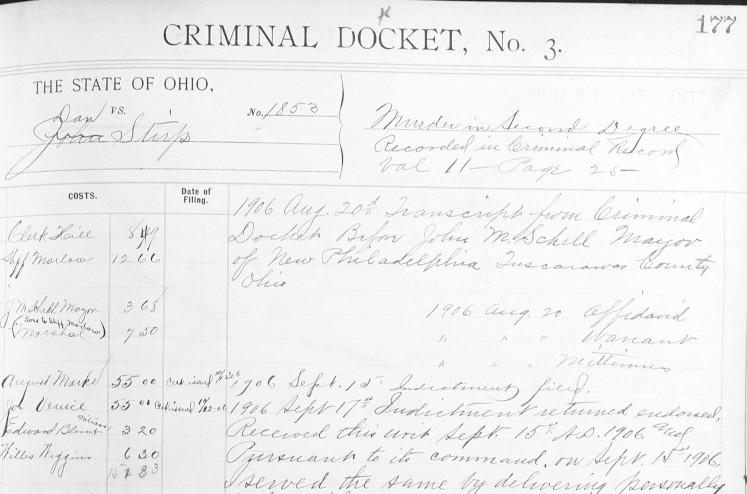
Detail from John “Dan” Stirp’s criminal record, October 1906. (Source: familysearch.org)
John “Dan” Stirp, born in 1875, was of Romanian and Hungarian heritage. He immigrated to the United States in 1904, leaving behind his life in Hungary, where he was married and had children. When his brother Nick arrived is unknown, but the two may have travelled together. While details of their early life remain limited, their journey reflects the broader wave of Central and Eastern European migration during the early 20th century, driven by the pursuit of economic opportunity and a better future. John’s American future ended that August night in a boxcar in Somerdale.
A Tuscarawas grand jury indicted Stirp for second degree murder in September 1906, to which he pleaded not guilty. A month later however, perhaps realizing the severity of his case, he decided to plead guilty to the lesser charge of third degree murder. Stirp was sentenced to ten years in the Ohio State Penitentiary, and was recorded as being an inmate there in the 1910 census. Three years later, under the agreement that he would return to his home country, John “Dan” Stirp was pardoned. What happened to the rest of the men involved in the Somerdale “riot” remains to be discovered.
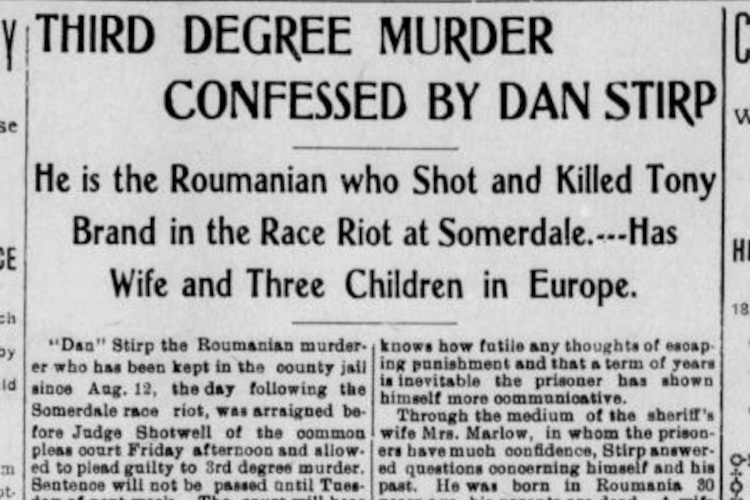
New Philadelphia newspaper article reporting John “Dan” Stirp’s guilty plea, October 1906. (Source: newspaperarchive.com) 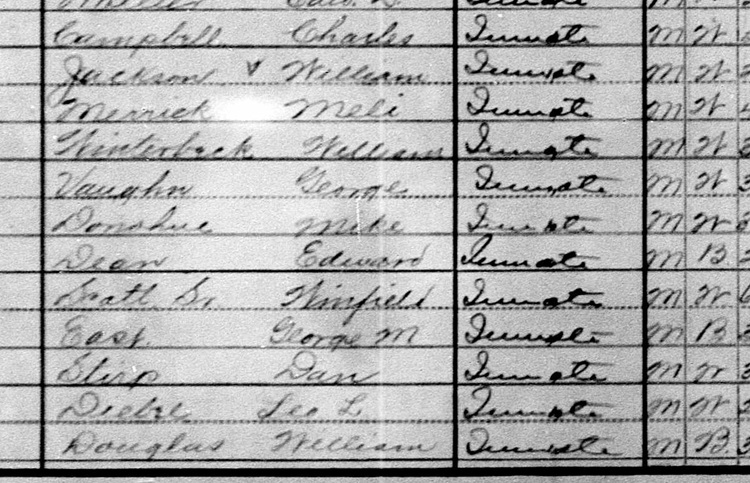
John “Dan” Stirp recorded in the 1910 census for the Ohio State Penitentiary. (Source: familysearch.org) 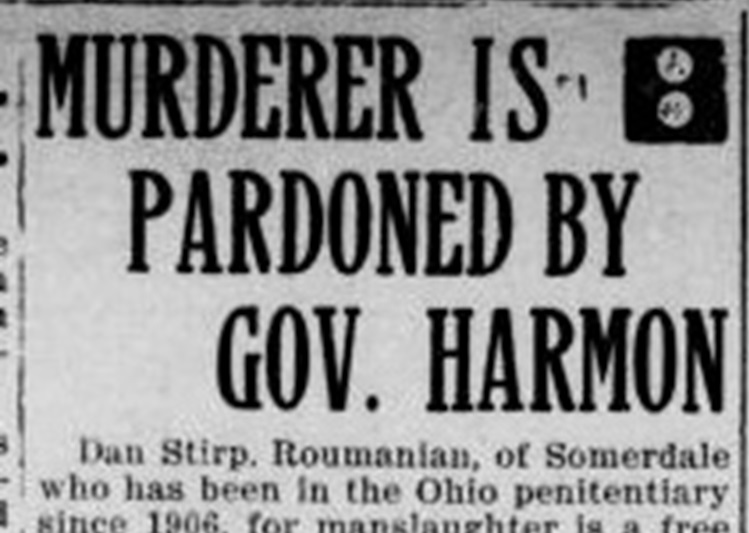
New Philadelphia newspaper article reporting the pardon of John “Dan” Stirp, January 1913. (Source: newspaperarchive.com)
Enjoy my stories?


© Noel B. Poirier, 2024.

