
When this family of tradespeople built their homes on the north end of Factory Street (now Tuscarawas) in Dover, Ohio in the late 19th century there were few homes there to be found. The houses they built, including this one, are still standing over 130 years later.
Leonard Weber (1817-1888) and his wife Catherine Hess (1815-1879) married in Prussia in the late 1830s. Leonard was a stone mason by trade and the family, including one daughter and one son, immigrated to the United States aboard the sailing ship Colchester in 1847. After arriving in New York the family made their way west, eventually settling in Dover, Ohio by 1850 where Leonard found ample need for his skills.
The family welcomed two more children by the time the 1850 census was recorded and three more by the time the 1860 census was taken. Among the seven children born by 1860 was a son named Peter C. Weber (1851-1926). Leonard must have hoped to diversify his family business as one son followed in his footsteps as a stonemason and at least two other sons, including Peter, were trained as carpenters. There was certainly plenty of work in the growing communities of Dover and New Philadelphia in the 1870s.

The passenger list for the sailing ship Colchester on which the names of Leonard Weber and his family are recorded, 1847. (Source: ancestry.com) 
The Weber family (mistakenly recorded as Weaver) in the 1860 census for Canal Dover. (Source: familysearch.org) 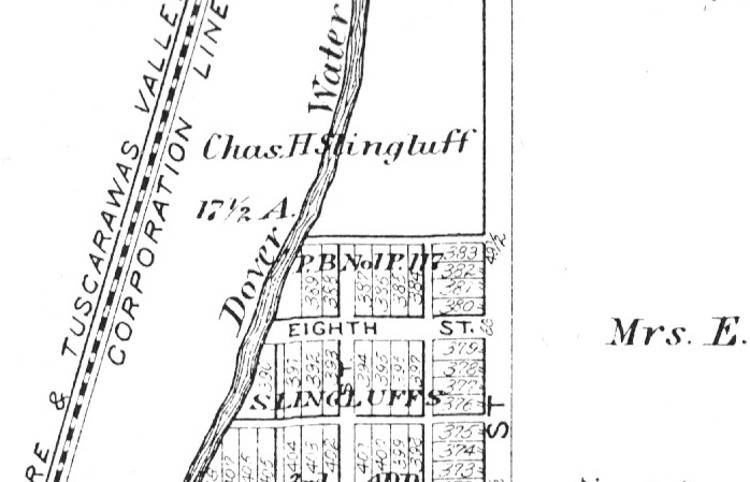
The area of land on North Factory Street (now Tuscarawas) in Dover where the Weber’s purchased their lots, 1875. (Source: ancestry.com)
It was perhaps through work or church that Peter met Margaret Worms (1858-1941), the daughter of a successful local farmer. Peter and Margaret married in the fall of 1876 and began their rather large family shortly afterwards. A few years later, in 1882, Charles Slinghuff began selling off lots in property he owned on the north end of Factory Street in Dover. Peter and two of his brothers were among the purchasers and, shortly after, began constructing their homes on the west side of North Factory Street.
The house that Peter and Margaret built on their lot was of the very common, and very simple, National Folk style home. The home was laid out as a gable-front and wing form with a small, single-story porch along the wing’s face. It is possible that there may have also been elements of decoration, like turned spindles and other decorative elements on the porch. An early 20th-century photograph of the home shows just this level of decoration. As the need arose, additions to the rear of the home were made to provide more room for their large family or business activities.

Peter C. Weber and Margaret Worms wedding photo, September 1876. (Source: ancestry.com) 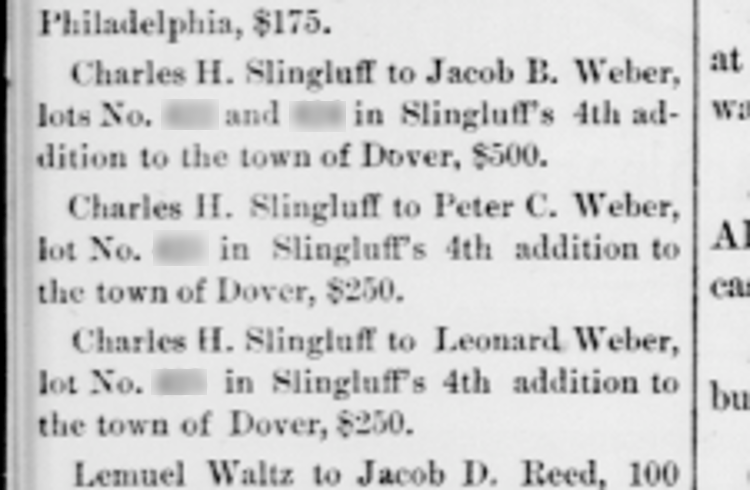
The Webers purchase of lots on North Factory Street from Charles Slinghuff reported in the Dover newspaper, August 1882. (Source: newspaperarchive.com) 
The Weber House noted on the 1899 Panoramic Map of Dover, Ohio. (Source: loc.gov) 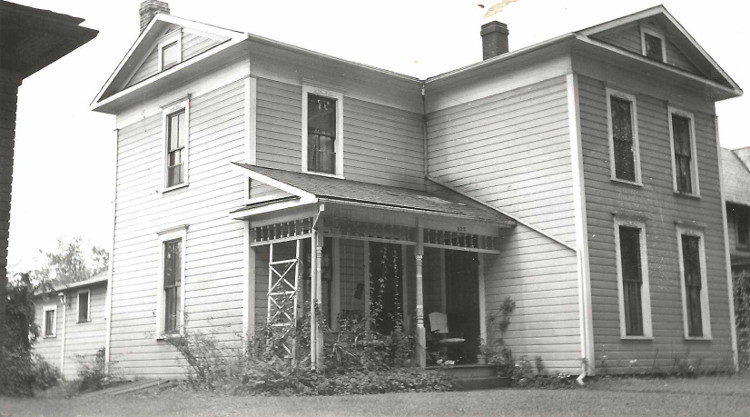
The Weber House in Dover, photographed c. 1917. (Source: ancestry.com)
Peter continued to work as a carpenter in Dover, working both for private individuals and for some of the manufactories in town. His sons often assisted him until they came of age and found other work in town, mostly in the local mills. Through about 1920, most of the Weber children continued to live in the home on North Factory Street. One of those children was a son named Herbert V. Weber (1886-1962) who served as a military policeman in Europe during World War One.
Peter Weber, then 75 years old, became ill in February 1926 and never recuperated. He died in April 1926 and was buried in St. Joseph’s Cemetery. Margaret continued to live in the home with an unmarried daughter for another 15 years before Margaret died in 1941. After Margaret’s death, Herbert Weber and his wife moved into the home and used a portion of the home for their barber shop and hair salon for many years. After Herbert’s death in 1962, his wife sold the home and, after nearly 80 years, it left the Weber family.
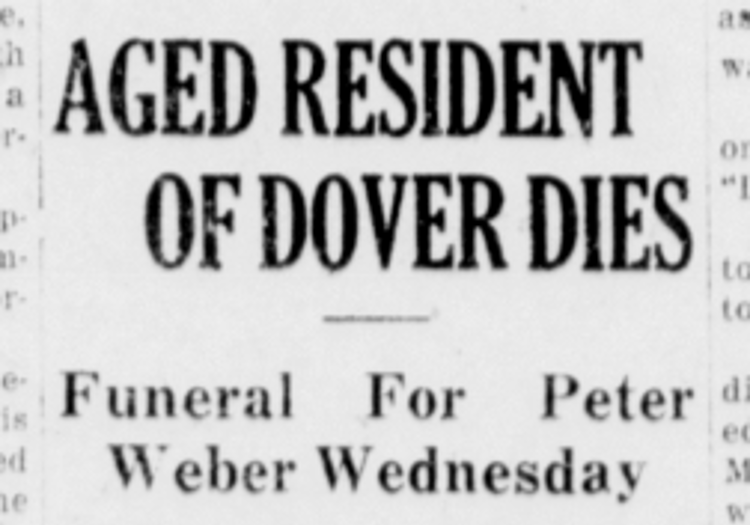
Peter C. Weber’s death announced in the New Philadelphia, Ohio newspaper, April 1926. (Source: newspaperarchive.com) 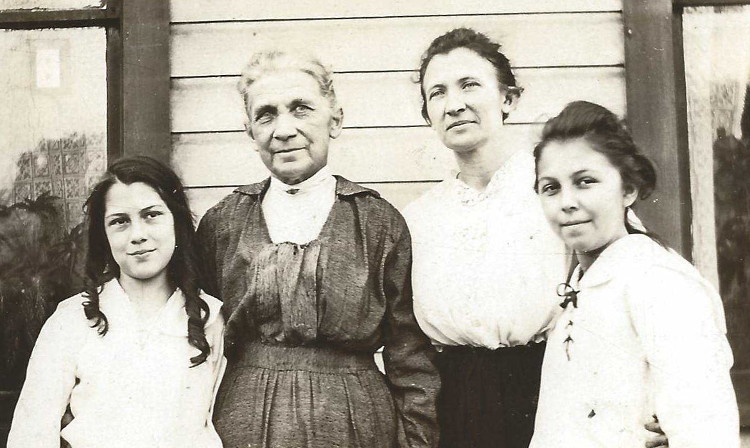
Margaret Weber (second from left) photographed in front of her home with a daughter and grandchildren, c. 1917. (Source: ancestry.com) 
Peter Weber’s headstone at St. Joseph’s Cemetery, Dover, Ohio, 2013. (Source: findagrave.com) 
Margaret Weber’s headstone at St. Joseph’s Cemetery, Dover, Ohio, 2013. (Source: findagrave.com) 
The Weber House on North Tuscarawas Avenue, Dover, Ohio, 2023. (Source: google.com) 
The Weber House on North Tuscarawas Avenue, Dover, Ohio, 2023. (Source: google.com)



© Noel B. Poirier, 2024.
 Tuscarawas County Stories