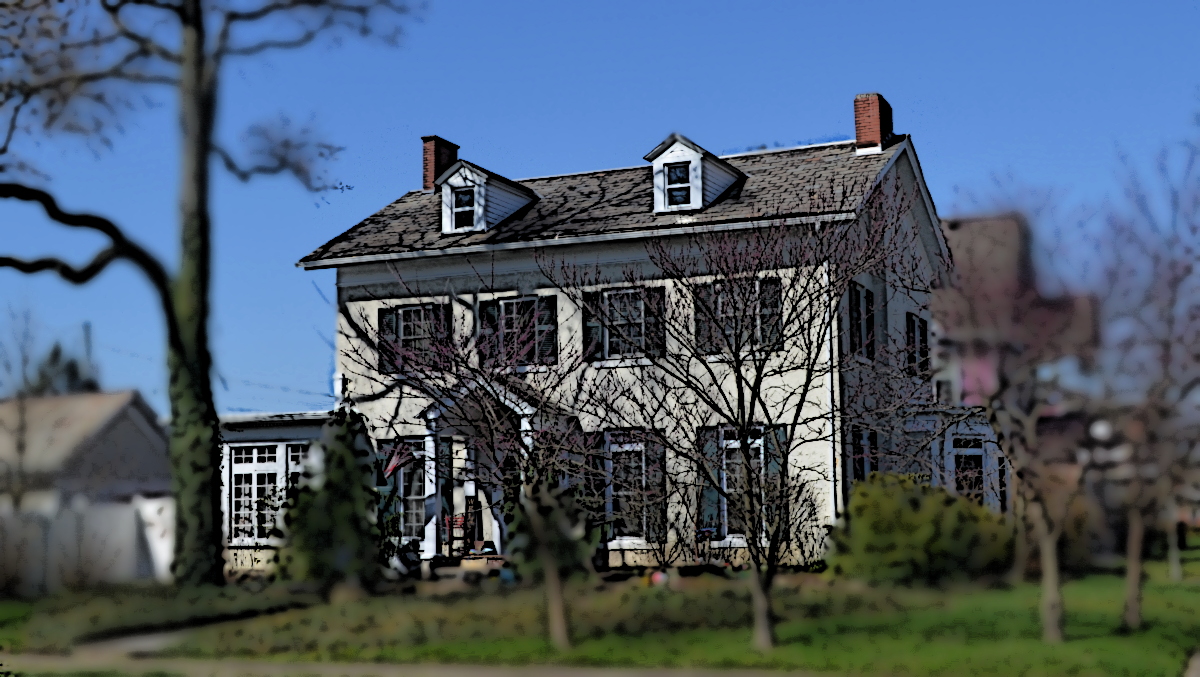
The story of my home’s construction is said to have started with a 19th century butcher named Samuel Crossland. I thought I would take a deeper dive into his life and discover more about the man who had my home built in the 1850s.
The Crossland family immigrated from Germany and originally settled in Lancaster County, Pennsylvania. It was there that Elijah Crossland (1782-1860) was born and learned the butcher’s trade, whether formally or informally is not clear. Elijah married Catherine Smith (1783-1868) in 1802 and the couple shortly welcomed the first of their many children. Elijah’s family migrated west into Fayette County, Pennsylvania and there Elijah established himself as a successful butcher, originally in Connellsville and later in Uniontown, Pennsylvania.
Among the couple’s many children was a son named Samuel Crossland (1810-1881) who trained with his father to be a butcher as well. After completing his training, and perhaps looking for excitement or escape, Samuel enlisted in the United States Army in March 1832. Apparently army life did not suit Samuel as he deserted only three months later in July 1832. After the army, Samuel made his way to Stark County, Ohio where he married Elizabeth Crosland (1816-1892) in February 1834. Whether the two were related in some way is unclear.
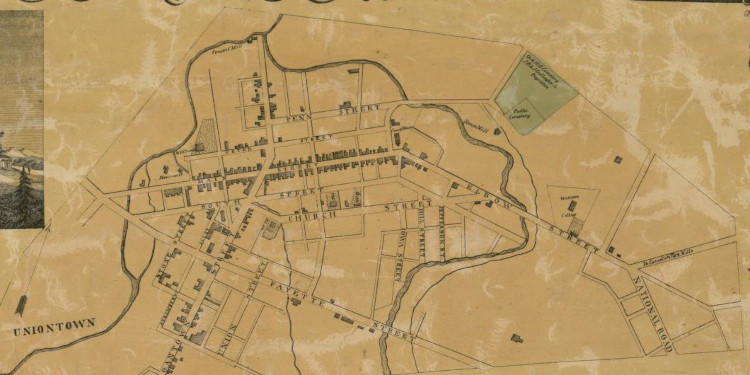
Map of Uniontown, Pennsylvania from an 1858 map of Fayette County, Pennsylvania. (Source: loc.gov) 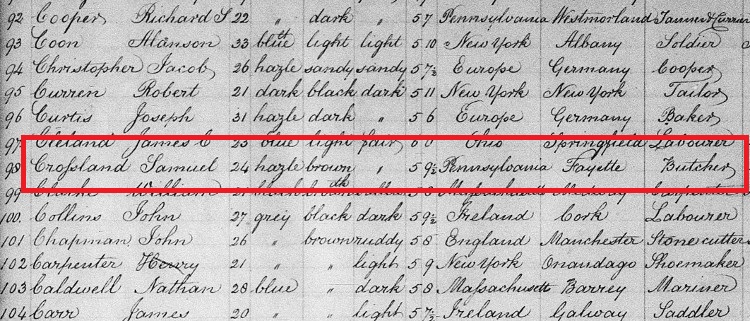
Record of Samuel Crossland’s enlistment, in and subsequent desertion from, the United States Army, 1832. (Source: familysearch.org) 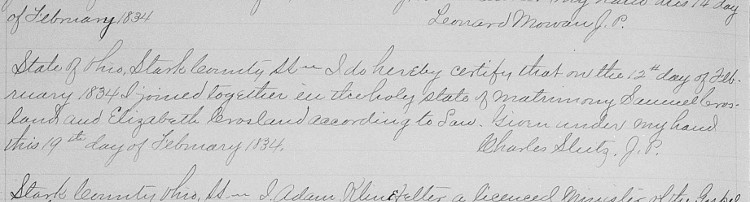
Samuel Crossland’s marriage to Elizabeth Crosland recorded in the Stark County, Ohio records, February 1834. (Source: familysearch.org) 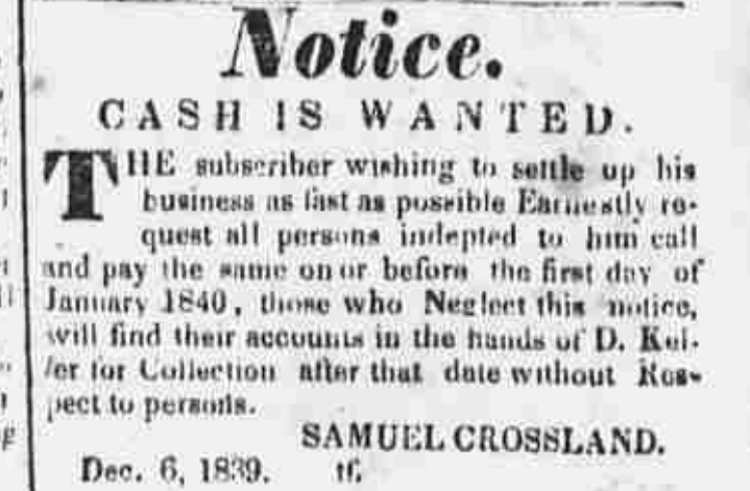
Samuel Crossland advertisement in the New Philadelphia, Ohio newspaper, December 1839. (Source: newspaperarchive.com)
The couple relocated to Dover, Ohio shortly after their wedding and, while living there, Samuel established his butchering business and sold meat in New Philadelphia’s Market House. Samuel, in 1850, purchased four New Philadelphia city lots (229, 230, 231, 232) from Andrew Herter at the intersection of Fair Street and (then) Sixth Street. When Crossland purchased the land it was valued at $750 and when he sold lots 231 and 232 in 1855 those two lots were valued at $1700. This indicates that between 1850 and 1855 Crossland had built the house that now stands on lot 232, though what that house originally looked like is unclear.
What is known about its appearance can be gleaned by its existing structure and 19th century depictions of the property that have survived. The home is a two-story brick home that rests on sandstone foundations over 15 inches thick. The home was likely built in the Greek Revival style common during that era. The home was depicted in an 1885 representation of the City of New Philadelphia has having a full-length, single-story porch along its façade. This feature also appeared in the 1892 layout depicted on that year’s Sanborne Fire Insurance maps. The home also appeared to have additions on the south side of the home that change over time. The house underwent a major renovation and redesign in the 1910s that give the home its modern appearance.
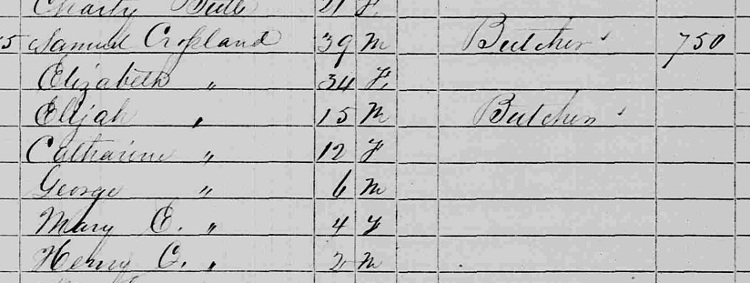
The Crossland family recorded in the 1850 Census for New Philadelphia, Ohio. (Source: familysearch.org) 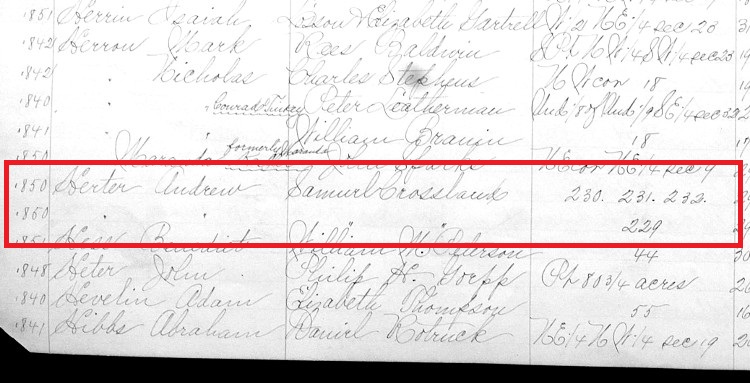
Samuel Crossland’s purchase of lots 229, 230, 231, and 232 from Andrew Herter from the Tuscarawas County Title Records, 1850. (Source: familysearch.org) 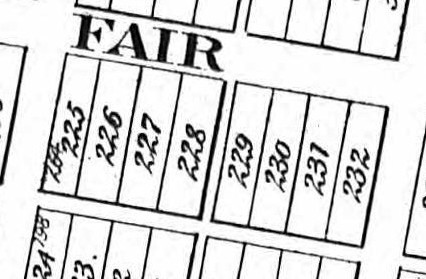
Lots 229. 230. 231, 232 from a Map of New Philadelphia in the 1875 Tuscarawas County Atlas. (Source: ancestry.com) 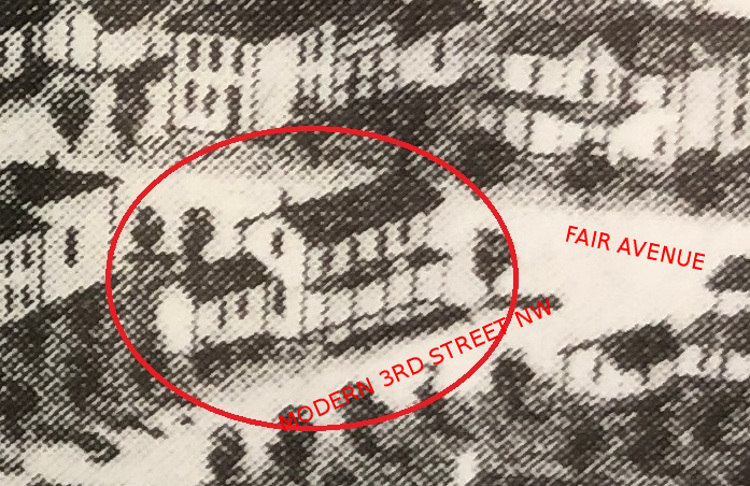
The Crossland House depicted on an 1885 birds-eye view of New Philadelphia, Ohio. 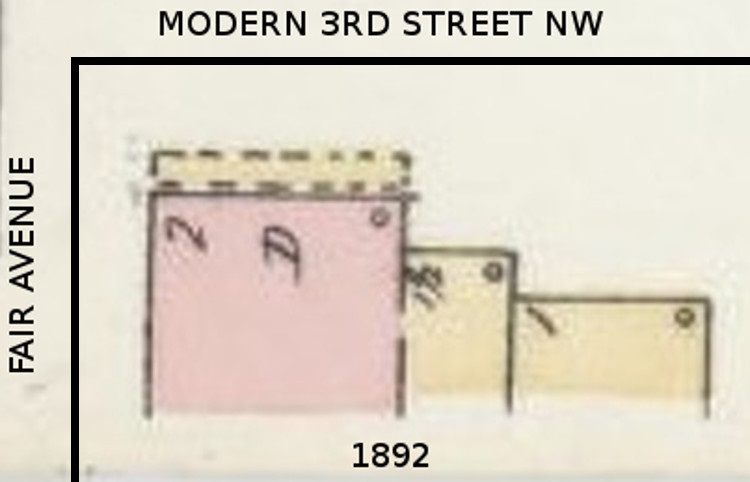
The Crossland House depicted on the 1892 Sanborne Fire Insurance Map for New Philadelphia. (Source: loc.gov)
Samuel Crossland and his sons continued to work as butchers and meat merchants in New Philadelphia after they sold the home. Samuel sold his portion of the family business to another local merchant in 1875 who then partnered with the Crossland sons. One of Samuel’s sons was regularly in trouble with the law, having once been jailed for robbing a man of his livestock at gunpoint and, later, arrested for stealing chickens from the coops of residents of North Broadway. Despite that, the “Crossland Brothers” continued to operate their meat market at No. 14, East High Street.
After selling the home they built on lots 231 and 232, the Crossland family purchased a home on the 400 block of North Fifth Street (modern 2nd Street NW) in New Philadelphia. Samuel and Elizabeth lived there with their sons and daughter until their deaths. Samuel died in September 1891 and Elizabeth lived only one year longer than her husband, dying in October 1892. The couple are both interred in the Fair Street Cemetery in New Philadelphia, Ohio and I continue to live in the home they built in the early 1850s.
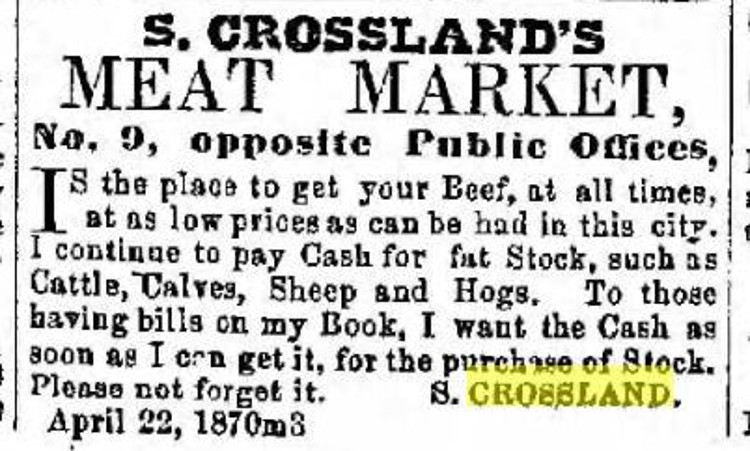
Advertisement for Samuel Crossland’s meat market in a New Philadelphia, Ohio newspaper, May 1870. (Source: newspaperarchive.com) 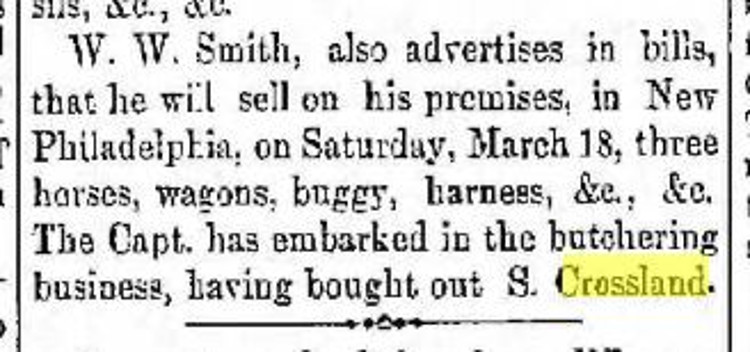
Reference to the sale of Samuel Crossland’s meat market in a New Philadelphia, Ohio newspaper, March 1876. (Source: newspaperarchive.com) 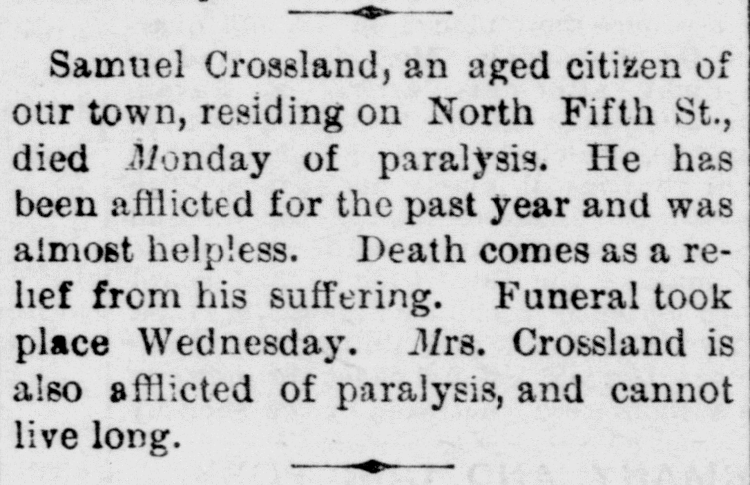
Samuel Crossland’s death reported in a New Philadelphia, Ohio newspaper, September 1891. (Source: newspaperarchive.com) 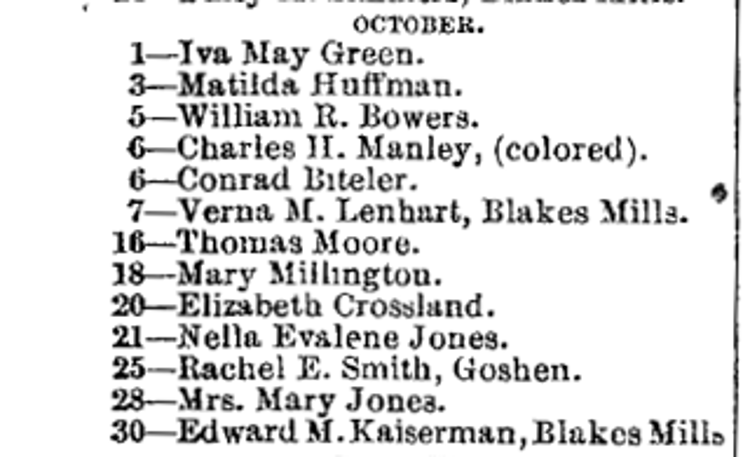
Elizabeth Crossland’s October 1892 death noted in a New Philadelphia, Ohio newspaper, January 1893. (Source: newspaperarchive.com) 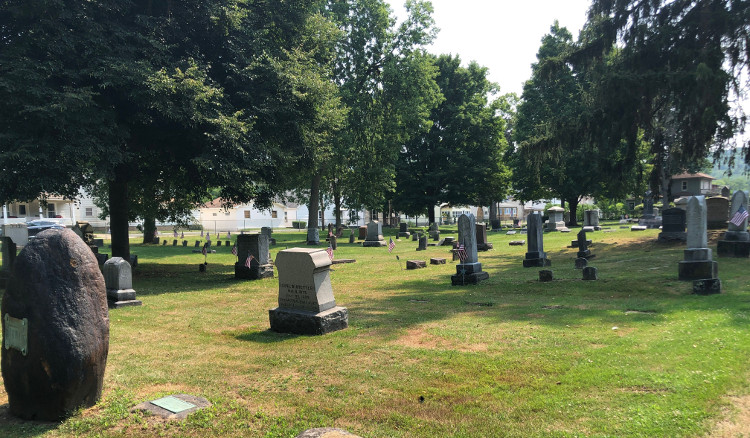
Samuel and Elizabeth Crossland are buried in Fair Street Cemetery, New Philadelphia, Ohio, 2021. (Source: findagrave.com)


© Noel B. Poirier, 2023.

