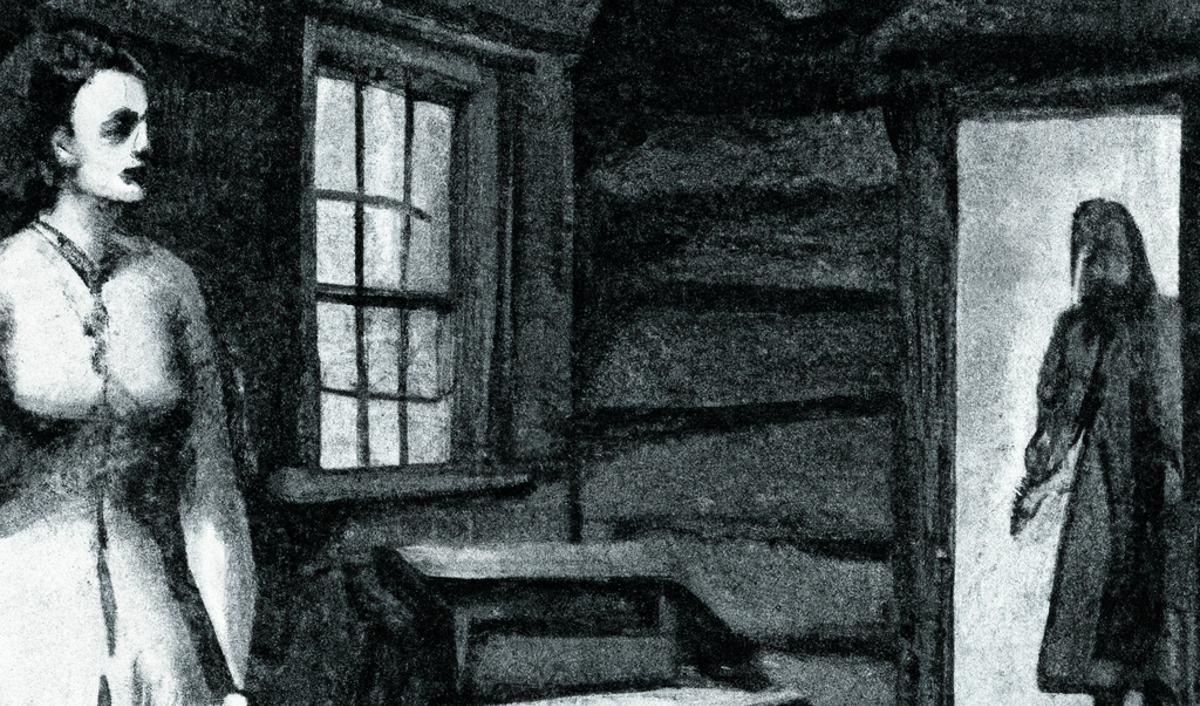
I stumbled across a letter written in 1819 from a Tuscarawas County resident in a Canton, Ohio newspaper that told a fantastical ghost story that I simply had to investigate further.
A letter from New Philadelphia, Ohio appeared on the front page of a July 1819 edition of the Canton Ohio Repository newspaper describing a series of paranormal events surrounding a one dollar coin and a resident of Tuscarawas County. According to the unnamed writer, he had questioned an acquaintance about a one dollar coin that sat on a window sill in the man’s home. According to the man the coin had come from a past acquaintance in Bedford County, Pennsylvania who had died a few years earlier. How the coin allegedly got to Tuscarawas County was the real story though, and the story the writer told in his letter.
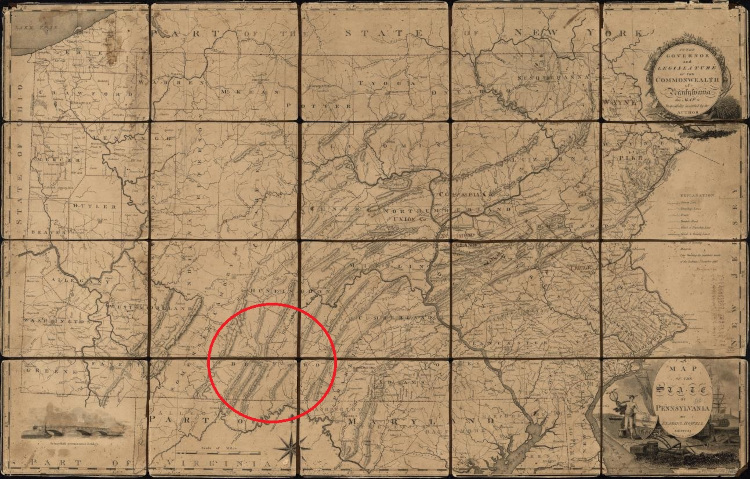
Four individuals were mentioned in the letter by name as having been involved in the coin’s travel from Bedford County, Pennsylvania to Tuscarawas County, Ohio. According to the author a man in Bedford County named Abraham Coon had died a few years earlier, apparently owing a debt to a past neighbor. Coon’s ghost appeared to a Bedford County woman named Miss Sills and told her that he had hidden a one dollar coin at the base of a specific tree prior to his death and that she had to deliver it to a past Bedford County resident who now lived in Tuscarawas County, Ohio named Conrad Haverstock. The ghost told her that if she did not deliver the coin she would be unable to live within a 100 miles of her home for three years.
Sure enough, when the woman went to the tree described to her she found the coin exactly where the apparition told her it would be. Believing that this confirmed the ghost’s story, and his threat, she and her uncle travelled to Tuscarawas County to complete the mission given her by the spirit. Upon arriving in Tuscarawas County, they sought out Haverstock to deliver the coin. Unfortunately, Haverstock claimed no knowledge of a debt owed him by his past neighbor and refused to accept the coin from Miss Sills. She, figuring she had done her part and wanting nothing more to do with the coin, dropped it on the ground and returned to Pennsylvania.
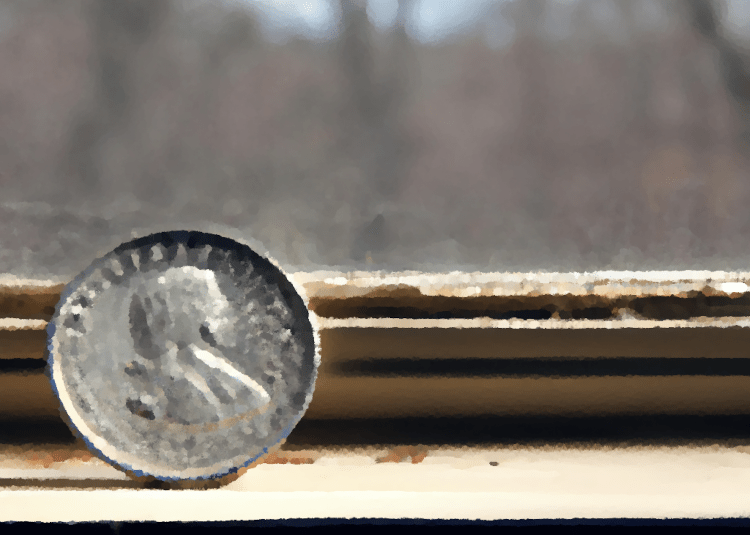
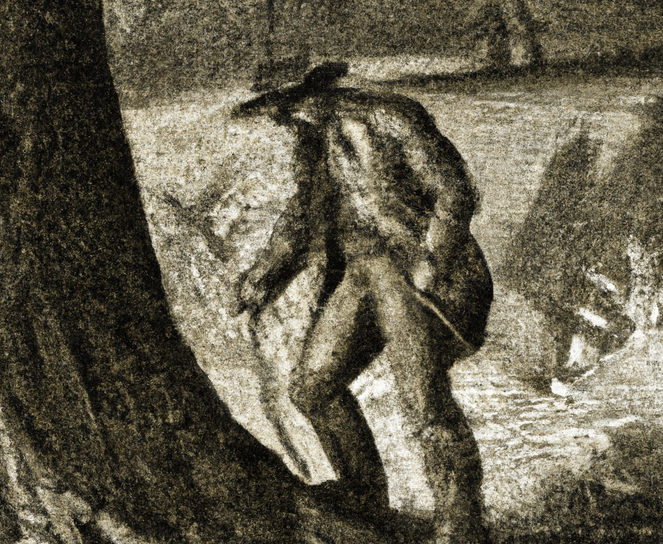
The story of the coin was not over. A young man named Knicely, called “Squire Knicely” by the author, saw the coin and did what any young man would do. He picked it up. A couple of days later an apparition wearing black and riding a horse appeared beside him as he worked burning a large brush pile on the family farm. The ghost said his name was Abraham Coon and that he knew that the woman had failed in delivering the coin and that the young man now must do it. A frightened young Knicely gave the coin to his father to deliver to Haverstock and, after much arguing, Haverstock finally agreed to keep the coin. He placed it on the window sill and it was sitting there when the author of the letter visited Haverstock a few days later.
I could not resist trying to document something about this amazing story. Did the people mentioned in the story even exist? If they did, does the timeline of the story fit with their actual lives? Where the heck is the coin now?! I started with determining if any of the named individuals were actually real people or merely fictional creations of the letter’s writer. I figured the best place to start was determining whether there was ever a person named Abraham Coon in Bedford County, Pennsylvania at the time the story takes place.

Detail from the letter printed in the Canton Ohio Repository telling the story of the ghost of Abraham Koons, July 1819. (Source: newspaperarchive.org) 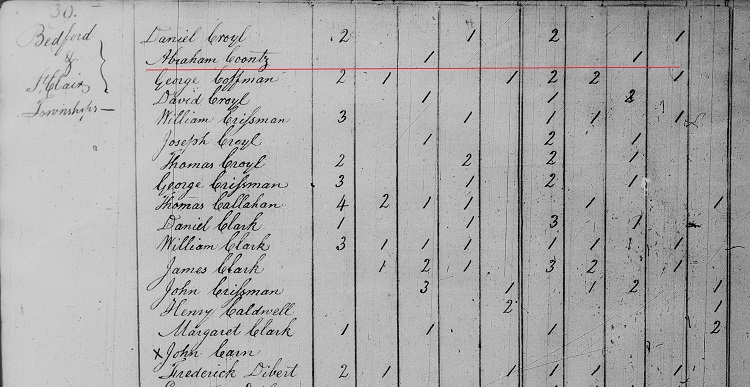
Abraham Koons and wife recorded in the 1800 census for Bedford County, Pennsylvania. (Source: familysearch.org) 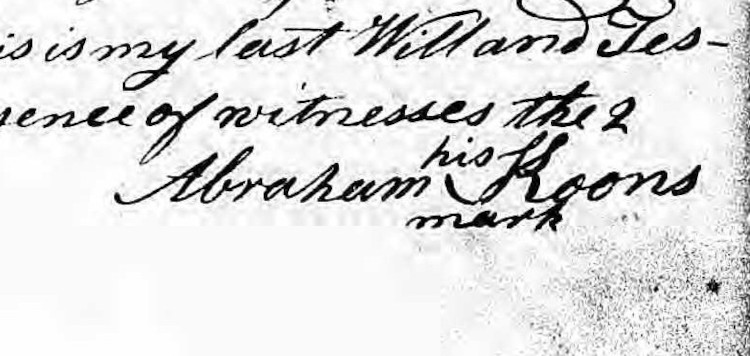
Abraham Koons’ will recorded in the Bedford County records, June 1813. (Source: ancestry.com)
There was indeed an Abraham Koons (1773-1813), though spelled a couple of ways in the records, living in Bedford County, Pennsylvania at the time attributed to the story. He was the son of a German immigrant who had relocated from Virginia to Bedford County, Pennsylvania in the 1760s. His death, occurring in 1813, also fits within the writer’s story describing him in 1819 as having died “a few years ago.” Next, I hoped to determine if the man Koons felt he owed a dollar to actually existed and could be tied to both Bedford County, Pennsylvania and Tuscarawas County, Ohio.
I was able to determine that Conrad Haverstock, Jr. (1790-1852), son of German-born Conrad Haverstock, Sr. (1755-1830), was born in Bedford County, Pennsylvania and moved with the family to Tuscarawas County, Ohio around 1812. Conrad Haverstock, Jr. married in Tuscarawas County in 1816 and was indeed living in the county in 1819. He eventually settled in Wayne Township, Tuscarawas County, died there in 1852, and is buried in Dundee, Ohio. So far, the two principal figures in the writer’s story certainly existed and the timelines of their lives line up with the story told by the author. What about the other people mentioned?
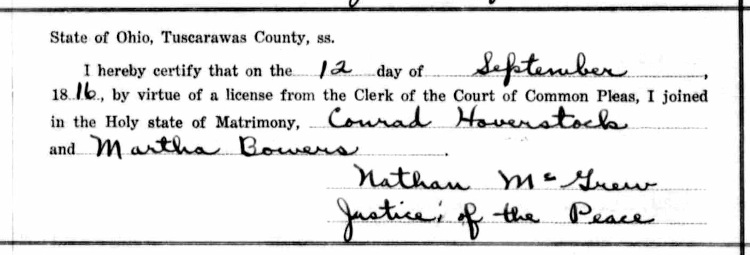
Marriage of Conrad Haverstock and Martha Bowers recorded in the Tuscarawas County records, September 1816. (Source: familysearch.org) 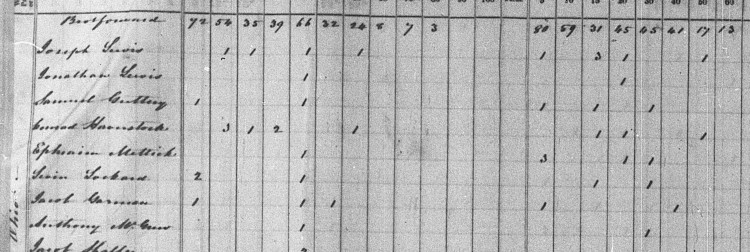
Conrad Haverstock and family recorded on the 1840 census for Wayne Township, Tuscarawas County. (Source: familysearch.org) 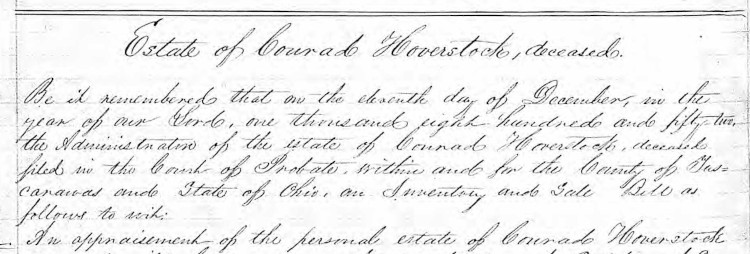
Detail from the estate records of Conrad Hoverstock from the Tuscarawas County records, December 1852. (Source: ancestry.com)
The other two individuals, “witnesses” to the ghost of Abraham Koons are more difficult to nail down. In the case of Miss Sills the best we can do is confirm that, in the 1820 census for Bedford County, Pennsylvania, there were five Sills households. All them included females of an age that might have fit the story’s Miss Sills. In the case of Young Knicley, the author likely meant a member of the well-known Tuscarawas County Knisely family. The 1820 census for Tuscarawas County records six households with the surname Knisely, four of which had young men who would fit the profile for the story’s “Squire Knicely.”
Did Conrad Haverstock simply make up the story of how the coin came to sit on his window sill? Were Miss Sills and “Squire” Knisely merely duped by pranksters, both in Pennsylvania and Ohio? Or, were they both visited by the spirit of Abraham Koons in his effort to pay off an old and forgotten debt? Who knows? What we do know is that the story of the one dollar ghost involves real people who lived and died in those communities at the time given by the storyteller. We still do not know what happened to the haunted coin.
To read the original 1819 story of the “One Dollar Ghost”, click here.

Like my stories?


© Noel B. Poirier, 2023.
 Tuscarawas County Stories
Thank you Noel for posting this story! I descend from Conrad’s brother Jacob. I had many ancestors from Bedford County PA who went to Tuscawaras County. This was a fun item to read.
LikeLike