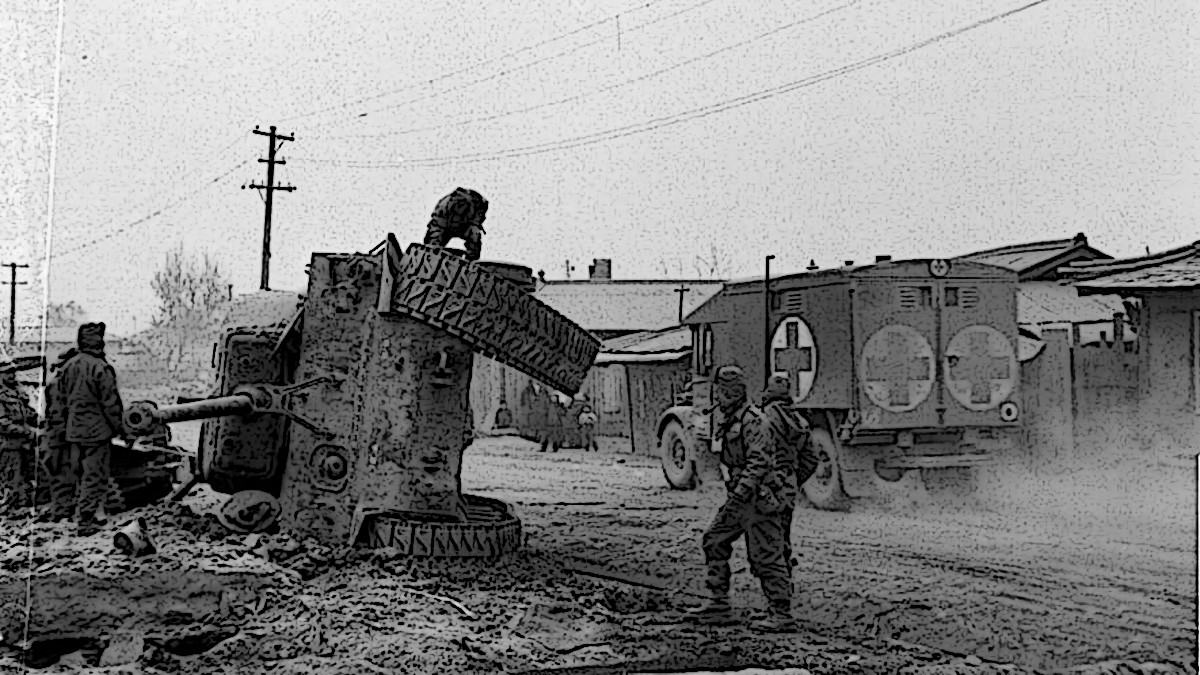
A soldier from Tuscarawas County vanished in a frozen Korean gauntlet, leaving his family waiting years for answers.
Russell D. May (1928-1950) was the son of Eugene Curtis May (1896-1957) and Mary Adeline Shonk (1906-1981). He grew up in the rural communities of Sugar Creek and Wayne Townships alongside his siblings, including a brother and two sisters. Russell was a attended Dundee High School and the family were members of the Church of God at Barrs Mills. Russell chose to leave his studies before graduation to answer the call of military service.
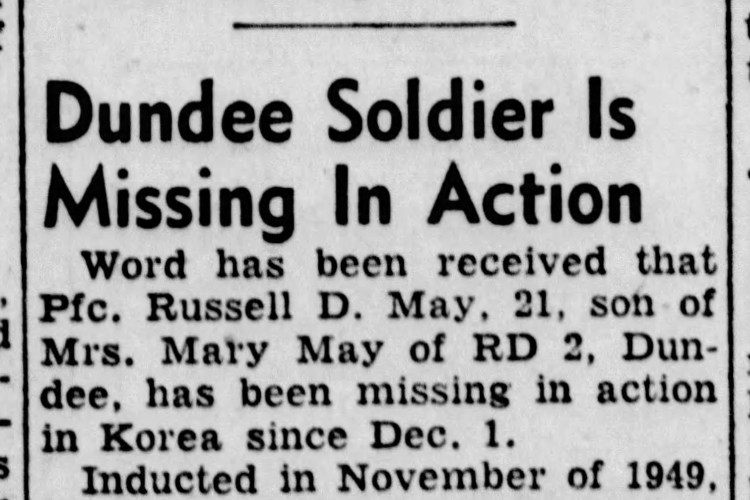
Russell entered the United States Army with his induction in November 1949 and he was sent to Camp Breckenridge, Kentucky, for his basic training. Following his training he was assigned to the 82nd Anti-Aircraft Artillery Battalion, a component of the 2nd Infantry Division. Now a Corporal, Russell was deployed overseas to the escalating conflict in Korea and reached the front lines only about two weeks before the tide of the war turned violently against United Nations’ forces.
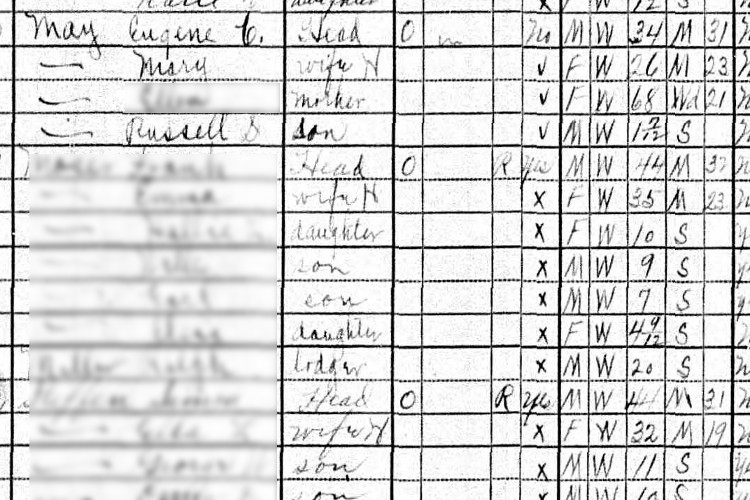
The May family recorded on the 1930 census for Sugar Creek Township, Wayne County, Ohio. (Source: familysearch.org) 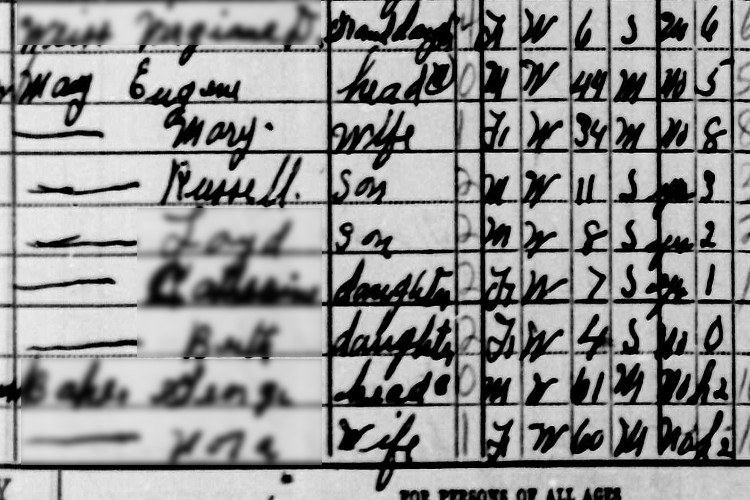
The May family recorded on the 1940 census for Wayne Township, Tuscarawas County, Ohio. (Source: familysearch.org) 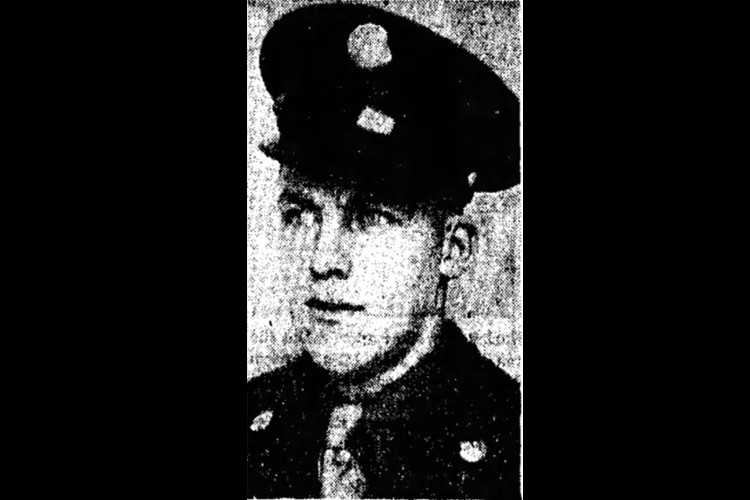
Photograph of Russell D. May that appeared in the New Philadelphia, Ohio newspaper after his death, September 1955. (Source: newspapers.com)
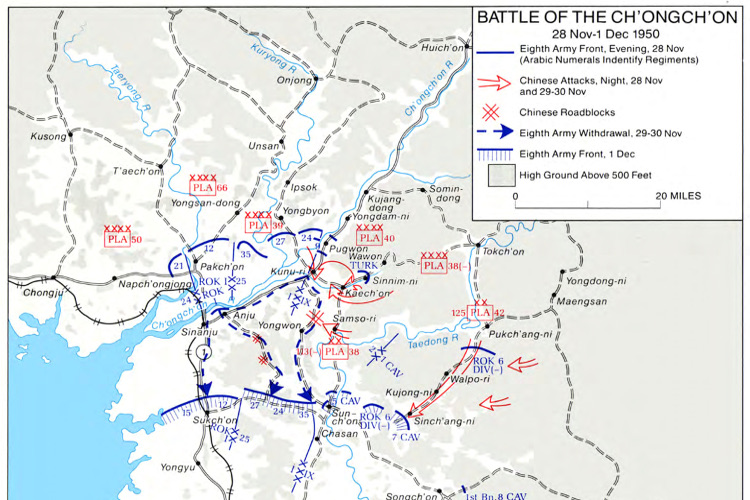
On December 1, 1950, Corporal May found himself in the midst of the Battle of the Ch’ongch’on River, a massive Chinese counteroffensive that forced a desperate UN retreat through a bottleneck near Kunu-ri. His division faced the brutal “Gauntlet,” a six-mile stretch of road where retreating soldiers were subjected to intense enemy fire in temperatures as low as −30 °F. The 2nd Infantry Division alone suffered 4,037 casualties during the battle. It was during this chaotic withdrawal that Russell was killed in action, though he was initially reported only as missing.
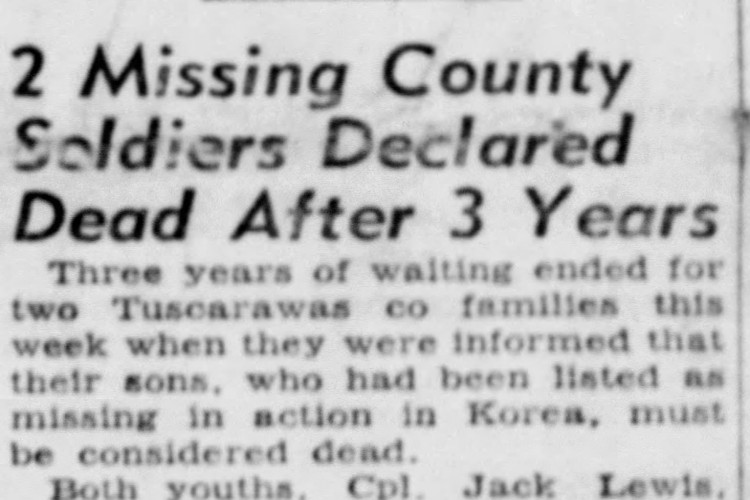
For the next three years, Russell’s family lived in a state of agonizing uncertainty as he remained listed as missing in action. Following the end of hostilities and the completion of prisoner repatriations in September 1953, official hope that he might still be alive as a prisoner of war faded and, in January 1954, the military finally informed his parents that he was officially presumed dead, ending years of waiting for the May family.
The finality of Russell’s sacrifice was confirmed in 1955 when his remains were among those returned to the United States by North Korean forces. His parents were officially notified of his death at that time, and preparations were made to bring him home to Ohio for a proper farewell. Posthumous records confirmed that the young soldier had indeed died on the very first day he went missing in the frozen hills of North Korea.
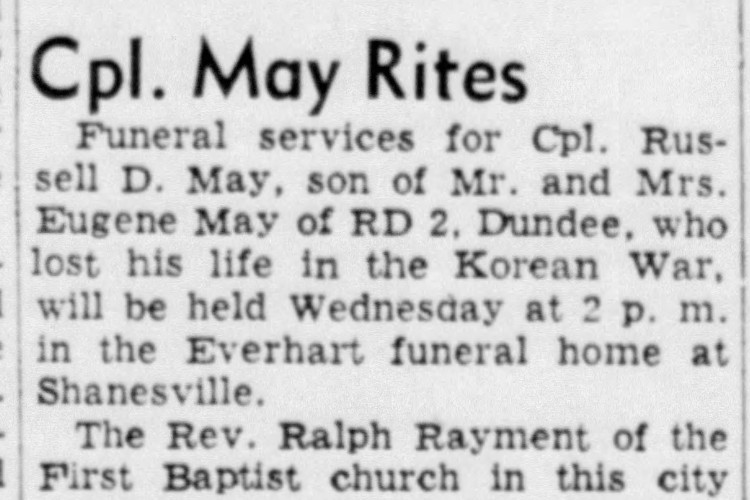
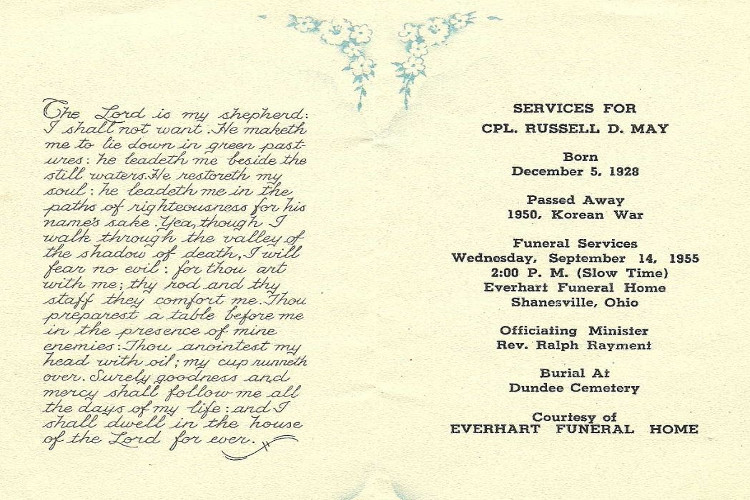
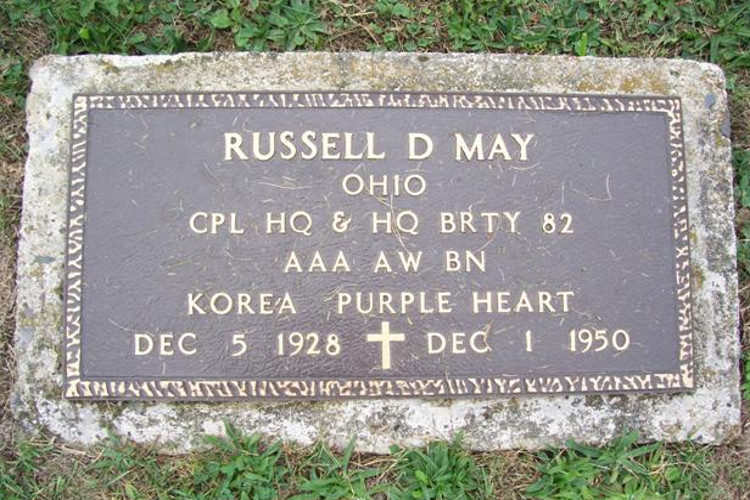
On September 14, 1955, funeral services for Russell May were held at the Everhart Funeral Home in Shanesville. He was laid to rest in Dundee Cemetery with full military honors. For his bravery and ultimate sacrifice, he was posthumously awarded several commendations, including the Purple Heart, the Korean Service Medal, and the United Nations Service Medal.
© Noel B. Poirier, 2026.
 Tuscarawas County Stories