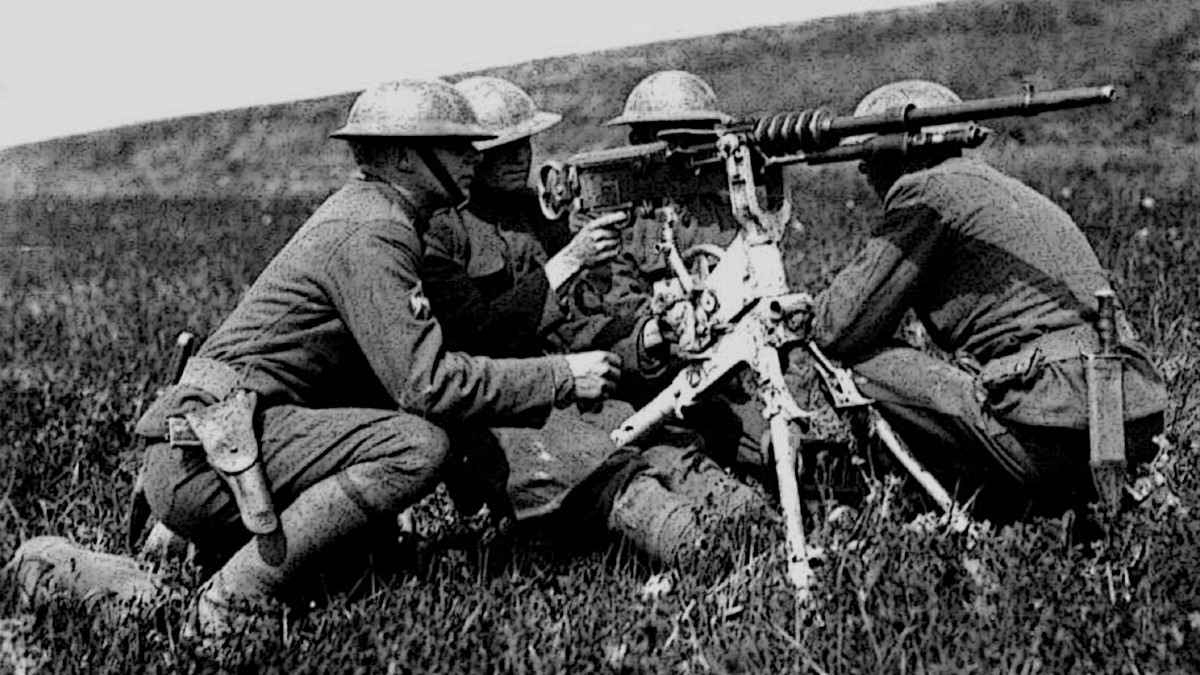
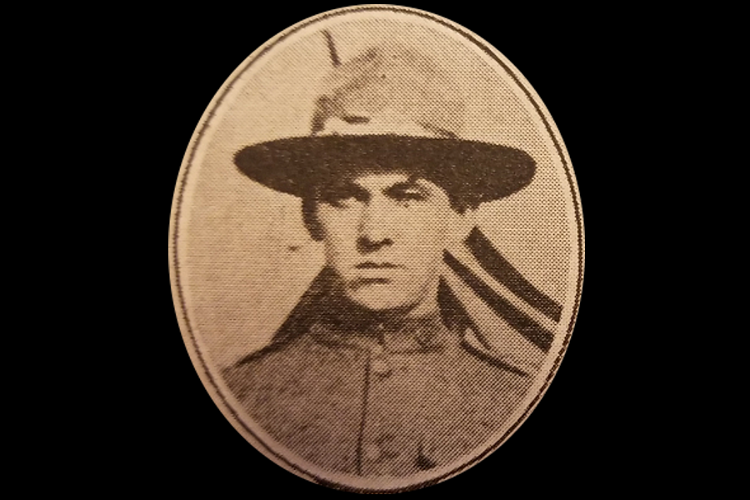
A young railroad fireman turned soldier, Clarence Benson, answered his nation’s call and made the ultimate sacrifice.
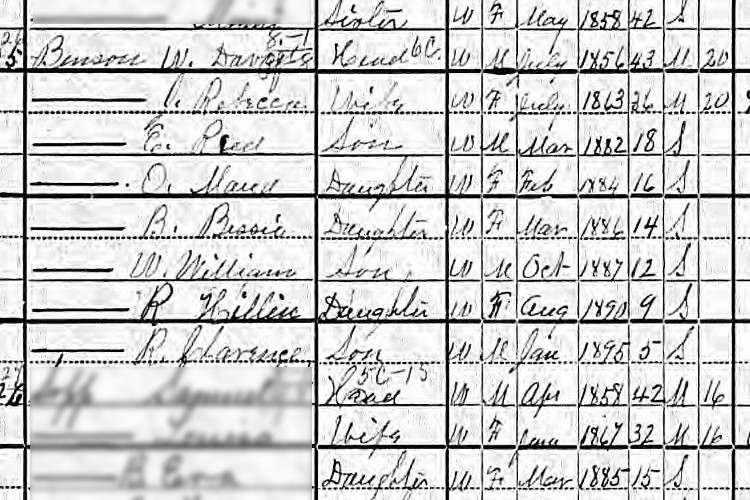
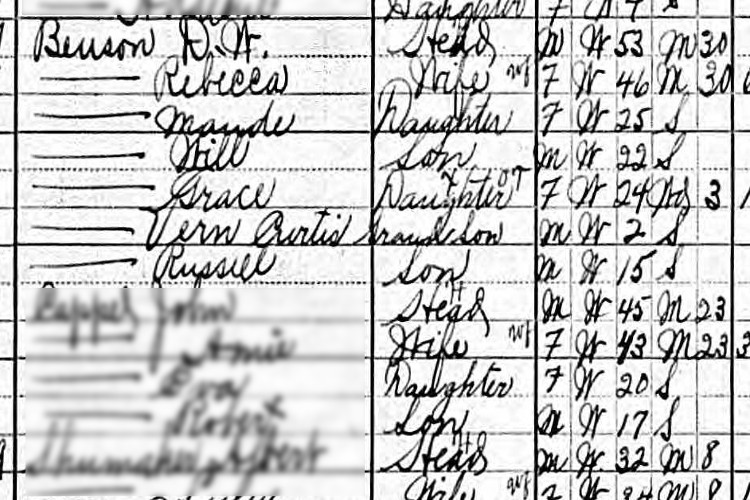
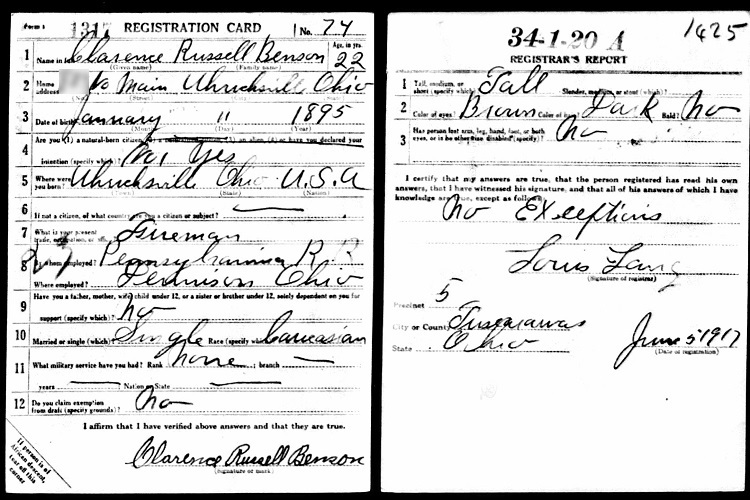
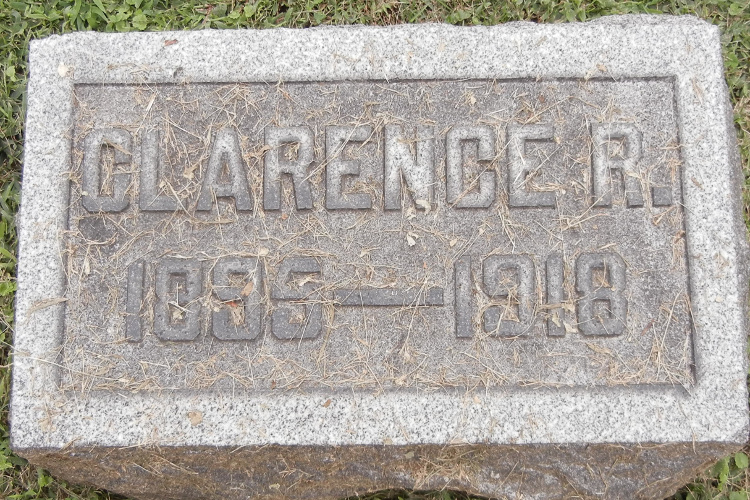
Clarence Russell Benson (1895-1918) was born in Uhrichsville, Ohio, the youngest child of David Benson (1856–1939), an Ohio-born railroad car carpenter, and Rebecca Jane Hefling Benson (1863–1943), also a native of Ohio. He grew up in Uhrichsville, where the family was firmly rooted in railroad life. When the census was taken in June 1900, Clarence lived with his parents and five older siblings, his father was employed as a railroad car carpenter in Dennison. Ten years later, Clarence remained at home in Uhrichsville with his parents and three older siblings, while his father continued his long-standing work for the railroad. Following in his father’s footsteps, Clarence entered railroad service himself, and by the time he registered for the draft in June 1917 he worked as a fireman for the Pennsylvania Railroad.
When Clarence registered for the World War I draft in June 1917, he described himself as single, tall in stature, with brown eyes and dark hair. That August, as the nation mobilized for war, Clarence enlisted in the Ohio National Guard at Dennison and was initially assigned to Company H of the 10th Infantry, Ohio National Guard. A month later, after completing basic training, he was transferred to Company D of the 134th Machine Gun Battalion, signaling his entry into a specialized combat role, and the following month he was promoted to Private First Class. In February 1918, Clarence was reassigned to Company D of the newly organized 136th Machine Gun Battalion. After months of training and preparation, he embarked for overseas service on June 22, 1918, departing from Newport News, Virginia aboard the transport S.S. Caserta.
The war record of the 136th Machine Gun Battalion traces its early operations in France during the summer and fall of 1918 as part of the American Expeditionary Forces. The battalion arrived at Brest on July 5, 1918, and moved through a series of staging and training locations including Sauville (Haute-Marne), Fontenoy-le-Joute (Meurthe-et-Moselle), and Merviller. By mid-September, the unit was advancing steadily toward active combat zones, passing through Doncières (Vosges), Fains (Meuse), and near Jubécourt, before moving into the Bois de Parois and the Recicourt area. In late September, the battalion entered the Bois de l’Argonne, where it participated in active combat operations from September 26 to October 1, 1918. This placed the unit directly within the Meuse-Argonne offensive, the largest and most significant American campaign of the war.
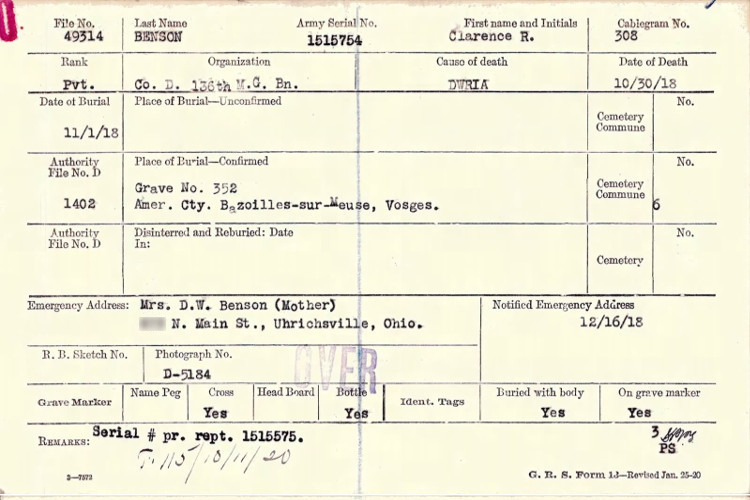
Following the Argonne fighting, the 136th continued its forward movement through eastern France, operating in and around Bois Chehmin, near Recicourt, Rigny–St. Martin, Mennilott, Pannes, and Dongermain between October 1 and October 20, 1918. The battalion then crossed into Belgium, arriving near Woenebeke on October 22, followed by rapid movements through Gits, Pitthem, and the Olsene area. It was during these advances that, on October 26, 1918, Clarence Benson suffered serious shrapnel wounds while in action. Once taken to the hospital, Clarence was able to dictate a letter home assuring his family that he would recover. Unfortunately for Clarence that was not to be the case and he died from his wounds on October 30, 1918.
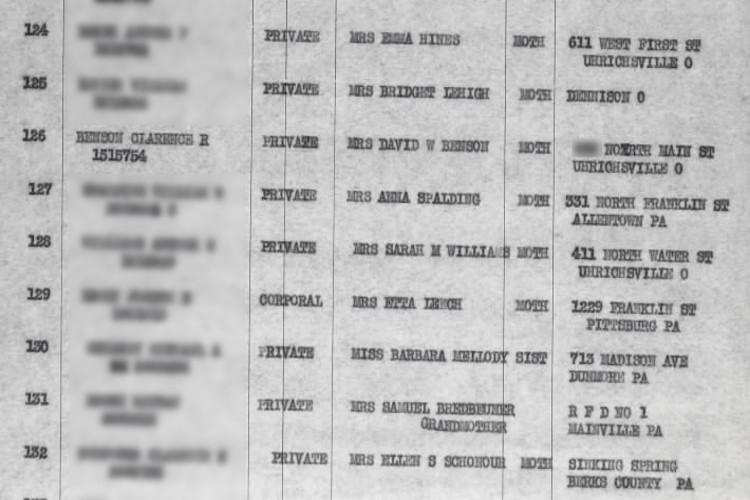
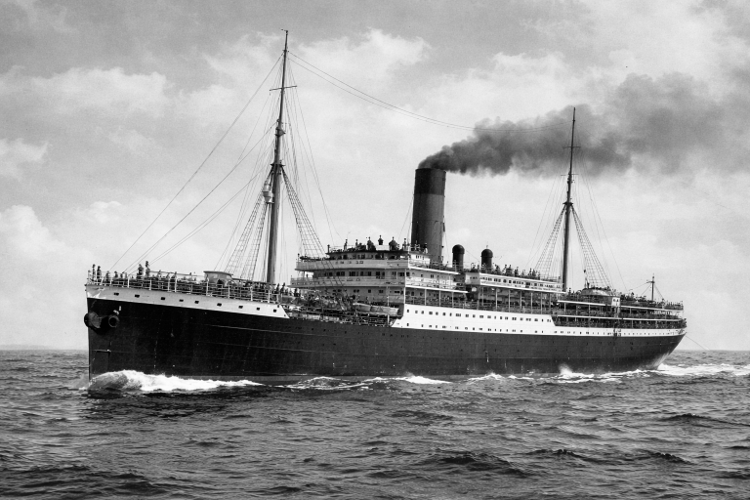
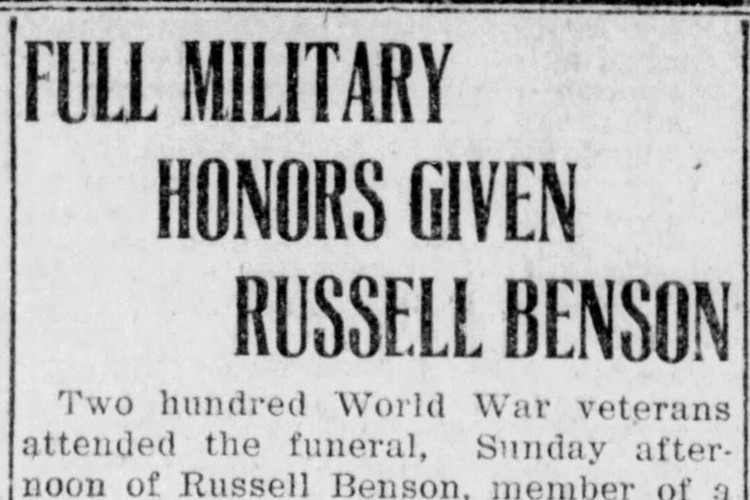
On November 1, 1918, Clarence Benson was laid to rest overseas in Grave Number 352 at the American Cemetery at Bazoilles-sur-Meuse in the Vosges region of France, among thousands of fallen American soldiers who never saw the Armistice that followed just days later. More than two years later, his remains were disinterred on February 8, 1921, as part of the effort to return America’s war dead to their families. Transferred from Cherbourg, France, aboard the USAT Heaton on March 14, 1921, Clarence made his final journey home, arriving at Hoboken, New Jersey, on May 1. He was laid to rest in Union Cemetery in Uhrichsville, Ohio on May 29, 1921, where a funeral with full military honors was held, attended by his family and more than 200 fellow World War I veterans, a solemn tribute to his service and sacrifice.
Several men in Company D of the 136th Machine Gun Battalion, which included many men from Tuscarawas County, lost their lives fighting during World War One. While Private First Class Clarence R. Benson was not the most famous member of Company D (that was reserved for the Company’s mascot, a dog named Bing) his sacrifice during the last days of World War One deserves to be remembered and his story told.
© Noel B. Poirier, 2026.
 Tuscarawas County Stories