
He may not have lived in New Philadelphia long, but his death shook the community.
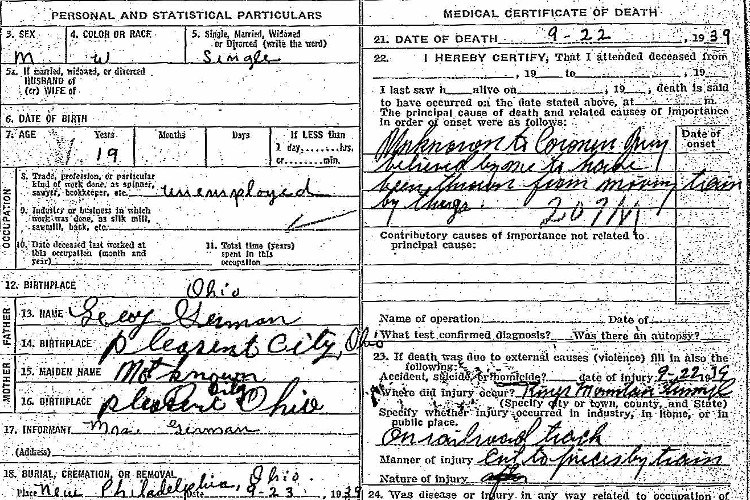
Very little can be definitively ascertained about the early family history of Roy William German (1920-1939) prior to his murder in the fall of 1939. Some can be pieced together from the newspaper accounts of his death and from his death certificate. Roy’s father was Leroy German (1900-?) whose birthplace on Roy’s death certificate was given as Pleasant City, Guernsey County, Ohio. His mother is not named on the certificate but the newspaper reported her as being Mrs. James Lindsay of Austin, Texas. That the parents were separated at the time of his death is obvious.
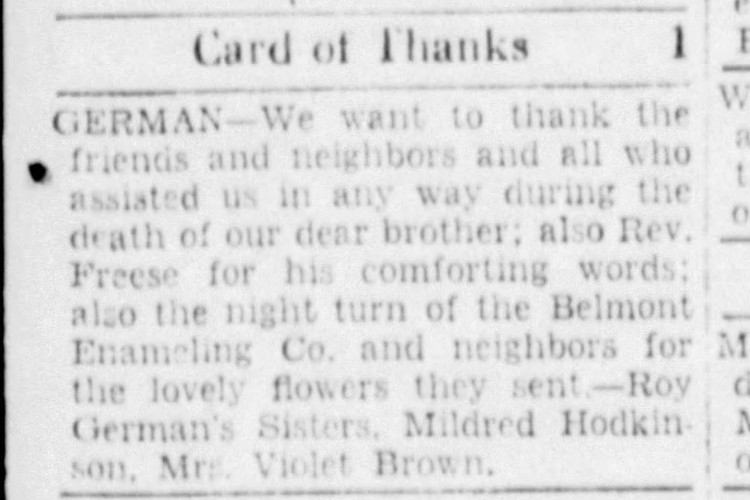
Roy lived with two of his sisters, who lived in New Philadelphia, Ohio, and had a brother in San Antonio, Texas as well. Why Roy lived in New Philadelphia with his sisters during his youth and school years is unclear though. After Roy finished his sophomore year in high school he left to find work in the Civilian Conservation Corps (CCC). They, in turn, sent him to a CCC camp in Texas for his training. After Roy completed the training, he decided to visit his sisters and hopped a freight train along with two other men to travel north to Ohio. They were not the only ones with that idea.
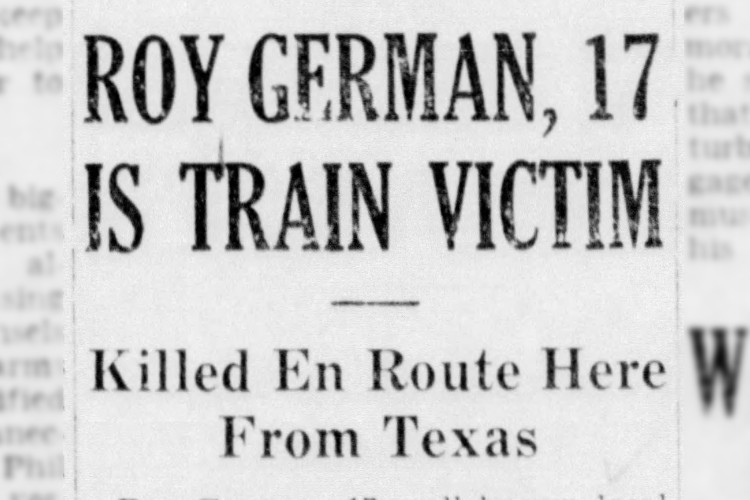
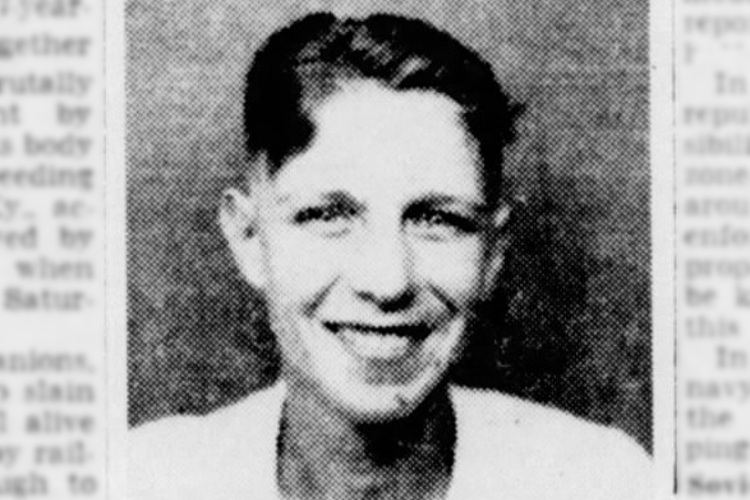
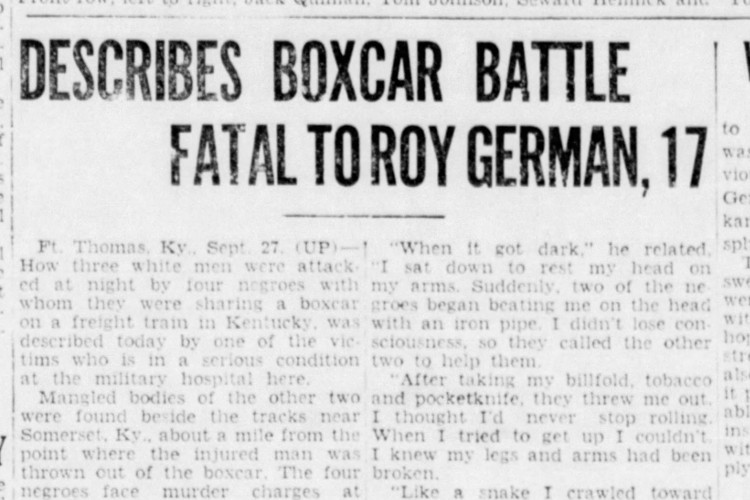
As the freight train Roy and his companions were riding passed through Kentucky they were joined by four other men also working their way north. On the 22nd of September an altercation occurred between the two groups of men and one of Roy’s companions, Lunnie Cox (1897-?) of Tennessee, was forced to jump from the moving train, badly breaking both his arms and legs. During the struggle between the two groups of men that continued, Roy German was thrown from the train near Kings Mountain, Kentucky and the third man, William D. Tittle (1896-1939) a short time later. Both Roy and Tittle died instantly when they fell under the train, but Lunnie Cox survived to report the crime to authorities.
According to the investigation, Roy’s body was so badly mangled by the train that his identity could only be confirmed by his social security card and papers from the CCC that he carried with him. Lunnie Cox’s immediate testimony made it possible for the police to arrest the four other men at a station just south of Cincinnati. The men were 19-year-old Hoyatt Butler and 21-year old Clement Letts of Pittsburgh, 23-year-old Roger Tate of Athens, Georgia, and 23-year-old Thomas Ross of Chattanooga, Tennessee. News of the crime had travelled quickly and authorities were forced to move the prisoners often to avoid potential mob justice.
A trial date for the four men was scheduled for December 1939 and as the investigation into the men continued it was learned that three of the men had criminal histories. The trial was held in Whitley City, Kentucky and on December 20, 1939 verdicts were read for the four men. All four were found guilty and Hoyatt Butler and Clement Letts were given the death penalty, while Roger Tate and Thomas Ross were each sentenced to 15 years in the state penitentiary. Butler and Letts appealed their decisions and were granted new trials in December 1940. The death penalty was overturned and all four men ended up with prison sentences.
Roy William German’s short life ended violently and far from his adopted home, a victim of a chance encounter and the perils of hoboing the rails during the Depression. The trials that followed brought a measure of justice, though altered by appeals and reduced sentences, and the case briefly captured national attention before fading into obscurity. Roy German’s body was shipped back to his adopted home of New Philadelphia and buried in the city’s Evergreen Burial Park.
Enjoy my stories?

© Noel B. Poirier, 2025.
 Tuscarawas County Stories