
In the fall of 1909, twenty-year old Florence Weber vanished after a phone call. Two days later, her body was found beneath a Dover bridge.
John W. Weber (1854-1927) was the son of German immigrants who settled in Ohio in the early 1850s. The Webers found themselves in Tuscarawas County, Ohio by the time the 1860 census was taken in June of that year. John worked as a laborer in the various industries in town and eventually rose to the job of engineer of a factory’s stationary steam powered engine. He married Ida Elizabeth Weinig (1862-1943) in May of 1883 and the couple had four children, including a daughter named Florence Weber (1888-1909) in December 1888. The Weber family resided in a modest home on East Third Street in Dover, Ohio at the end of first decade of the 1900s.
Florence Weber attended school in Dover as a child and, following school, found work initially at the Dover Manufacturing Company. Florence worked a number of jobs before settling into the role of a telephone operator in Dover. She worked that job for a few years before she accepted an operator job in Cleveland, though her time there was short. A year after leaving for her new life in Cleveland, Florence returned home to Dover in August of 1909, for reasons that remain unclear. Upon her return, she took on housekeeping duties for her widowed uncle who also lived on East Third Street in Dover.
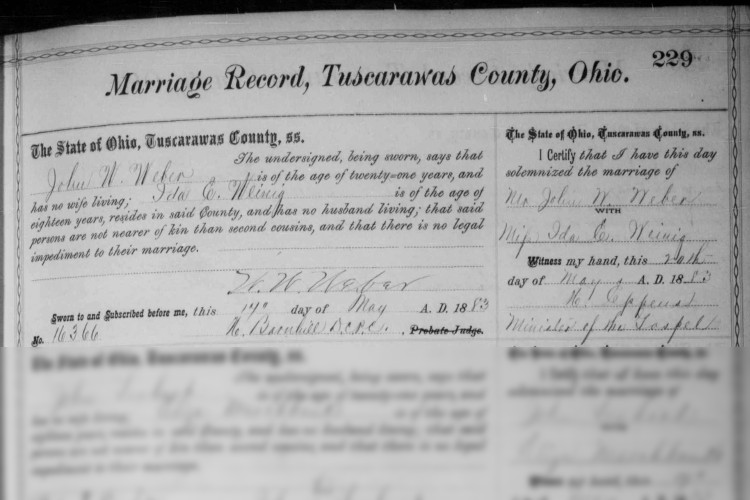
Record of John W Weber’s marriage to Ida Elizabeth Weinig, May 1883. (Source: familysearch.org) 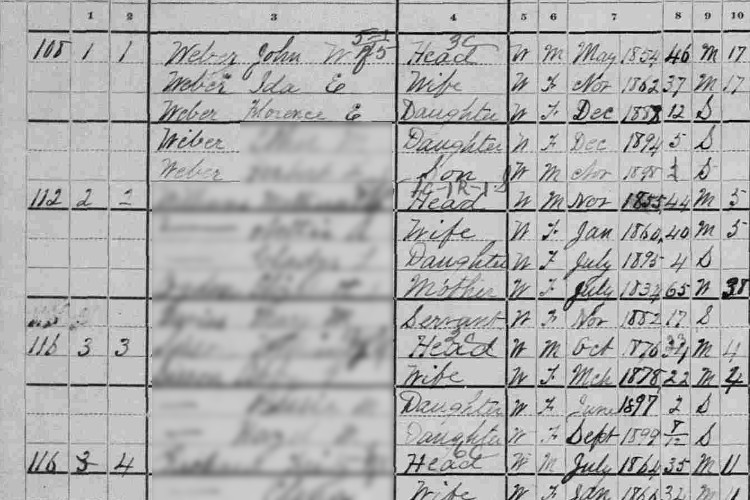
The Weber family recorded on the 1900 census for Dover, Ohio. (Source: familysearch.org) 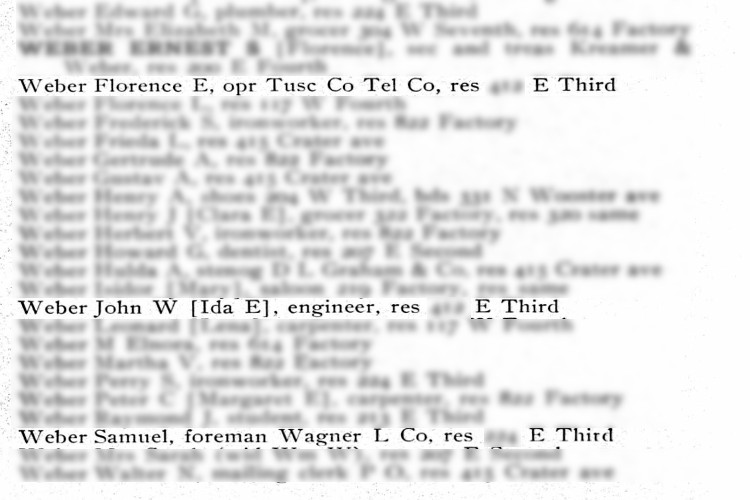
Florence, John, and Samuel Weber recorded in the 1907 City Directory for Dover, Ohio. (Source: ancestry.com) 
The home of John Weber family on East Third Street, Dover, Ohio, 2023. (Source: google.com)
On the evening of Monday, September 13, 1909 Florence received a phone call at her uncle’s home from a woman caller. After the call, Florence told her uncle and his son that she needed step out. She assured them that she would return shortly; she even left the light on in her room – a subtle but telling sign of her intention to return. Unfortunately, Florence never returned to her uncle’s home that night and the Weber family became concerned as one night turned into two. Two days after she left her uncle’s home a body matching her description was found in the Tuscarawas River entangled on a piling of the Factory Street Bridge.
Florence’s body, discovered by two young boys who worked at the nearby iron works, was bloated but not decomposed, indicating she had not been in the water long. Dover Patrolman Frank Casebeer (1879-1954) and two other men retrieved the body from the river as a crowd gathered. Witnesses at the scene claimed they saw visible marks reportedly suggesting violence led to her death. Once Coroner Milton Romig (1842-1927) arrived on scene, he opened an inquest into her death and authorities questioned potential witnesses in Dover and elsewhere.
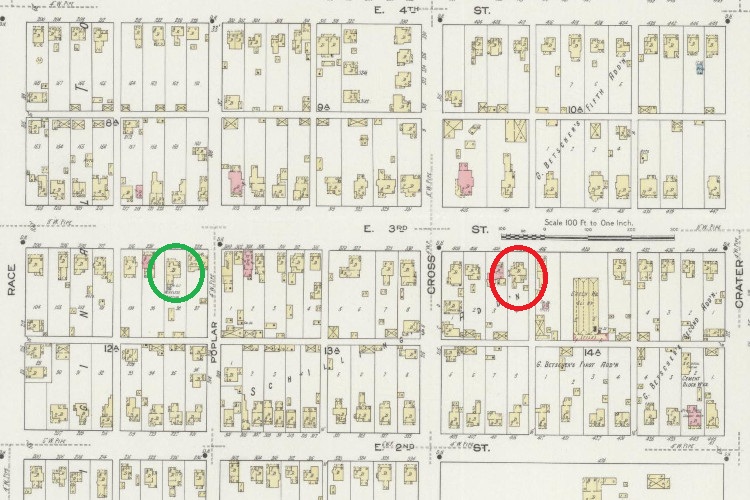
The Weber homes on East 3rd Street in Dover, Ohio. John Weber (red) and Samuel Weber (green), 1914. (Source: loc.gov) 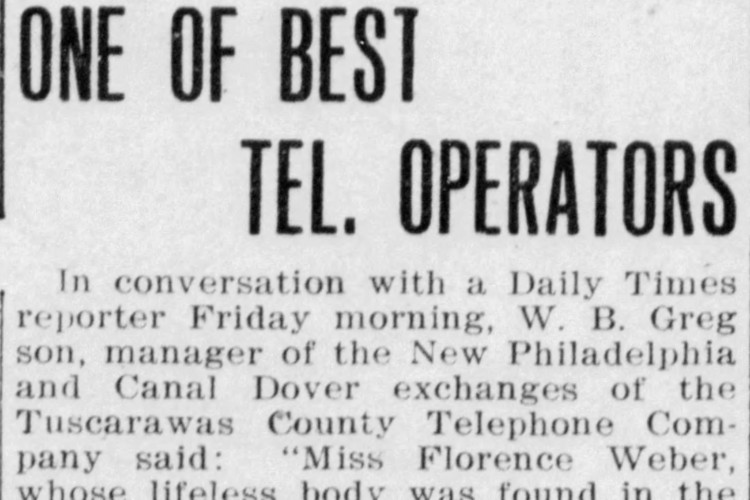
New Philadelphia, Ohio newspaper article about Florence Weber, September 1909. (Source: newspapers.com) 
Early 20th century postcard of the Factory Street Bridge in Dover, Ohio, c. 1910. (Source: eBay.com) 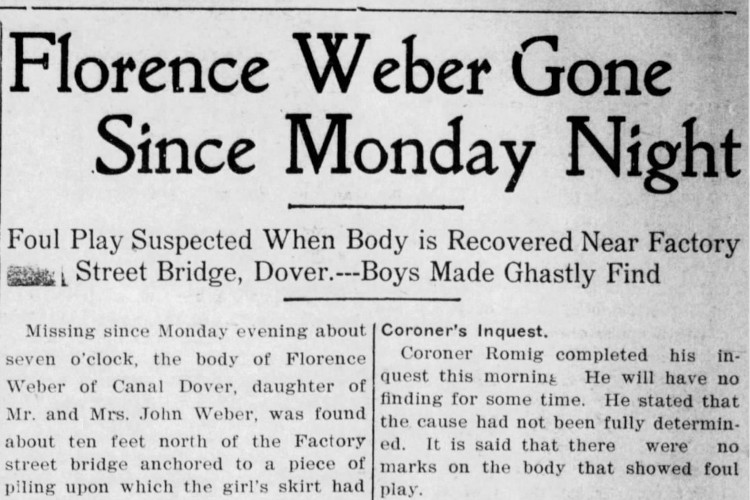
New Philadelphia, Ohio newspaper headline on the disappearance and death of Florence Weber, September 1909. (Source: newspapers.com)
During the days that followed the discovery of Florence’s body, there was a flurry of speculation. Florence was well-regarded, with no known troubles that might explain her disappearance or death. Suicide or accidental drowning seemed unlikely to those who knew Florence well. The brief investigation cast a wide net, authorities interviewed 22 individuals including family, friends, employers and co-workers, but no arrests followed. Coroner Romig recorded Florence’s cause of death on her death certificate as “…asphyxiation due to drowning” without any indication of how she ended up, fully clothed, in the river in the first place.
Despite the initial suspicion of foul play, Florence Weber’s death gradually faded from the public eye, and left behind only grief and unanswered questions. The mystery of what—or who—led Florence to the river that September night was never solved, and no one was ever held accountable. Florence Weber was more than just a mystery—she was a daughter, a niece, a friend, and a young woman whose life was cut short without reason or resolution. Florence Weber is buried in Maple Grove Cemetery in Dover, Ohio.
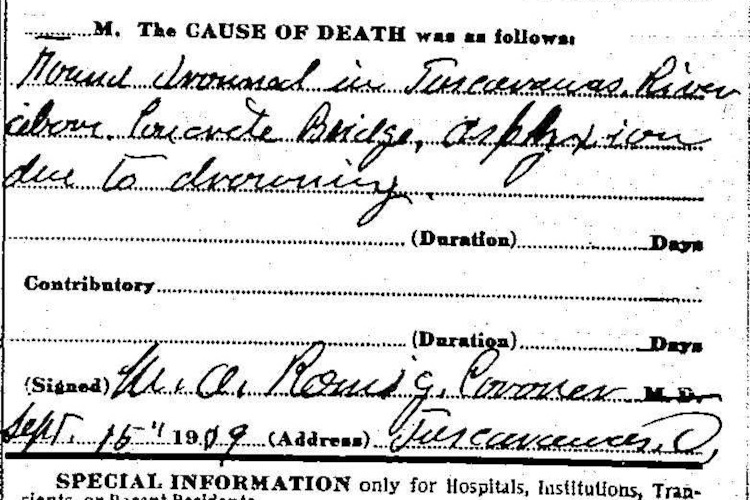
Detail from Florence Weber’s death certificate, September 1909. (Source: familysearch.org) 
New Philadelphia, Ohio newspaper headline on story about Florence Weber’s death, September 1909. (Source: newspapers.com) 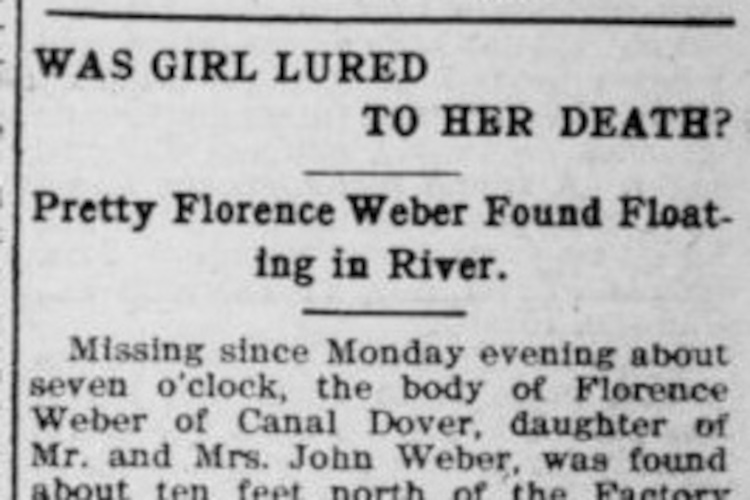
New Philadelphia, Ohio newspaper article on theories about Florence Weber’s death, September 1909. (Source: newspaperarchive.com) 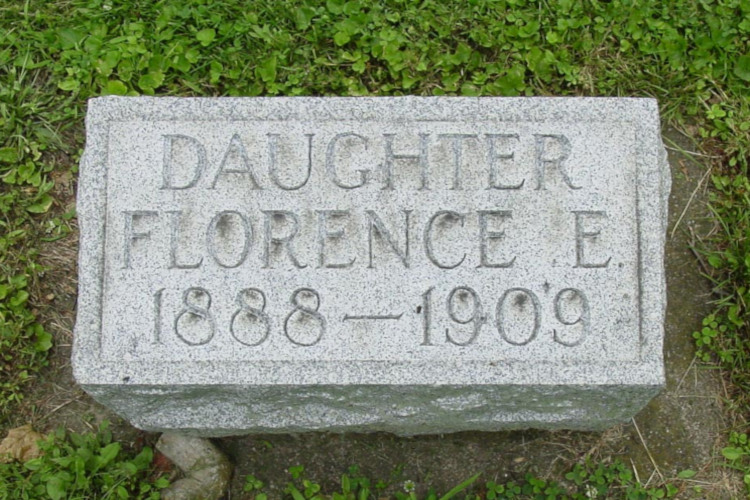
Florence Weber’s grave marker at Maple Grove Cemetery, Dover, Ohio, 2011. (Source: findagrave.com)
Enjoy my stories?

© Noel B. Poirier, 2025.
 Tuscarawas County Stories