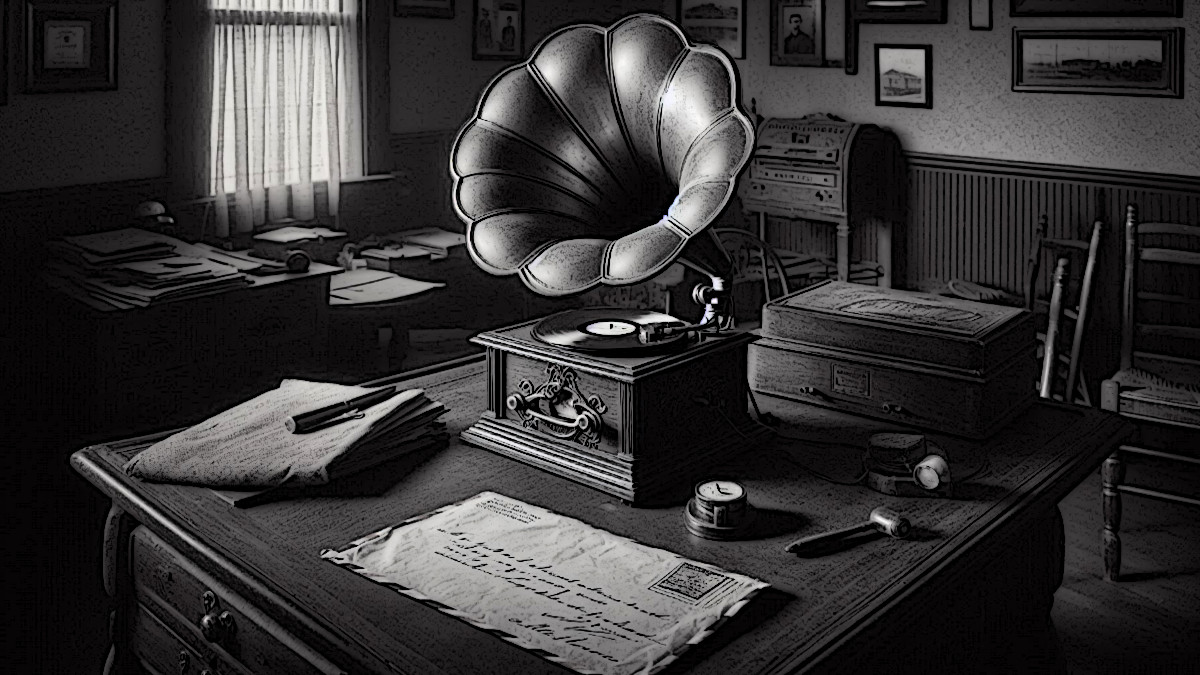
A Dover man, torn by rejection, planned a horrible crime only to have it lead to his heroic death.
Born in 1924, Norman James Hollis (1924-1944) was the second child of Floyd James Hollis (1900-1983) and Bessie Lovett (1906-1970), who married four years earlier in Wayne County, Tennessee. Around the time of Norman’s birth, the Hollis family had relocated from Tennessee to Dover, Ohio, bringing with them their firstborn daughter. Floyd worked in the growing industrial sector, and secured a position as a checker in a steel mill. The family, which grew again in 1926 with the birth of another son, settled into life in Dover. The family lived in a modest rented home on Regent Street in the neighborhood known as “Tin Town” in early 1930, navigating the economic difficulties of the Great Depression with steady employment in the local steel industry.
The rhythm of life shifted temporarily for the Hollis family in 1940. During that year, Floyd accepted an assignment in East Chicago, Indiana, where he worked as an inspector for a steel mill. He took Norman and their daughter with him, while Bessie remained behind in Dover with the youngest child. Before the end of the year, the family had reunited in Dover and resumed life in a rented home, with Floyd once again employed in a local steel mill. By the time that World War Two started, Floyd and the oldest children had returned to East Chicago, though Norman returned to Dover frequently and stayed with his mother.
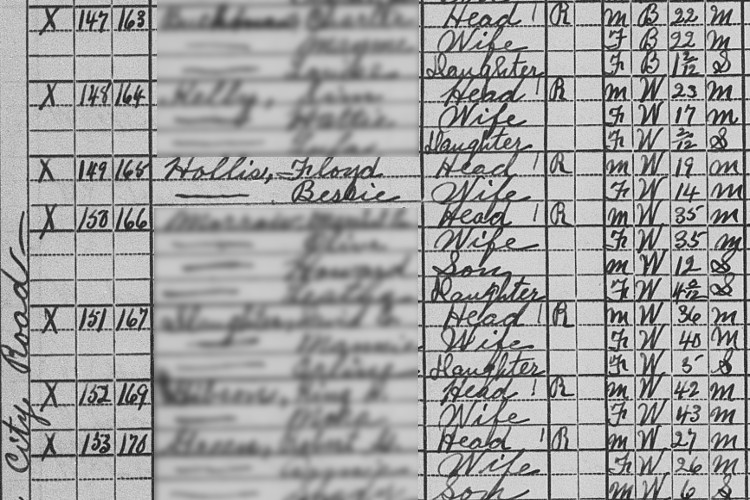
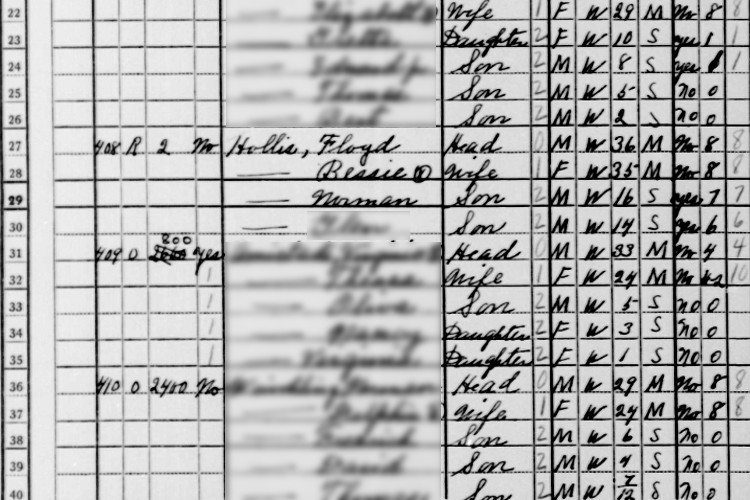
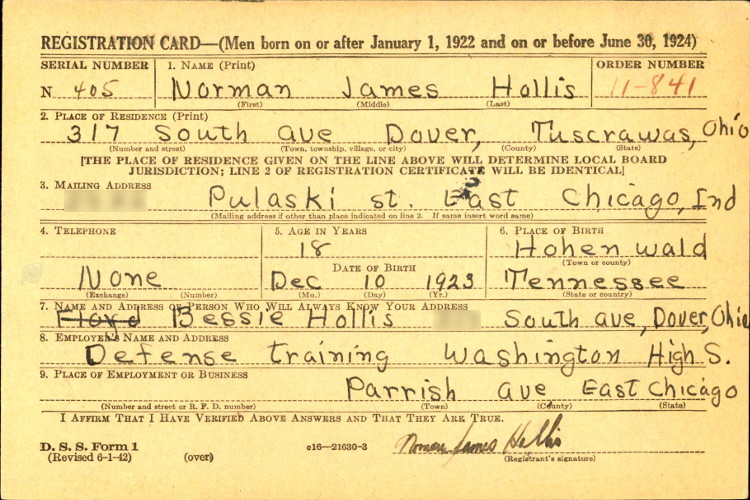
Norman dated, and became infatuated with, a daughter of Hungarian immigrants named Helen Ruszin (1919-1980). Helen eventually broke off the relationship and Norman fell into despair. His despair was heightened when, in 1942, the United States Marine Corps refused to enlist Norman on three separate occasions due to his eyesight. After the last refusal, and with Helen on his mind, Norman planned the unthinkable. He walked into a Cleveland novelty shop and recorded a confession to a plan to murder Helen when he returned to Dover. Norman placed the record in the mail, addressed to Dover Police Chief Frank H. Havens (1896-1974), and boarded a bus for Dover.
Click here to read Norman J. Hollis’s “Confession”
When Norman returned to Dover on August 12, 1942, he acquired his .22 rifle and a hunting knife from his mother’s home and slept at the Fairgrounds where Helen worked. Norman met Helen as she walked to work, they chatted briefly – Norman mentioned a record at the police station – and Norman left Helen to continue on her way. He later stated that he “lost his nerve”. Norman was arrested later that day at his mother’s house. Norman was charged with lunacy, and a hearing on his mental state was planned. The judge decided, however, that if the United States Army would take Norman, that he would forego the lunacy hearing altogether. Norman was accepted into the Army on September 1, 1942.
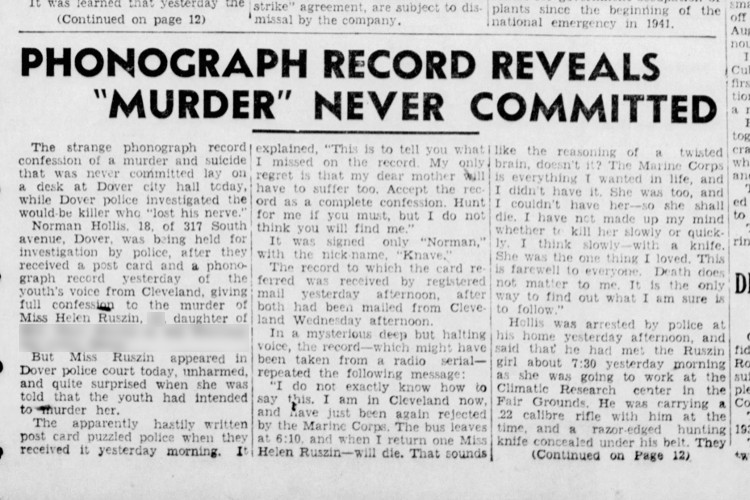
Newspaper article describing Norman J. Hollis’s failed murder attempt, August 1942. (Source: newspapers.com) 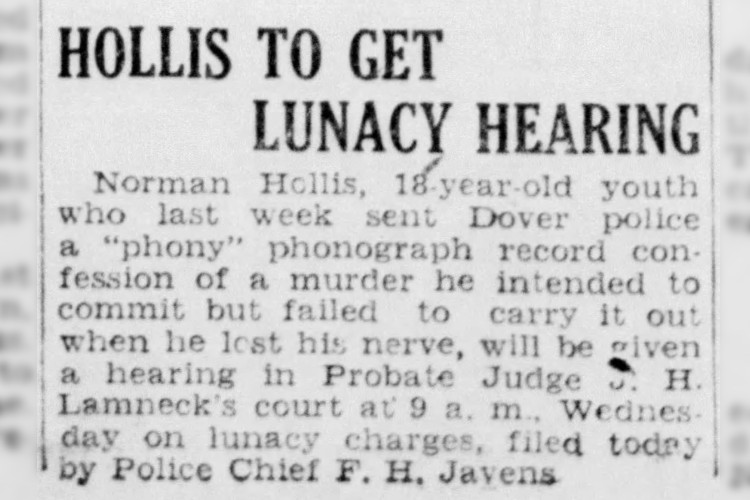
Newspaper article reporting on Norman J. Hollis’s lunacy hearing, August 1942. (Source: newspapers.com) 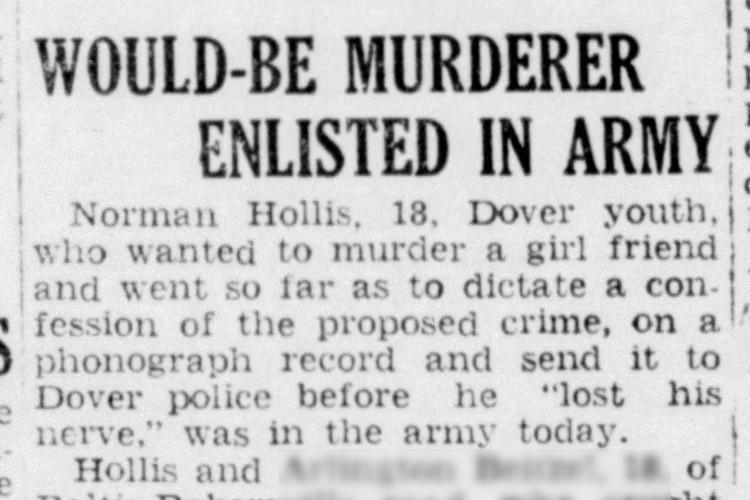
Newspaper article reporting on Norman J. Hollis’s enlistment in the US Army, August 1942. (Source: newspapers.com)
After he completed basic training, Norman was assigned to the United States Army Air Corps and trained as a radio operator. He was eventually assigned to the 571st Bomb Squadron of the 390th Bomber Group, Heavy as a radio operator in the B-17 bombers flown by the squadron. Norman became part of the crew on the bomber nicknamed “Pickle Dropper IV”, a bomber that flew over 50 missions from their base in Framlingham, England. Like many bombers with that number of missions, the “Pickle Dropper IV”‘s luck soon ran out.
As preparation for the invasion of France in June 1944, Norman’s bomber group was assigned to bomb German defenses along the French coastline. On the morning of June 5th, after dropping their payload, the “Pickle Dropper IV” was struck by anti-aircraft fire north of Dieppe, France and then collided with another bomber. The 8-man crew of the “Pickle Dropper IV”, including Norman, bailed out over the North Sea. Witnesses reported the plane engulfed in flames as it hit the water. All but one of the men died, and Staff Sergeant Norman J. Hollis was among the dead. The Hollis family was informed in late June 1944 that Norman was missing and, a year later, that he had died.

The crew of the B-17 “Pickle Dropper IV”. It is not clear if Norman J. Hollis is pictured, 1944. (Source: Fold3.com) 
Newspaper article reporting on Norman J. Hollis’s status as missing in action, June 1944. (Source: newspapers.com) 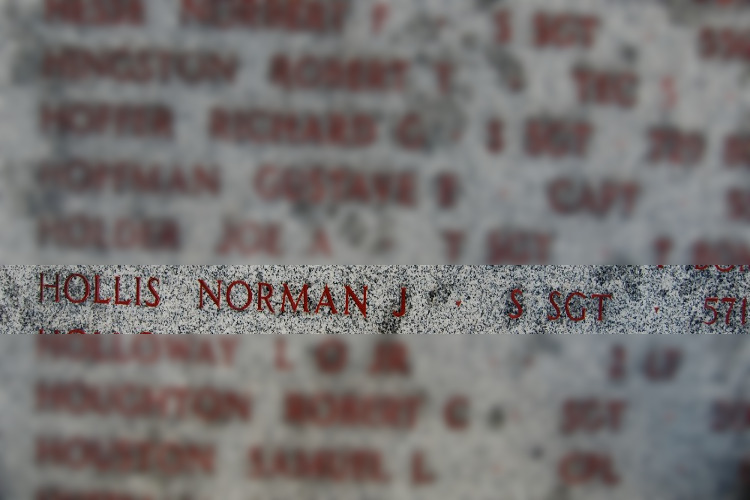
Norman J. Hollis memorialized on the Tablets of the Missing at the Ardennes American Cemetery and Memorial in Belgium. (Source: findagrave,com)
Enjoy my stories?


© Noel B. Poirier, 2024.
 Tuscarawas County Stories