
When a Dover man stood up to defend his landlady’s honor in 1917, the violent aftermath set in motion a life shaped by injury, heartbreak, and ultimately, a tragic end.
Content warning: This post contains references to suicide. If you or someone you know has a mental illness, is struggling emotionally, or has concerns about their mental health, there are ways to get help. Click here for resources to find help for you, a friend, or a family member.
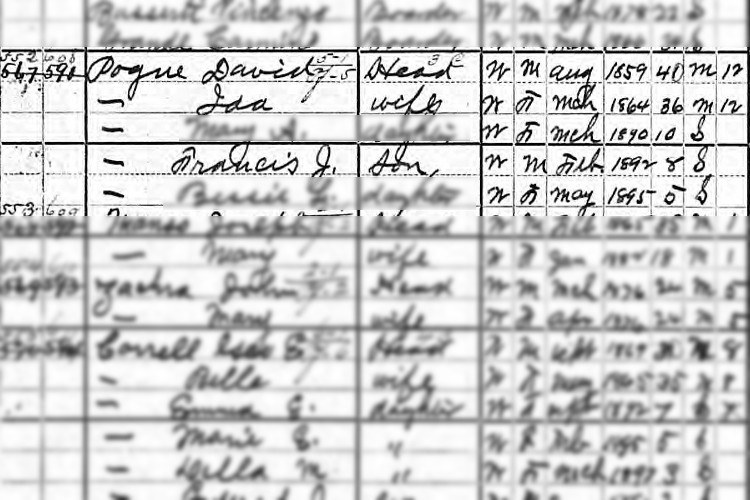
Francis (Frank) J. Pogue (1892-1937) was born in Belmont County, Ohio, to David (1858-1929) and Ida (Kennedy) Pogue (1864-1939). He was the second of six children and grew up in Dover, Ohio, where the family settled by the turn of the century. His early life was rooted in working-class values, shaped by his parents’ modest beginnings—David had worked on farms in Belmont and Monroe Counties, and Ida was raised in Harrison County before the couple married in 1887 in Tuscarawas County. Frank attended school in Dover and by 1910, at the age of 18, was already contributing to the household income as a teamster laborer while living on Front Street with his family.
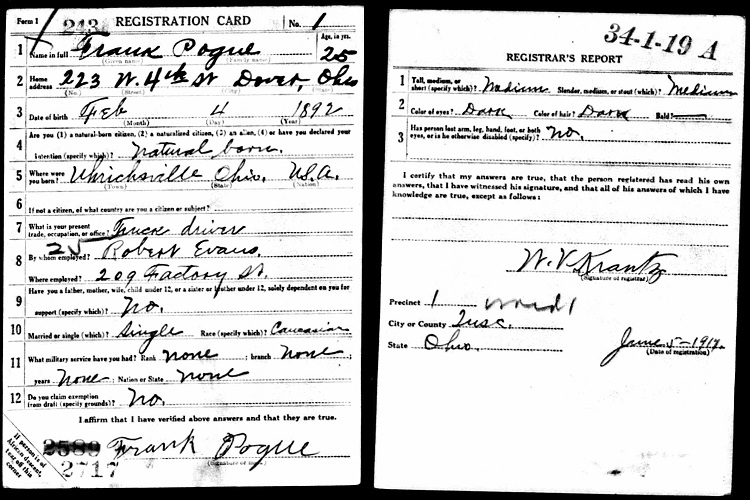
Between 1910 and 1917, Frank worked a number of different jobs, including a job at a local Dover saloon frequented by the growing Italian immigrant community. Frank lived on West Fourth Street in Dover and was employed as a truck driver when he registered for the World War One draft in June 1917. He was described in his draft registration as of medium height and build, with dark eyes and hair. By September of 1917 Frank took a job with the American Sheet & Tin Plate Company and lived in a rented room in the home of the Kaelin Family on West Fourth Street.
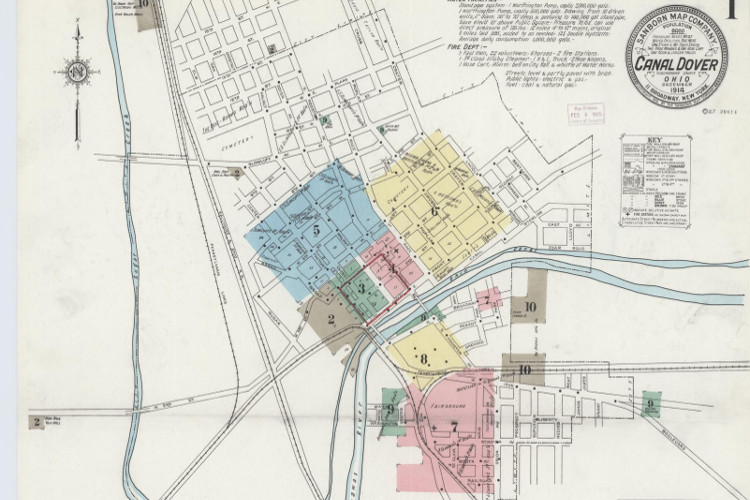
On the evening of September 16, 1917 a confrontation erupted that would leave Frank Pogue severely wounded and draw the community’s attention. That night, a group of men allegedly insulted Mrs. Tillie Kaelin (1883-1966) and her teenage daughter Marie (1903-1995) as they passed by. Frank Pogue, once told, took offense to the disrespect shown to his landlady and her daughter. Intent on defending their honor, he sought out the men and found them gathered in nearby Cherry Alley. There, Pogue confronted the group and accused them of the insult, but the situation quickly escalated into violence.
During the ensuing fight, one of the men drew a knife. As Pogue attempted to restrain the attacker, another member of the group pulled a gun and shot him three times. Even after being shot, Pogue was stabbed before the assailants fled the scene. A former saloon worker familiar with the rowdy edges of town life, Pogue’s sense of justice and loyalty may have compelled him to take such a bold stand. He was rushed to Union Hospital where he spent several weeks recovering from his serious injuries. The authorities swiftly arrested three men—Dominick Tavilla (1886-?), Dominick Cugliari (1894-1975), and Dominick Franze (?-?)—with Cugliari charged as the shooter.
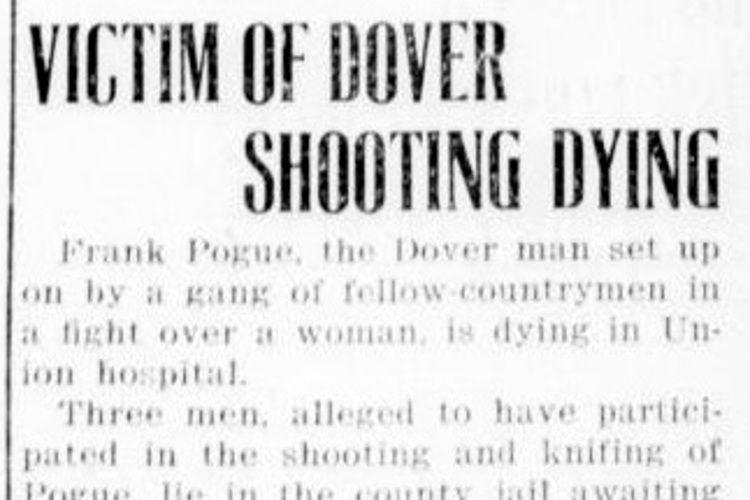
New Philadelphia, Ohio newspaper headline for story on the shooting of Frank Pogue, September 1917. (Source: newspaperarchive.com) 
Tuscarawas County Jail Register recording the assailants of Frank Pogue, September 1917. (Source: familysearch.org) 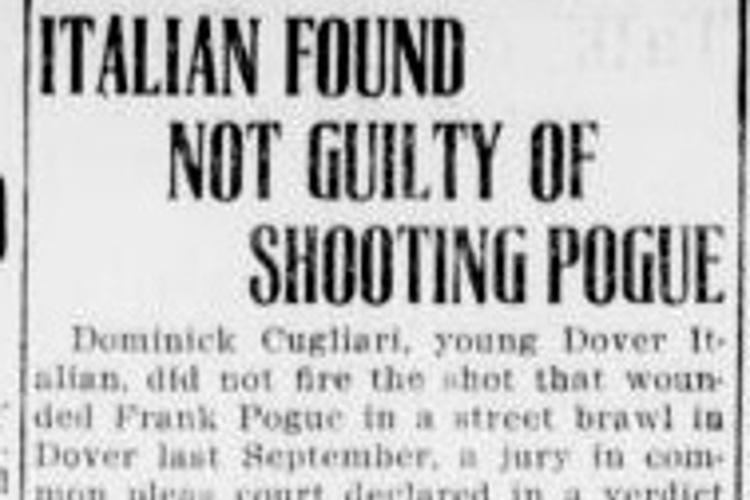
New Philadelphia, Ohio newspaper headline announcing the verdict in the Pogue shooting case against Dominick Cugliari, December 1917. (Source: newspaperarchive.com) 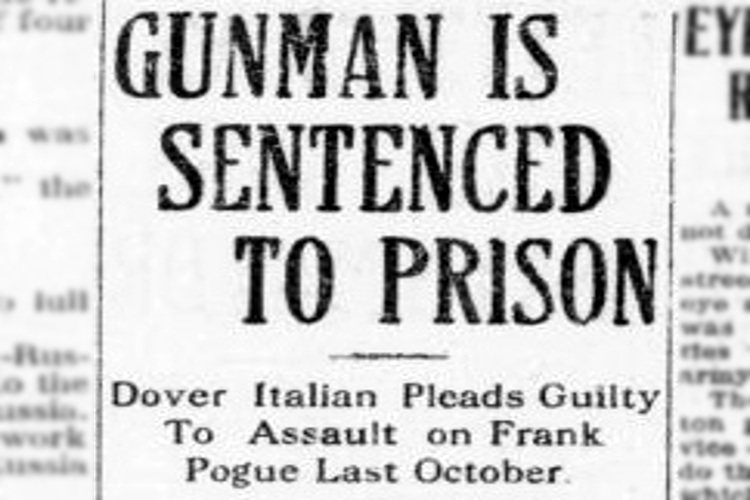
New Philadelphia, Ohio newspaper headline announcing Dominick Tavilla’s guilty plea in the Pogue shooting case, February 1918. (Source: newspaperarchive.com)
The three accused assailants were held in the Tuscarawas County Jail until October 1917, when all three men posted bond and were released to await trial. Cugliari stood trial in December 1917 for shooting Pogue and the proceedings drew a large crowd, particularly from Dover’s Italian immigrant community. After two days of testimony, the jury found Cugliari not guilty. However, during the trial, Tavilla inadvertently implicated himself in the shooting, shifting some of the legal focus his way. Franze, meanwhile, was never formally charged. Dominick Tavilla pleaded guilty in February 1918, to a reduced charge of assault and battery and received a 60-day sentence to be served in the Canton, Ohio workhouse.
Following his recovery from the 1917 attack, Frank Pogue was drafted into the U.S. Army in June 1918 as World War I neared its end. Returning to civilian life in Dover in 1919, Pogue resumed a laborer’s life, working in a foundry and later as a coal truck driver. He married Katherine Detterline in Oakland, Maryland in 1924—a union that would end in divorce by 1930. Later that same year, records show him living with a new wife, Gladys, in Dover, though the exact date of their marriage is unknown.
Despite efforts to rebuild his life, Pogue’s later years were marked by instability and personal hardship. He was divorced again by 1937 and lived alone in New Philadelphia, Ohio when tragedy struck. In November of that year, Frank Pogue died from a gunshot wound to the head caused by a .32 caliber revolver. While newspapers reported the incident as a suicide, county death records officially classified it as an accident. His death, whether intentional or not, marked a quiet and somber end to a life shaped by labor, war, loyalty, and violence—a man emblematic of the struggles faced by many working-class Doverites in the early 20th century.
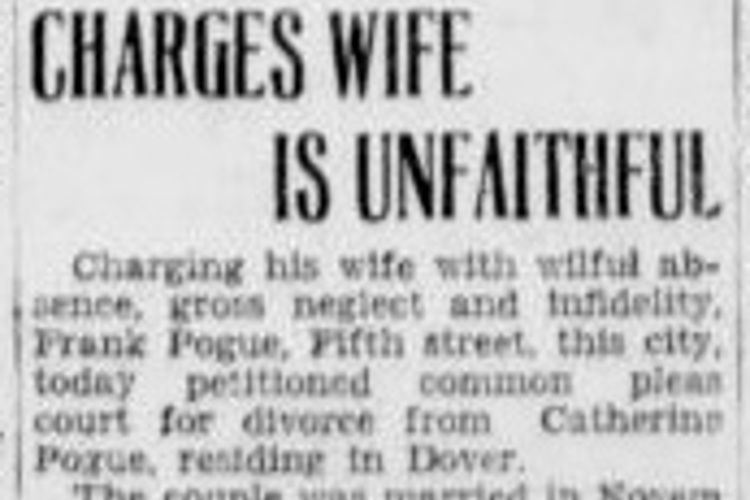
New Philadelphia, Ohio newspaper article on the marital troubles between Frank Pogue and his first wife, October 1928. (Source: newspaperarchive.com) 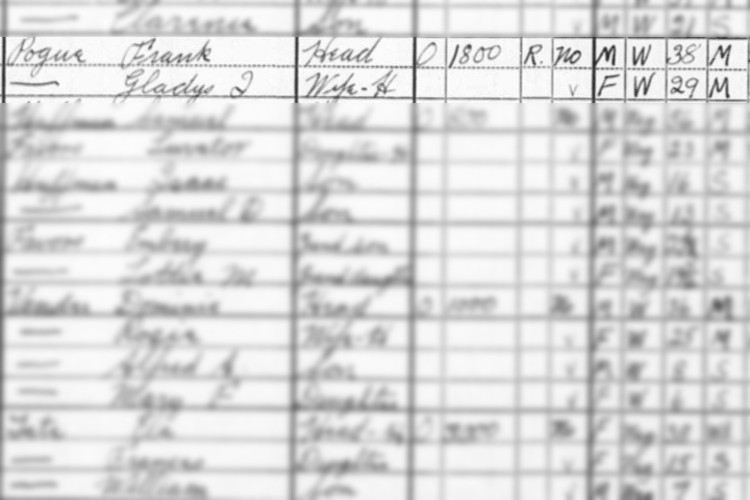
Frank Pogue and his second wife recorded on the 1930 census record for Dover, Ohio. (Source: familysearch.org) 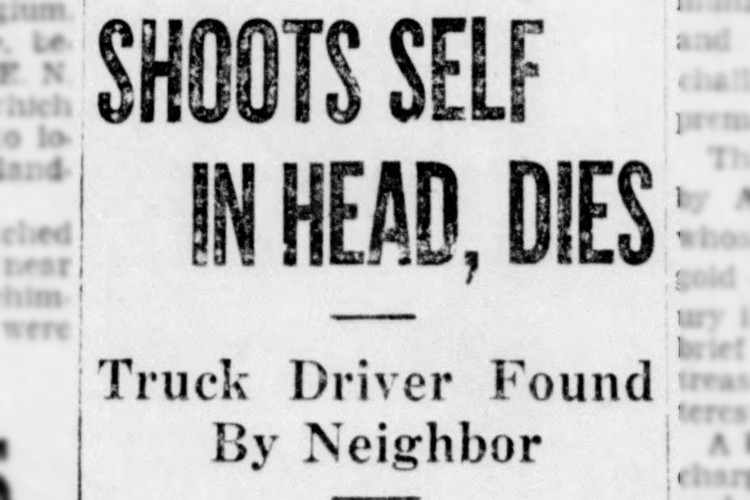
New Philadelphia, Ohio newspaper headline reporting on the death of Frank Pogue, November 1937. (Source: newspaperarchive.com) 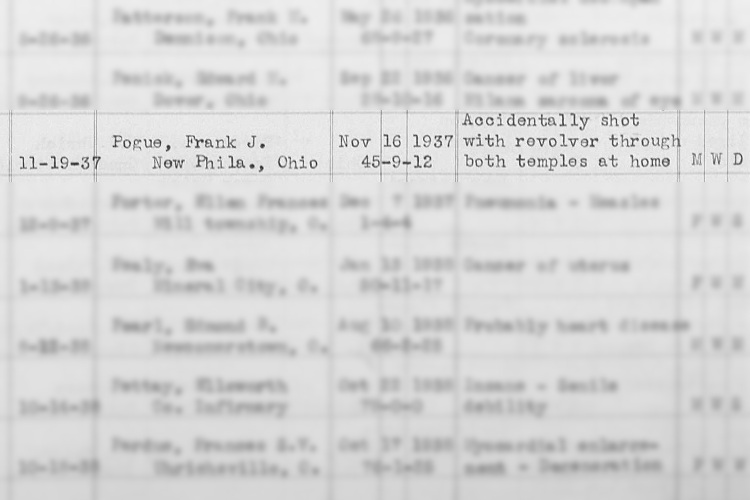
Frank Pogue’s county death record recording his death was accidental, November 1937. (Source: familysearch.org)
Enjoy my stories?


© Noel B. Poirier, 2024.
 Tuscarawas County Stories