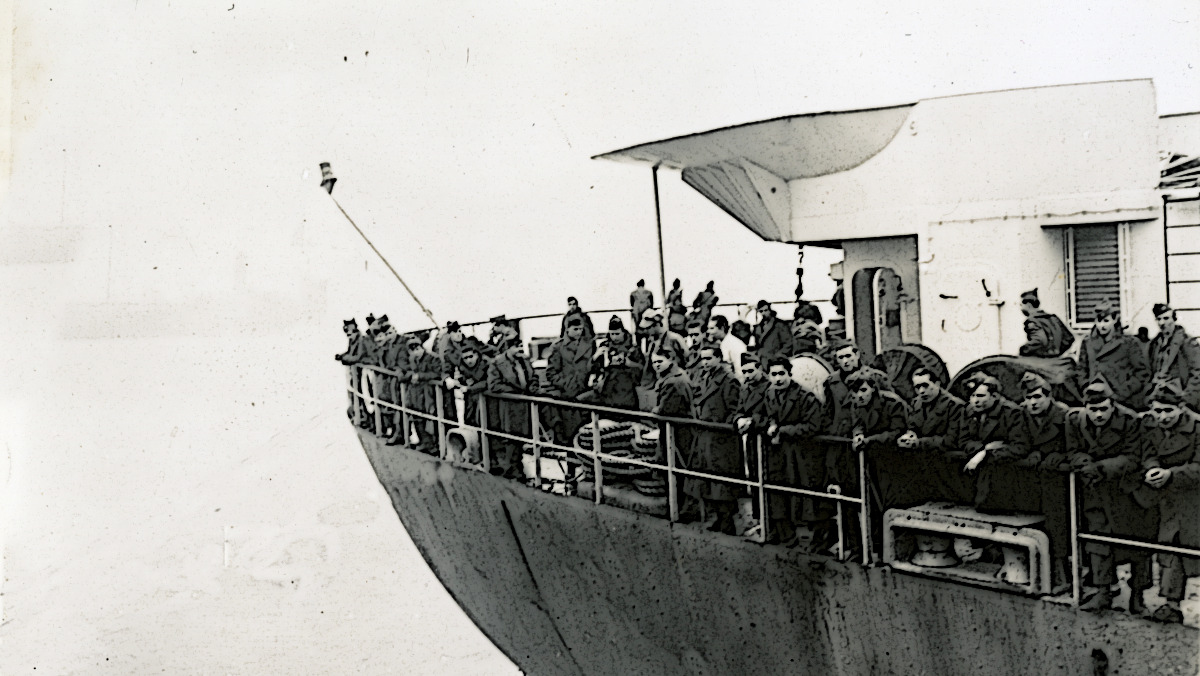
Joseph Pancheri’s life, marked by dedication to his family and country, ended tragically during one of World War II’s most devastating and long-concealed maritime disasters.
Severino Pancheri (1893–1957) immigrated from an Italian speaking territory in Austria in 1913, arriving in New York harbor on March 23 that year aboard the SS Niagara. Severino initially settled on the Upper Peninsula of Michigan where he mined iron ore before he shortly moved to Roswell, Ohio. There, Severino met, and then married, a daughter of Italian immigrants named Rose Ruffini Zucal (1895-1977). Rose’s first husband died in 1918 and she and Severino were married about a year later in 1919.
The couple established their family in the tight-knit Tuscarawas County mining community. Severino worked as a coal and clay miner, contributing to the local industries that were the backbone of the area’s economy. The couple had three children, two daughters and a son named Joseph Abel Pancheri (1920-1944). When the United States entered World War Two in 1941, Severino was working at the Louis Paris Coal Mine in Roswell.
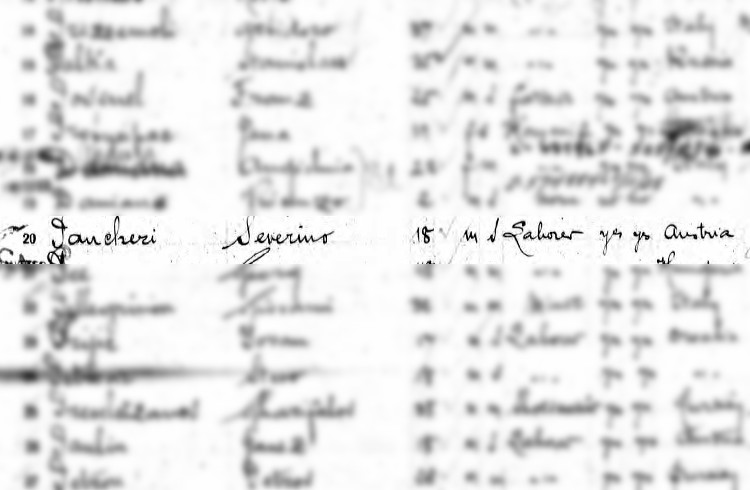
Severino Pancheri recorded on a passenger list when he immigrated to the United States, 1913. (Source: familysearch.org) 
Severino Pancheri’s World War One draft registration card, 1917. (Source: familysearch.org) 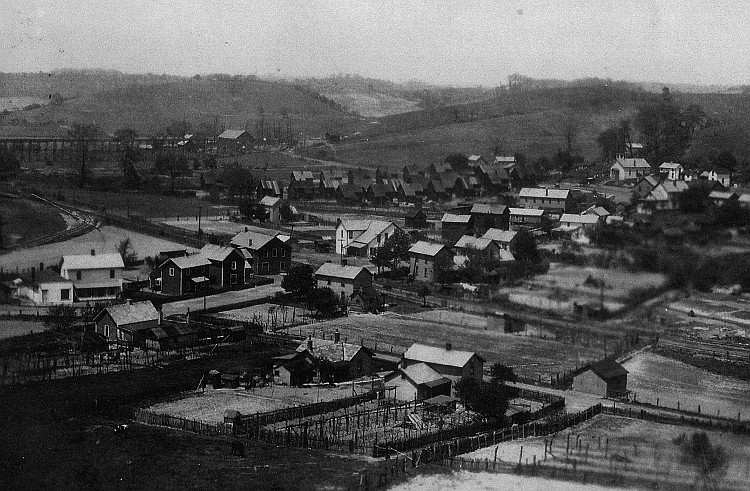
View of Roswell, Ohio in Tuscarawas County, 1923. (Source: Tuscarawas County Historical Society) 
The Pancheri family recorded on the 1930 census for Roswell, Tuscarawas County, Ohio. (Source: familysearch.org)
The Pancheri’s son, Joseph Pancheri, was a hardworking young man with blue eyes, brown hair, and a light brown complexion. Standing at 5’3″ and weighing 135 pounds, he grew up in Midvale, where he attended Midvale High School and sang in the school choir. Joseph worked as a coal miner after leaving school and later transitioned to a laborer position at the Belmont Enameling & Stamping Company in New Philadelphia where he worked when he registered for the draft in July 1941.
Joseph was inducted into the United States Army in 1943, assigned to Company H of the 262nd Infantry Regiment of the 66th Infantry Division. His basic training took him to Camp Blanding in Florida with later training at Camp Robinson in Arkansas, and Camp Rucker in Alabama. Joseph rose to the rank of corporal by August 1944 and returned home briefly that month to attend his sister’s wedding. Shortly after the 262nd Infantry Regiment was sent to England where it arrived on November 29, 1944. By the time his unit arrived in England, Joseph Pancheri held the rank of Staff Sergeant.
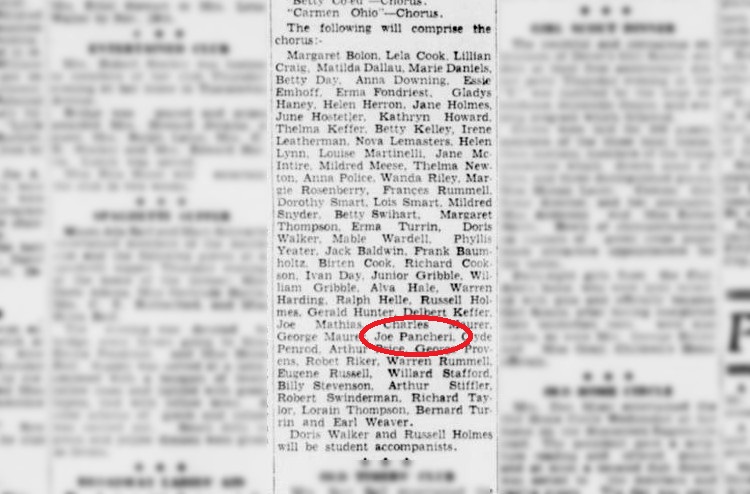
Joseph Pancheri listed as a member of the Midvale High School chorus, November 1935. (Source: newspaperarchive.com) 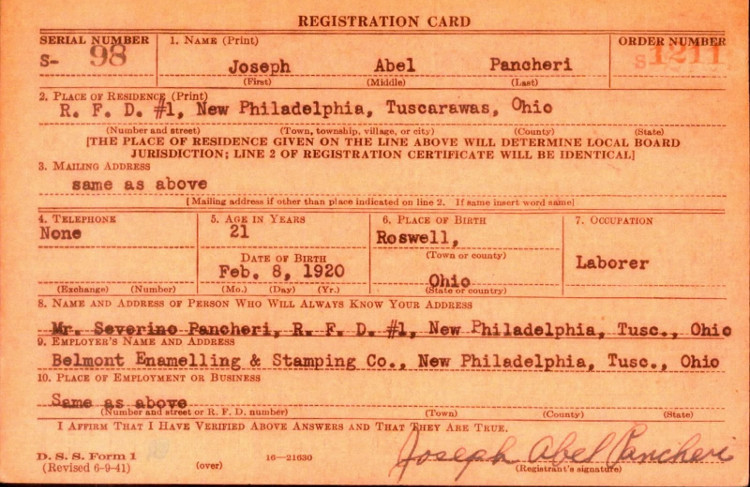
Joseph Pancheri’s World War Two draft registration, July 1941. (Source: fold3.com) 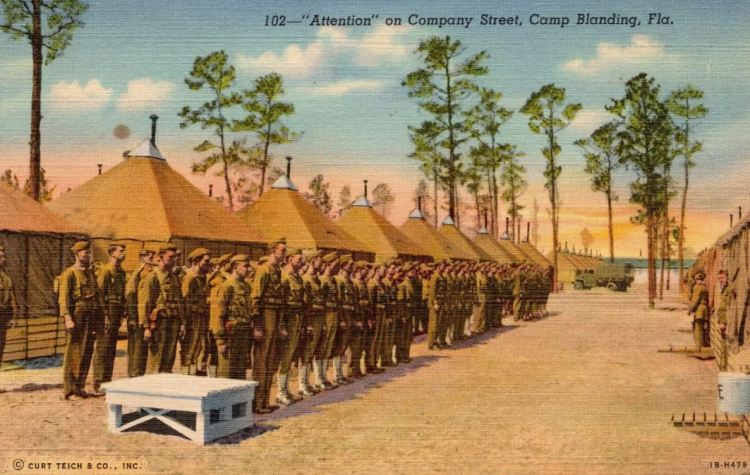
Postcard of soldiers at Camp Blanding, Florida, c. 1942. (Source: ebay.com) 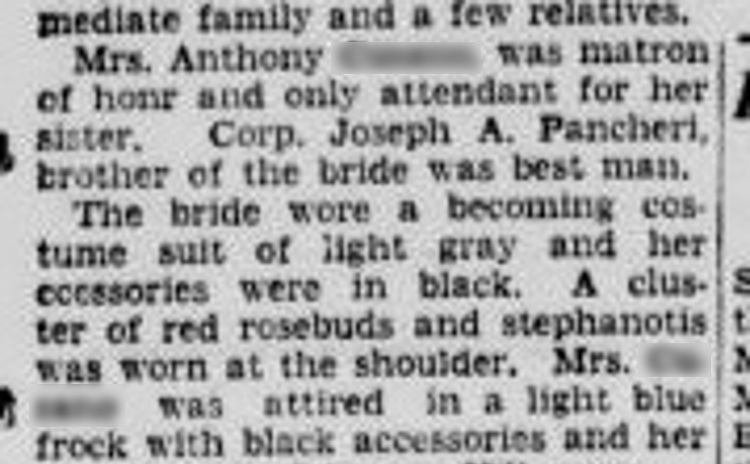
Joseph Pancheri as the Best Man in his sister’s wedding reported in the New Philadelphia, Ohio newspaper, August 1944. (Source: newspaperarchive.com)
When the German offensive known as the Battle of the Bulge began in December 1944, reinforcements were gathered in England for transport to the mainland. The Belgian flagged troop ship SS Leopoldville departed for Cherbourg on December 23, 1944, carrying 2,235 soldiers from the 66th Infantry Division, including men from the 262nd Infantry Regiment. The ship, crowded and lacking safety training for the troops on how to lower life boats, left port at 9:00 a.m. under the protection of four naval frigates. Despite two alerts during the voyage, no enemy action was encountered until the ship was just five miles from its destination.
It was around 6:00 p.m. when a German U-boat, U-486, fired torpedoes at the Leopoldville. One torpedo struck the troop ship and sent it into chaos. Some soldiers attempted to leap to safety aboard the nearby HMS Brilliant that pulled alongside the sinking vessel. The ships situation worsened and over 1,200 men remained stranded on the Leopoldville after two hours. In the frigid 48-degree waters of the English Channel, the ship eventually foundered, listed, and sank. 763 United States infantrymen perished and 493 of them, including Staff Sergeant Joseph Pancheri, were never recovered.
The military, in an effort to hide the enormity of the loss, withheld information from the families of the soldiers lost for months. Many men, including Staff Sergeant Joseph Pancheri, were reported as missing despite the fact that the United States Army was well aware of their death. The Pancheri family did not learn of his death until March 1945 and, even then, the details of his death were kept from them. It was not until the 1960s that the true story of what happened to the SS Leopoldville, and Staff Sergeant Joseph Pancheri and his comrades, was known.
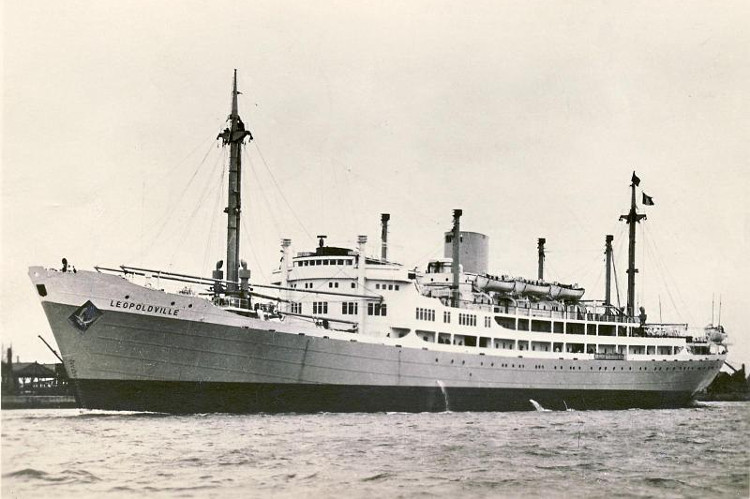
Photograph of the SS Leopoldville. (Source: belgian-navy.be) 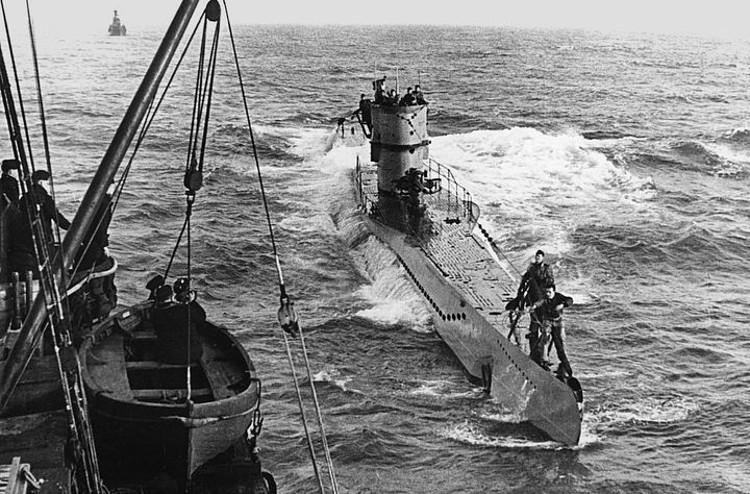
Photograph of the German submarine U-486 refueling at sea, c. 1944. (Source: reddit.com) 
Joseph Pancheri reported as missing in the New Philadelphia, Ohio newspaper, January 1945. (Source: newspaperarchive.com) 
Staff Sergeant Joseph A. Pancheri’s name on the Wall of the Missing at the American Cemetery in Normandy, France.
To learn more about the SS Leopoldville disaster click here.
© Noel B. Poirier, 2024.
 Tuscarawas County Stories