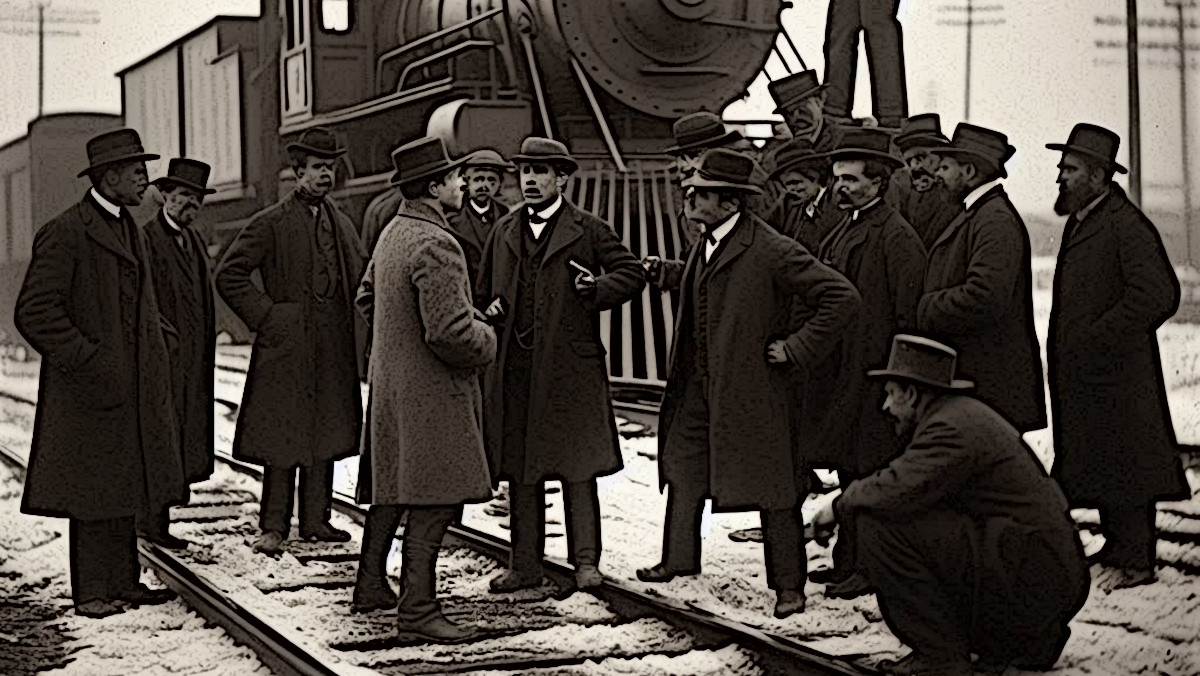
The Canton-New Philadelphia Street Railway Company prepared to lay tracks down Wooster Avenue in Dover, Ohio, amidst a heated dispute with the Cleveland & Pittsburgh Railroad. The conflict escalated into a dramatic standoff between railroad workers from both sides.
It was January 1903 by the time the interurban Canton-New Philadelphia Street Railway Company was ready to begin to lay tracks down Wooster Avenue in Dover, Ohio into New Philadelphia. In order to do so, they had to lay a crossing at the point on Wooster Avenue where the road was crossed by the Cleveland & Pittsburgh Railroad. This crossing was south of the Tuscarawas River and of the Dover residential neighborhood known as “Tin Town” just before the point where Wooster Avenue met Iron Avenue.
Since the previous October the Canton-New Philadelphia Street Railway Company and the Cleveland & Pittsburgh Railroad’s owner, the Pennsylvania Railroad, were disputing whether the former was able to cross the latter’s tracks in Dover. As the dispute dragged on into the winter, the Canton-New Philadelphia Street Railway Company decided to lay the tracks regardless of any opposition from the Pennsylvania Railroad. They had their own construction schedule to maintain and wanted service running by early spring 1903.

A Canton-New Philadelphia Interurban Street Railway Car, c. 1910. (Source: ebay.com) 
Location of the disputed crossing as shown on the 1908 map of Dover, Ohio in the Tuscarawas County Atlas. (Source: ancestry.com) 
A Cleveland and Pittsburgh locomotive and cars photographed in Jefferson County, Ohio, c. 1905. (Source: ebay.com)
The Canton-New Philadelphia Street Railway Company decided that their best bet to get the work completed unmolested by the Pennsylvania Railroad was to do the work early on a Sunday morning. They chose Sunday, January 4 as the date to undertake the crossing work. Unfortunately for them, the Pennsylvania Railroad found out and had a plan for challenging the effort to lay the new crossing. Early that Sunday morning a Cleveland & Pittsburgh locomotive and six cars of ash and cinder, carrying about 70 or so railroad workers aboard, stopped in the middle of the crossing and halted any effort by the street railway company to lay the new crossing.
Also present at the crossing that morning were representatives of both competing rail companies and county and Dover law enforcement officers. The street railway company’s work party consisted of just two work wagons and a handful of men but, as one of the wagons moved towards the crossing, law enforcement forced the railroad to clear the crossing to allow the wagon through. Once cleared, the street railway men began pulling railroad spikes up as quickly as possible before the train could be moved back over the crossing. Men from the railroad began throwing and shoveling ash and cinders at the work crew below, striking some. Shovels, spikes, and other tools were also hurled back and forth between the two competing groups of railroaders.

Tin Town (looking west) in Dover, Ohio near the Reeves Manufacturing Company during the 1913 Flood. (Source: Tuscarawas County Historical Society) 
New Philadelphia, Ohio newspaper headline about the confrontation on Wooster Street, January 1903. (Source: newspaperarchive.com) 
Canton, Ohio newspaper headline about the confrontation on Wooster Street, January 1903. (Source: newspaperarchive.com)
Law enforcement finally stepped in after they noticed one man brandishing a dagger during the fight. Sheriff Charles J. Wagner (1860-1912) arrested the Cleveland & Pittsburgh train crew that included New Philadelphia residents John Albert Tarbot (1870-1951) and Martin E. Lamport (1862-1954), both conductors. He also arrested the man, the Italian-born Tony Thompson, who displayed the knife. After the arrest of the train crew, men from the Canton-New Philadelphia Street Railway Company moved the locomotive off the crossing and their work crew were able to complete the work of installing the new crossing for their tracks.
The heated dispute between the Pennsylvania Railroad’s Cleveland & Pittsburgh Railroad and the Canton-New Philadelphia Street Railway Company over the Wooster Avenue crossing in Dover was short-lived. Less than three weeks after the incident, the parties came to a settlement and the Canton-New Philadelphia Street Railway Company was able to begin its service to New Philadelphia. None of the men arrested during the melee on January 4, 1903 was indicted for a crime and the Battle for the Wooster Avenue Crossing became a footnote in the railroad history of Tuscarawas County.

New Philadelphia, Ohio newspaper article about the settlement of the “crossing” dispute, January 1903. (Source: newspaperarchive.com) 
A Canton-New Philadelphia Street Railway Company streetcar on Wooster Avenue in Dover, Ohio depicted in a c. 1910 postcard. (Source: ebay.com) 
The location of the disputed crossing on Wooster Avenue as seen in 2024. (Source: earth.google.com)
Enjoy my stories?


© Noel B. Poirier, 2024.
 Tuscarawas County Stories