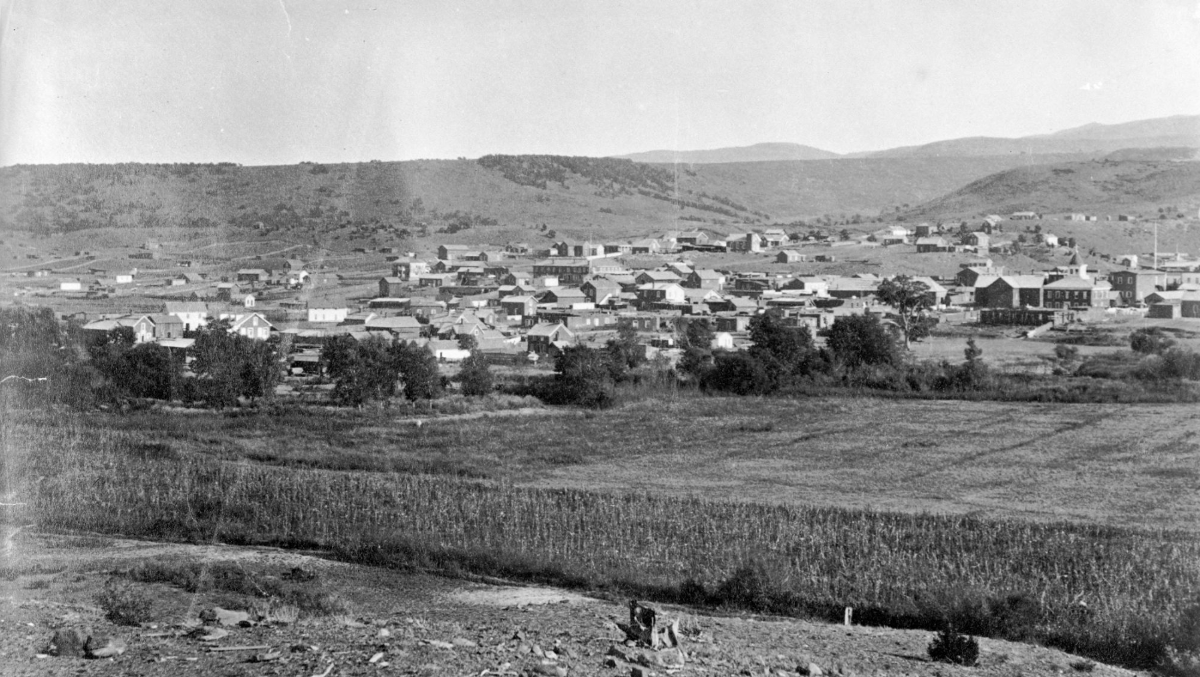
New Philadelphia carpenter William Carlile laid the foundation for his family’s future. Little did he know, his son James N. Carlile would carve a path far beyond the realm of sawdust and nails.
William Carlile (1806-1887) was a Pennsylvania born carpenter who migrated to Tuscarawas County, Ohio in the 1830s with his family. He originally settled in the city of New Philadelphia where there was ample work for a man with his skills. Not surprisingly, the Carlile sons also learned the carpenter’s trade and the family eventually earned enough money to buy a farm in Carroll County, though they kept their land in New Philadelphia as well. One of William’s sons, James N. Carlile (1836-1921), was apparently not content to pursue the life of an Ohio carpenter/farmer.
When James actually began his westward journey is unclear. A later biography claimed that, at 14 years-old, he took a job on the Pan Handle railroad in Ohio where he learned his railroading skills. A 20-year-old Ohio born carpenter named James Carlile appears on the 1857 census of un-surveyed lands in northern Minnesota, and another later biography of James records that he “crossed the plains with an ox-team in 1859”. Regardless of the exact date of his departure, he was living in Denver, Colorado by the time he married Maria Bennett (1845-1931) in 1869.

William Carlile and family recorded on the 1850 census for the city of New Philadelphia, Ohio. (Source: familysearch.org) 
Marriage of James Carlile and Maria Bennett reported in the Denver, Colorado newspaper, June 1869. (Source: http://www.coloradohistoricnewspapers.org) 
James Carlile family recorded on the 1870 census for Pueblo, Colorado. (Source: familysearch.org)
Prior to his marriage to Marie Bennett, James had been working and making a name for himself as a bit of a frontiersman and prospector. James mined, freighted goods across the region, and partnered to construct railroads. Among the railroads his partnerships built were sections of the Denver Pacific, Colorado Central, Kansas Pacific, Denver and Rio Grande Railroad, and others. This work brought him into to contact with many well-known western American figures, among them Kit Carson. It was Carson who allegedly encouraged James to acquire land in what became known as Pueblo, Colorado.
James and his family first appear in Pueblo on the 1870 census and, while he continued his work on constructing railroads, he invested in the development of large livestock holdings. One of James’s younger brothers, William Carlile (1843-1914), had joined James in Pueblo by that 1870 census. James Carlile’s property, including his home and livestock, were valued at $11,000 in 1870 demonstrating just how successful he had become in the west. Railroads that James and his partners built sections of in the 1870s were Atchison, Topeka and Santa Fe, Denver and Rio Grande, and the Denver and South Park railroads. He returned home to New Philadelphia in 1872 and recruited his sister and brother-in-law, George Crites (1828-1903), to move to Pueblo as well.

Portion of a map of the Denver and Rio Grande Railroad showing Pueblo, Colorado, 1873. (Source: loc.gov) 
Portion of a newspaper article from the New Philadelphia, Ohio newspaper discussing James Carlile’s visit in February 1872. (Source: newspaperarchive.com) 
The Carlile home Pueblo, Colorado depicted in the “History of the Arkansas Valley, Colorado”, 1881. (Source: archive.org)
Not surprisingly, given his wealth and status as one of Pueblo’s earliest citizens, James Carlile began a prominent political career in the late 1870s and 1880s. He was elected to represent Pueblo County in the first Colorado State Legislature in 1876, was elected as County Treasurer in 1880, served as an at-large delegate for the State of Colorado at the 1888 Democratic National Convention, was put forth as Colorado’s selection for Vice-President at the same convention, and served as the Treasurer for the State of Colorado in the early 1890s. Meanwhile, his ranch outside of Pueblo was breeding some of the finest racehorses in the country.
James father and sister moved to Pueblo after the death of James’s mother in the 1870s and the family all lived near one another for a number of years. James and Maria Carlile lived in their home on the Pueblo Mesa for the rest of their lives, though they enlarged it and modernized it as time went on to accommodate their growing family and household servants. When James Carlile died in October 1921 the newspaper referred to him as “a rare man” who “gave away thousands” of dollars over his lifetime. James came a long way from the days as a carpenter’s apprentice to his father in New Philadelphia.

Portrait of James N. Carlile, c. 1910. (Source: ancestry.com) 
The Carlile House in Pueblo, Colorado as it appeared in c. 1900. (Source: “Colorado Homes” by Sandra Dallas, 1986; archive.org) 
Portion of John N. Carlile’s obituary from the Pueblo, Colorado newspaper, October 1921. (Source: http://www.coloradohistoricnewspapers.org)


© Noel B. Poirier, 2024.
 Tuscarawas County Stories