
The early 20th century Lord family of Mineral City, Ohio had a secret; a secret that had passed down through at least two generations by 1910. When that secret came to light in 1917 it cost the family a son, but the secret persisted after his death whether intentionally or with a community’s acceptance.
Content warning: This post contains a discussion of ethnicity and race in Tuscarawas County and references to suicide. If you or someone you know has a mental illness, is struggling emotionally, or has concerns about their mental health, there are ways to get help. Click here for resources to find help for you, a friend, or a family member.
According to the earliest census record where he is listed, Augustus Lord (1819-1889) was born in Pennsylvania in 1819. Very little information on Augustus’s first 31 years is known, but some can be gleaned from his 1850 Census record. He was living in the community of Busti, New York at the time that census was taken and he was married a woman named Sarah Pero (1826-aft.1875). The couple married in 1843 in New York State and had four children by 1850. Sarah’s mother was also living with them at the time of the 1850 census.
Augustus and Sarah’s marriage did not last however, and they divorced before 1855. Augustus made his way to Huron County, Ohio where, in June 1855, he married a woman named Samantha Haynard (c. 1840-?) though she is often recorded as Hannah. The couple and their children lived in Mansfield, Ohio in 1860, Sandusky, Ohio in 1863, Tiffin, Ohio in 1870, and LaPorte, Indiana in 1880. Augustus worked as a barber until his death in 1889 and it was a trade he passed on to at least two of his sons, including Thomas Ford Lord (1859-1925), who most often went by the name Ford.
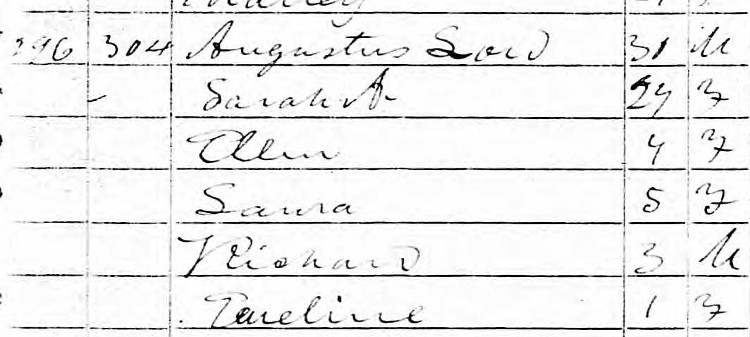
Augustus Lord, his first wife, and their family recorded in the 1850 Census. (Source: familysearch.org) 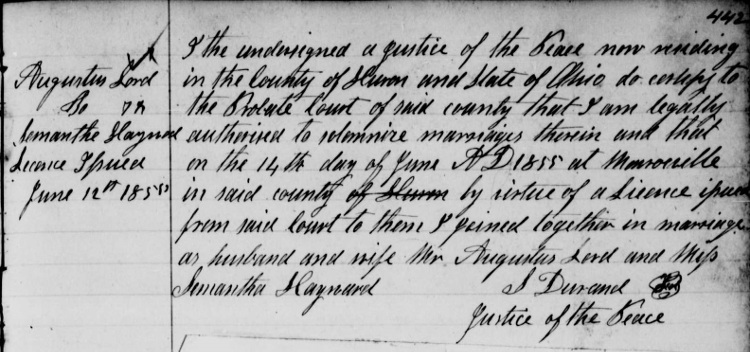
Record of Augustus Lord’s marriage to his second wife in Huron County, Ohio, June 1855. (Source: familysearch.org) 
Detail from a 1908 postcard of Mineral City, Ohio. (Source: ebay.com) 
The marriage of Ford Lord and Susan Culp reported in the New Philadelphia, Ohio newspaper, June 1890. (Source: newspaperarchive.com)
It is not clear what motivated Ford to move from LaPorte, Indiana to the town of Mineral City, Ohio, but he was there at least as early as 1890, as that year Ford married Susan Culp (1869-1903) in Tuscarawas County. Ford eventually worked as barber Mineral City while also supplementing his income by working in the nearby mines. Ford’s mother, Hannah, moved into his household, which now included two sons, sometime in the 1890s. An examination of the 1902 Sanborn Map for Mineral City shows one small barber shop, located on Miners Street, that may have been Ford’s shop at the time.
Susan Culp Lord contracted tuberculosis and died in August 1903 after only 13 years of marriage, leaving Ford to raise his two sons with the assistance of his mother. The two sons, one of which was named Edward Augustus Lord (1890-1917), attended school in Mineral City and, when old enough, found work to help support the family. Edward worked as a teamster in Mineral City while his younger brother worked as a janitor at the nearby opera house. When World War One began, both of the Lord boys registered for the draft, and Edward’s name came up for the second call-up of men from Tuscarawas County. Edward left for recruit training at Camp Sherman in Chillicothe, Ohio in September 1917.
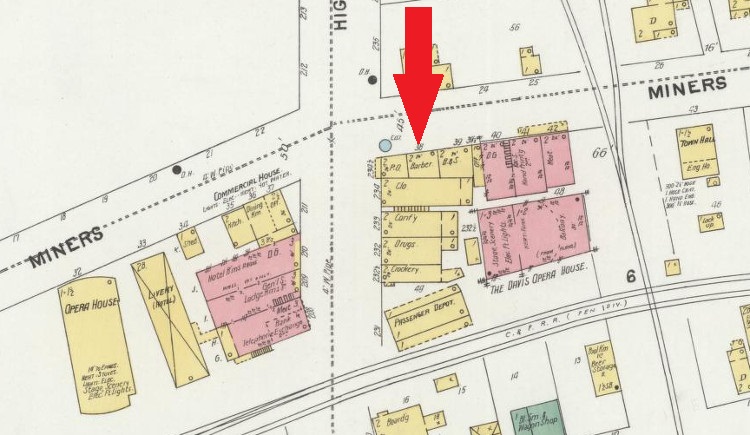
The lone barber shop in Mineral City, Ohio that may have been Ford Lord’s shop indicated on the 1902 Sanborn Map for Mineral City, Ohio. (Source: loc.gov) 
Postcard of Mineral City’s High Street, looking North, c. 1910. (Source: ebay.com) 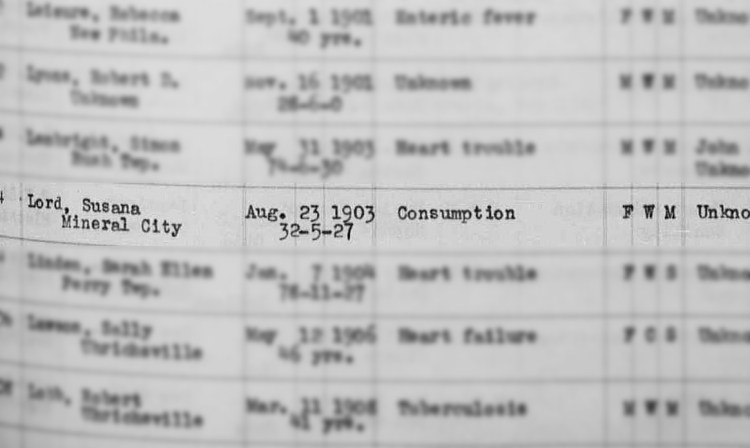
Susan Lord’s death recorded in the Tuscarawas County records, August 1903. (Source: familysearch.org) 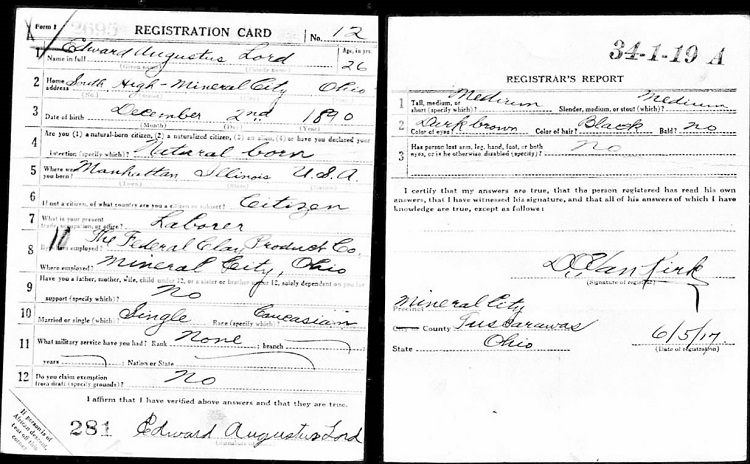
Edward Lord’s World War One draft registration card, June 1917. (Source: familysearch.org)
The Lord family “secret” traveled with Edward to Camp Sherman in the fall of 1917. Edward Lord’s grandfather, Augustus, was recorded on all census records as being either Black or of mixed ethnicity while his wives were listed as either White or of mixed ethnicity. Edward’s father, Ford, was also recorded in census records as being either Black or of mixed ethnicity, while Edward’s mother was recorded as being White. Edward himself, on census records, was recorded as being Black or of mixed ethnicity. Whether Edward Lord knew of his family’s ethnicity when he registered for the World War One draft as a “Caucasian” is impossible to know, though it is very possible that some of his fellow soldiers from Tuscarawas County knew.
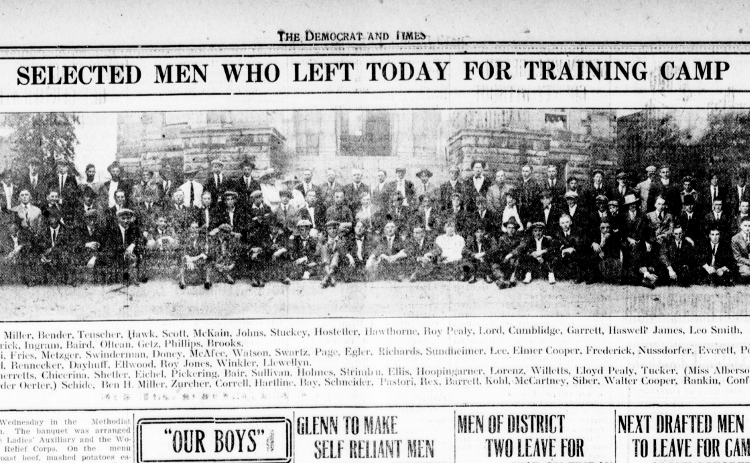
Edward Lord was photographed, along with the rest of the September 1917 selectees, in front of the Tuscarawas County Courthouse before departing for Camp Sherman. (Source: newspaperarchive.com) 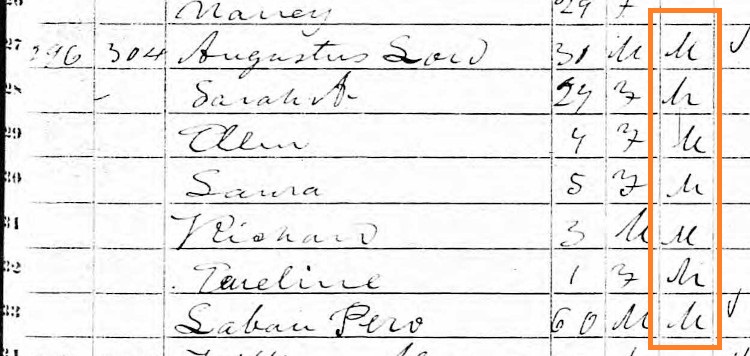
The Ford family recorded on the 1850 Census with the letter “M” for Mulatto (an archaic term for mixed ethnicity). (Source: familysearch.org) 
Thomas Ford Lord and Susan Culp’s marriage license with the words “are of white blood” crossed out, May 1890. (Source: familysearch.org) 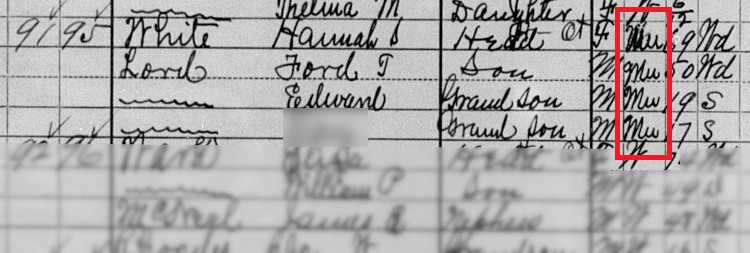
The Ford family recorded on the 1910 Census with the letters “Mu” for Mulatto (an archaic term for mixed ethnicity). (Source: familysearch.org)
When the Tuscarawas selectees arrived at Camp Sherman, they were all required to undergo a thorough physical examination by the camp’s medical staff. According to newspaper reports at the time, Edward Augustus Lord was informed by the medical staff that he was of mixed race, and not White, and therefore would not be permitted to serve with a White unit. He would have to wait until a Black unit was created; instead, Edward, distraught, took his own life on the morning of Monday, September 24, 1917.
According to newspaper accounts in the days following Edward’s death, there were two scenarios that led to Edward’s ethnicity being questioned. One scenario, provided by the Army, was that Edward volunteered that he was Black during his physical examination. Edward’s father’s response to that claim, that the family was White and always had been, seems to indicate that the Lord family was “passing” as White. Another account was that the doctors had been informed of Edward’s ethnicity by one of Edward’s neighbors who knew, and disapproved of, the Lord family’s attempt to “pass” as White (if indeed that was what they were consciously doing). Regardless, Edward’s father refused to accept the return of his son’s body and the Army buried Edward in Greenlawn Cemetery in Chillicothe, Ohio. One year later, Edward’s younger brother was drafted and served in the army as a White person and subsequent census and death records for the Lord family recorded their ethnicity as White as well. The historical documents told a different story however.

Edward Lord’s death certificate in which his cause of death, suicide, and his ethnicity is edited, September 1917. (Source: familysearch.org) 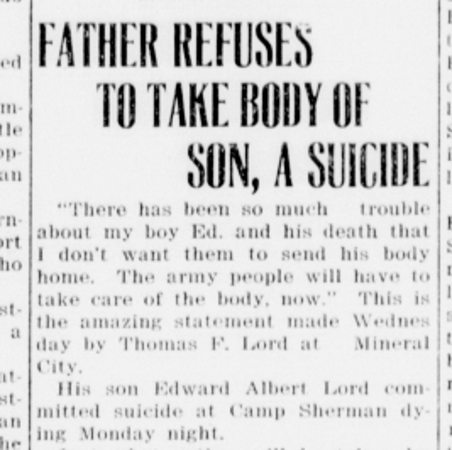
Newspaper article in the New Philadelphia, Ohio newspaper where Ford Lord refuses to accept the body of his dead son, instead turning him over to the army for burial, October 1917. (Source: newspaperarchive.com) 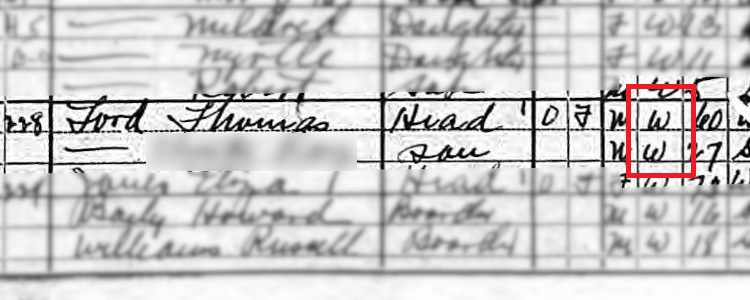
The Ford family recorded on the 1920 Census with the letter “W” for White recorded. (Source: familysearch.org) 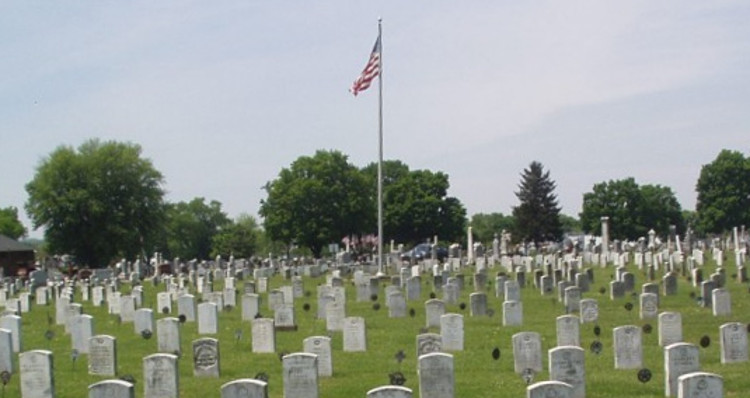
Soldiers’ graves at Greenlawn Cemetery in Chillicothe, Ohio where Edward Augustus Lord was buried, 2005. (Source: findagrave.com)
To learn more about “passing” visit:



© Noel B. Poirier, 2024.
 Tuscarawas County Stories