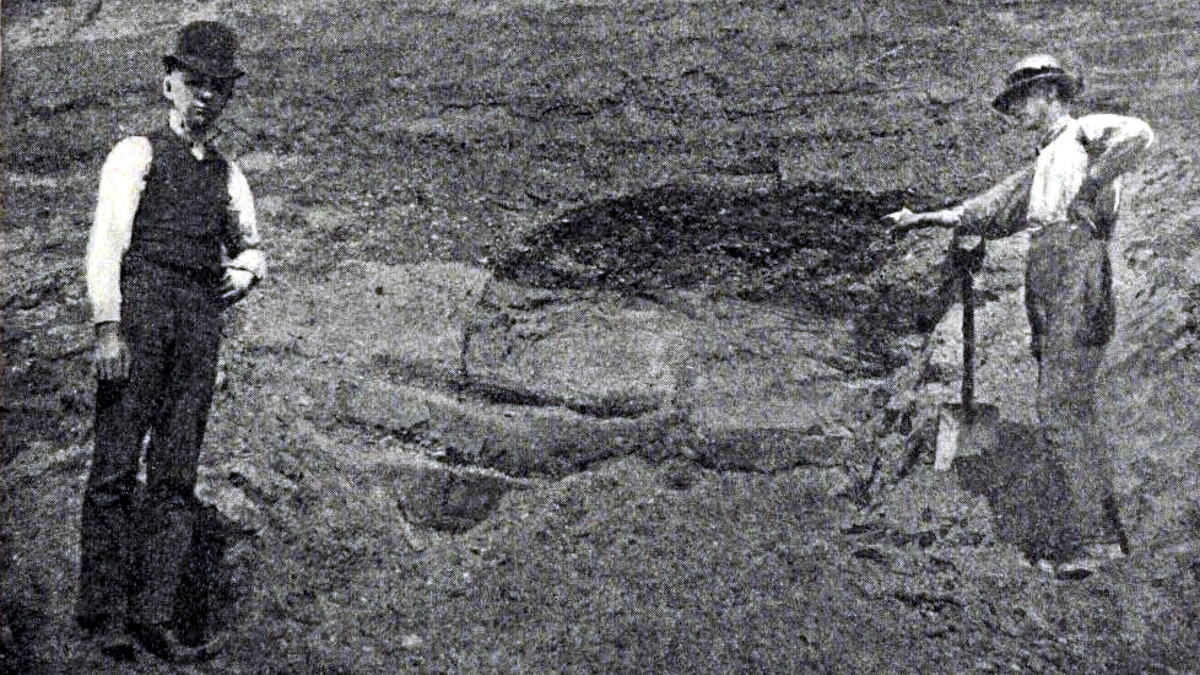
Amateur archaeologist and druggist William C. Mills excavated two indigenous burial mounds and other locations around Newcomerstown in the late 1880s. What he discovered during these excavations altered how historians and archaeologists viewed native culture in the region forever.
Archaeology as we know it today did not exist when William C. Mills (1860-1928) became interested in the numerous indigenous artifacts that inevitably turned up on his father’s Montgomery County, Ohio farm in the 1860s and 1870s. These early finds sparked a lifelong interest in Ohio’s indigenous mound-building culture that ultimately led to him becoming, at the time, one of the preeminent experts of that culture in Ohio. Mills also amassed an enormous personal collection of artifacts over the course of his lifetime.
Mills attended his local schools in Montgomery County as a child, taught for a time in those schools, attended Ohio State University before then attending medical and pharmaceutical school in Cincinnati. After graduation he married, became a druggist, and moved about the state (and outside) before setting up a business in Newcomerstown, Ohio around 1887. All the while, he continued to be active in local and regional archaeological societies and took part in various efforts to discover, document, and excavate indigenous sites and artifacts. It was while living in Newcomerstown that he discovered an artifact he believed proved that indigenous cultures had resided in Ohio before the Mound Builders.
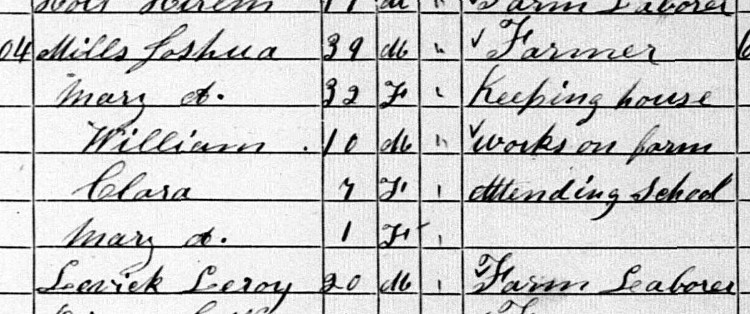
The Mills family recorded on the 1870 census for Montgomery County, Ohio. (Source: familysearch.org) 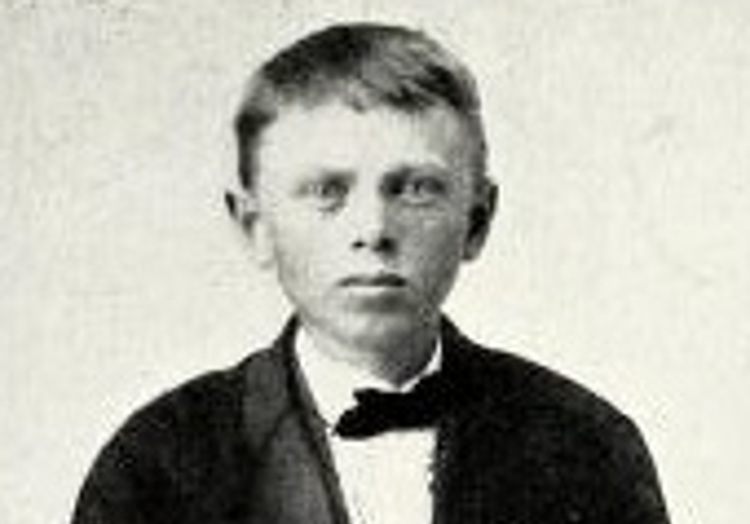
Photograph of 12 year old William C. Mills, c. 1872, from the book Records of the Past, Volume II, 1903. (Source: archive.org) 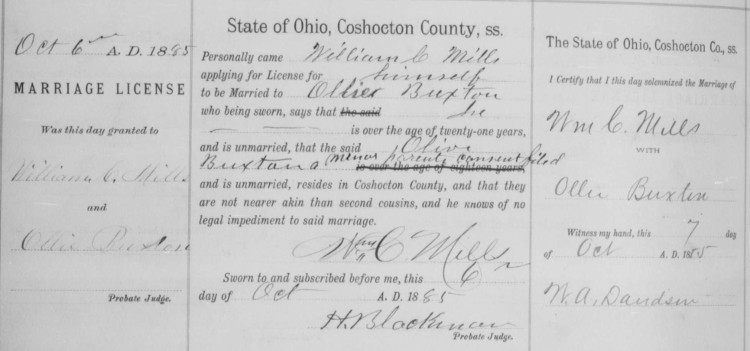
William C. Mills’ marriage to Olive Buxton recorded in the Coshocton County records, 1885. (Source: familysearch.org)
During the late summer and early fall of 1888, Mills was requested by the state archaeological society to explore two mounds located just west of Newcomerstown. One mound was a little over a mile or so northwest of the town and the second was about another mile west of the first. The first mound was recorded as being approximately fifty feet in diameter and Mills and his team excavated a four foot cross section of the mound. Seven feet or so below the surface of the mound they discovered two well-preserved human remains lying on a bed of charcoal and buried with them were knives, scrapers, ornaments, and stone beads.
Mills recorded the second mound as being around sixty feet in diameter and seven feet high at its highest point. Another trench was excavated through this mound and within it were found numerous flint implements, including knives, scrapers, awls, and drills. Just west of the center of the mound they also found human skeletal remains, once again lying on a bed of charcoal and ash, surrounded by the shells of river clams and numerous flakes of flint. The artifacts, and some of the human remains, were retained by Mills for his personal collection.
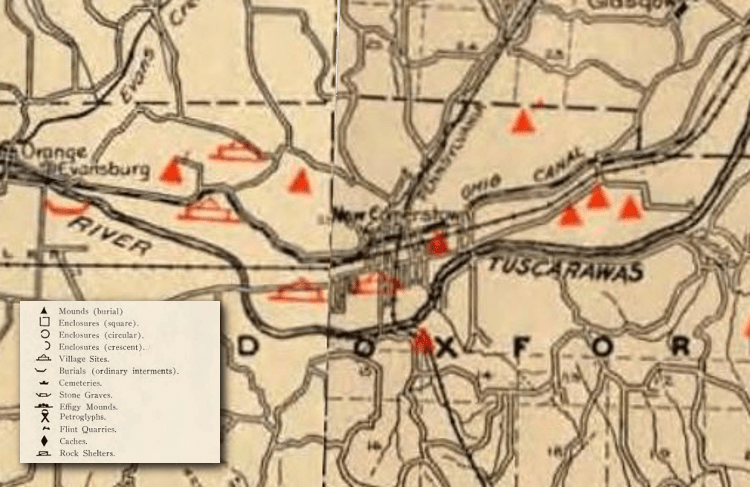
The location of various indigenous features around Newcomerstown as depicted in Mills’ Archaeological Atlas of Ohio, 1914. (Source: archive.org) 
Modern view of the general location of the mounds west of Newcomerstown, Ohio excavated by Mills in 1888-1890. (Source: earth.google.com) 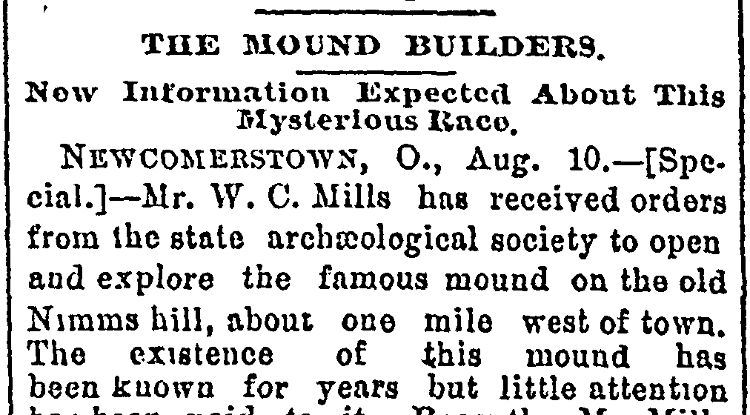
Newspaper account of Mills’ excavations in Newcomerstown reported in the Cleveland Weekly Plain Dealer newspaper, August 1888. (Source: genealogybank.com) 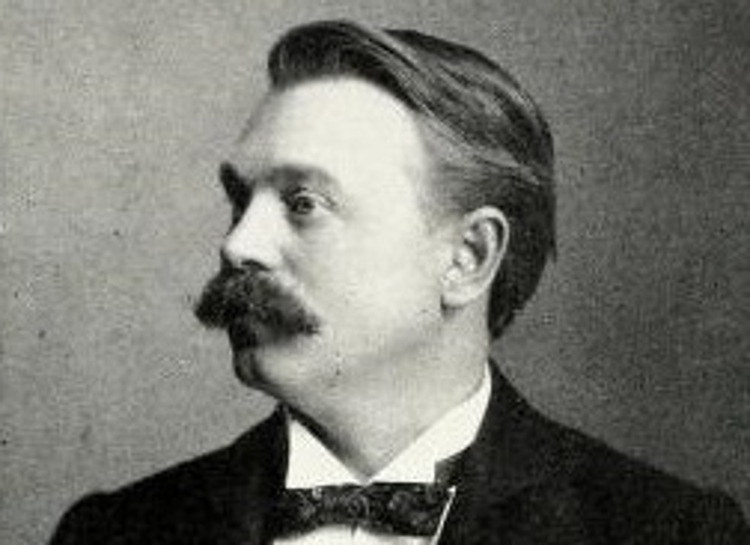
William C. Mills, c. 1898, from the book Records of the Past, Volume II, 1903. (Source: archive.org)
The Newcomerstown find that made William C. Mills’ name and reputation was found not in a mound, but in a glacial deposit along the river near town. There Mills found a flint implement similar to ones found at paleolithic sites in England and France. Mills believed this implement proved that indigenous people were living in Ohio thousands of years before the mound builders. The implement was sent to other experts and geologists to confirm Mills’ theory and, in 1890 their research was presented to the Western Reserve Historical Society and received much accolade and enthusiasm. Shortly after, Mills left Newcomerstown and returned to Ohio State University where he graduated in 1902 with a Master of Science degree.
Just prior to graduating Mills was elected as the Curator for the Ohio State Archaeological and Historical Society and eventually became instrumental in the growth and expansion of the society over the next twenty years. Mills was named as the Director of the society’s museum in 1921, a position he held until his death in 1928. I reached out to the Ohio History Connection’s archaeology department to discover if any of the Newcomerstown artifacts collected by Mills were part of their collection. Unfortunately, they could not identify any that were associated with the two Newcomerstown excavations. William C. Mills died in January 1928 and is entombed in Amaranth Abbey Mausoleum in Columbus, Ohio.
It should be pointed out that, today, much of what Mills did in excavating indigenous burial mounds and retaining the artifacts and human remains would clearly violate modern archaeological ethics and laws. At the time however, it was a common practice and despite how it would be perceived today, Mills’ work did contribute considerably to our modern understanding of Ohio’s early indigenous inhabitants and established that Newcomerstown is an important component of that understanding. To learn more about the The Native American Graves Repatriation Act, or NAGPRA, visit the National Park Service NAGPRA website.
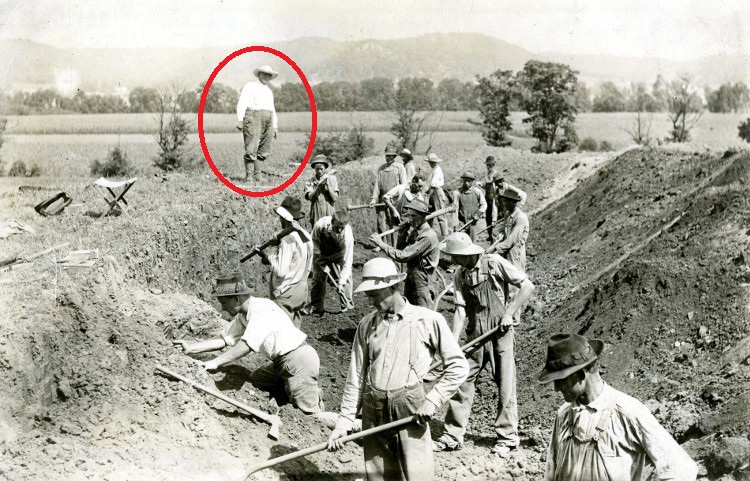
William C. Mills (circled) overseeing the 1915 excavation of the Temper Mound in Scioto County, Ohio. (Source: ohiomemory.org) 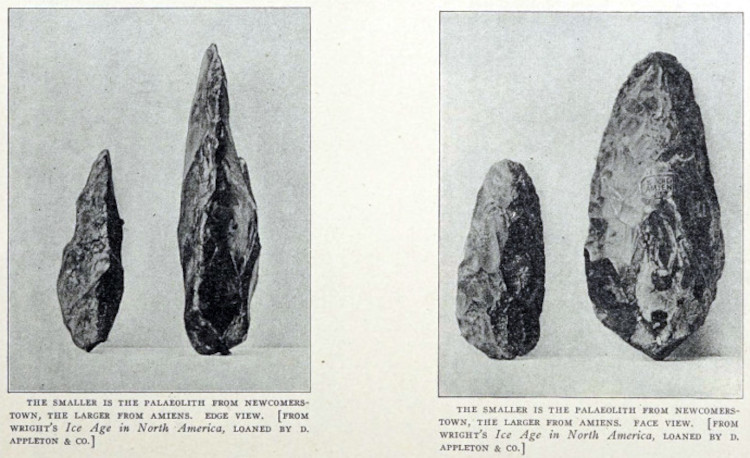
Photos of the flint point (L) found in Records of the Past, Volume II, 1903 that Mills believed proved that indigenous people lived in Ohio before the glacial period. (Source: archive.org) 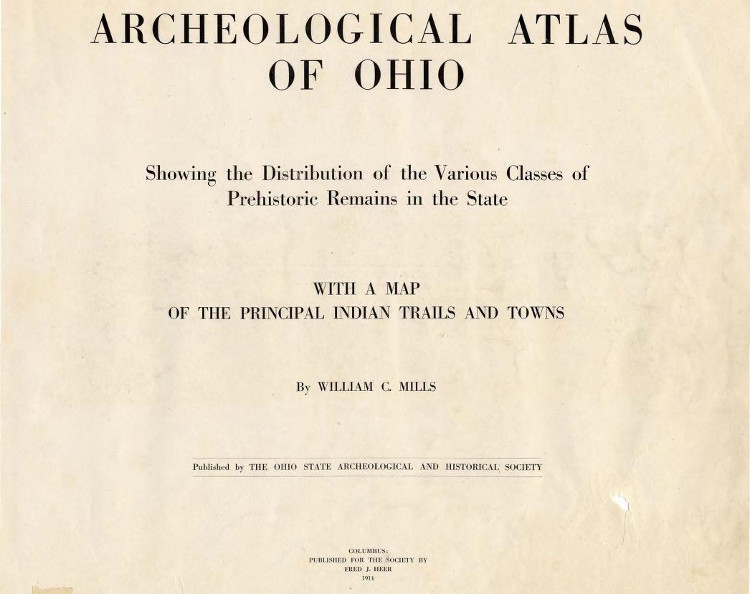
The title page of William C. Mills’ Archeological Atlas of Ohio, 1914. (Source: archive.org) 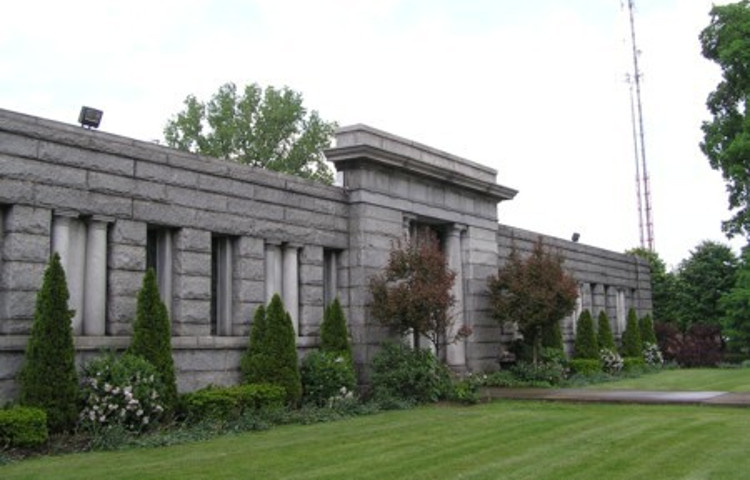
William C. Mills and his wife Olive are entombed at the Amaranth Abbey Mausoleum in Columbus, Ohio. (Source: findagrave.com)

© Noel B. Poirier, 2023.
 Tuscarawas County Stories