
A discovery in 1875 on land just south of New Philadelphia helped prove the veracity of a one-hundred year legend from the era of the American Revolution and the mission at Schoenbrunn.
In the spring of 1875 Josiah Hensel (1825-1919) was busy trying to determine if there was any iron ore to be mined on a hill that bisected his property south of New Philadelphia. Walking along the ridge with his shovel he occasionally stopped to dig a hole and see if there were any promising locations. He may have been looking for iron ore, but what he discovered on that ridge that spring day in 1875 provided evidence for an over one hundred year old story of murder and perceived betrayal.
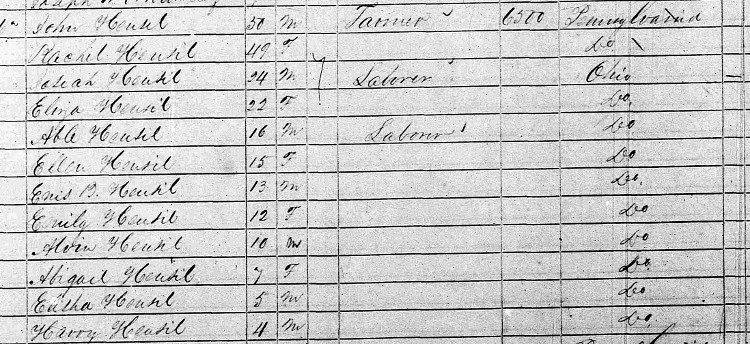
Josiah was the oldest child of Pennsylvania-born parents John Hensel (1800-1871) and Rachel Barton (1801-1855). John migrated to Tuscarawas County as a teenager and there married Rachel, acquired land in York Township, and raised a large family of twelve children. Josiah married Catherine Hawk (1831-1872) in June 1850 and the couple settled down in Goshen Township where they raised their ten children. It was on this land in Goshen Township, not more than a mile or so south of the Tuscarawas River that Josiah made his discovery.
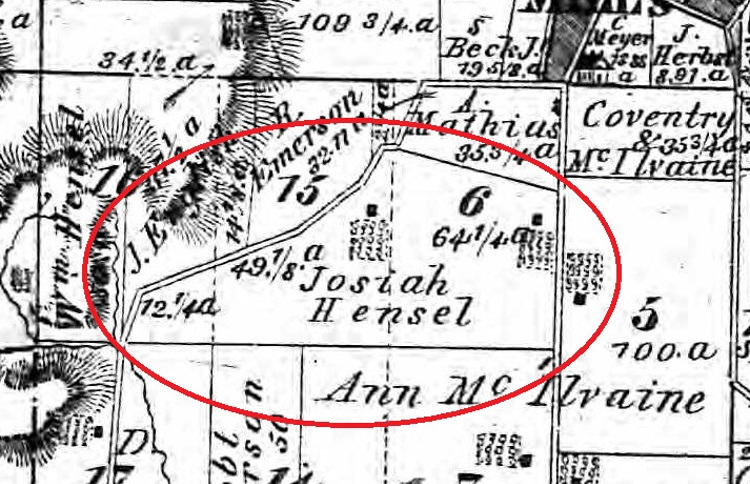
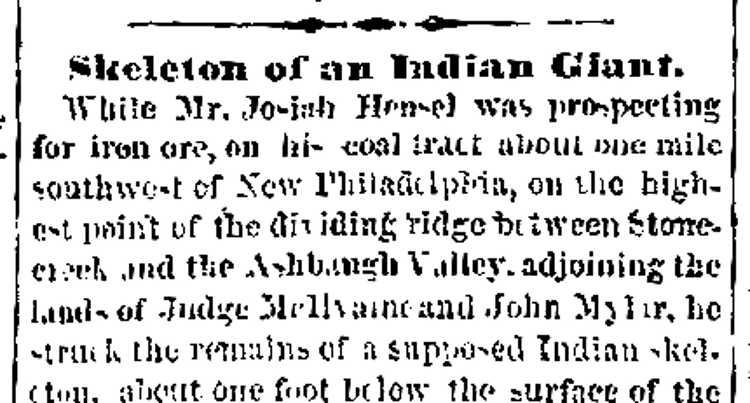
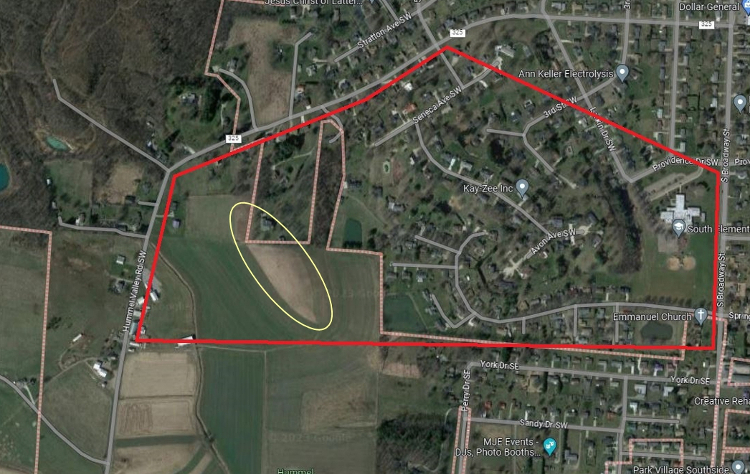
What Josiah surprisingly discovered as he dug in search of iron ore were three skeletons buried in shallow graves. One of the skeletons was rather large with long arm and leg bones and it appeared as if its skull had be damaged by some type of weapon. The other two skeletons were much smaller and, found among them, were objects associated with indigenous people of Ohio including two strings of beads, a spoon made of shell, and some stone implements. The objects led Josiah, and the local press, to speculate that these skeleton’s may have been victims of General Anthony Wayne’s campaign in Ohio in the 1790s.
Historian Charles Hallowell Mitchener, author of 1876’s Ohio Annals: Historic events in the Tuscarawas and Muskingum Valleys, and in other portions of the state of Ohio, connected the skeletons to a report from 1779. According to Mitchener, there was the story of a large Mingo warrior who was married to a European woman who was captured on the Pennsylvania frontier and who he had saved from certain death by marrying her. The pair were part of a party of Mingoes who had stumbled onto pack horses loaded with provisions for Fort Laurens that had run off after being spooked by gunfire. After taking advantage of their find, the couple made their way to the Moravian Mission at Schoenbrunn.

Allegedly, the warrior and his wife, while at Schoenbrunn, listened to a sermon in the mission’s church given by David Zeisberger (1721-1808). The Moravian converts at Schoenbrunn attempted to convince the European wife of the Mingo warrior to stay with them at Schoenbrunn but she refused to stay if her husband did not. The husband had no interest in remaining at the mission, so some of residents conspired to separate the couple by introducing the husband to a particularly attractive unconverted native resident. According to the story, the warrior and this woman went on a walk together to heights above the Tuscarawas River near present day Dover.
When the wife discovered that her husband had left with the other woman, she followed their trail to the heights. There she allegedly attacked her husband with a tomahawk, killing him and causing his body to fall the nearly 100 feet to the riverbank below. She then turned her violent attention to the woman, attacking her and as a result both fell to their deaths as well. Other residents of the mission who had followed the wife, upon discovering the scene, brought the bodies back to Schoenbrunn. Because none of the three had been converted, they were denied burial inside the mission and instead had to be buried somewhere “beyond the sound of the church bell.”
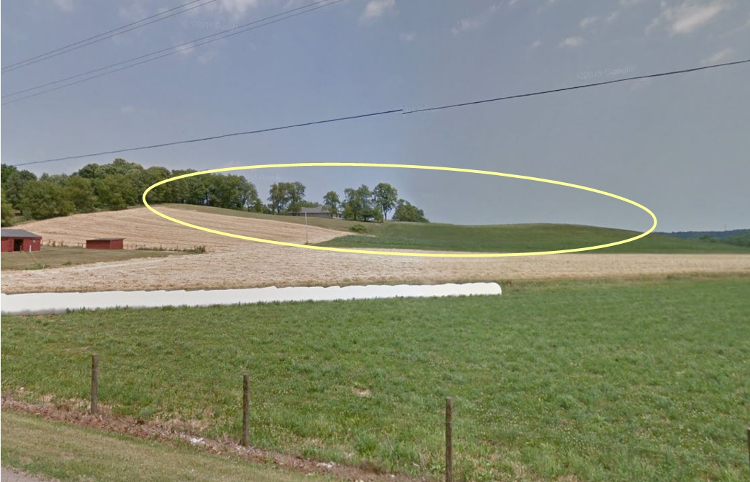
Josiah Hensel’s land sits about two miles, as the crow flies, from Schoenbrunn and easily outside the sound of the church bell. His accidental discovery of the three skeletons on his property put the exclamation point on a legend that, until then, had been just that. What happened to the three skeletons after Josiah Hensel uncovered them in unclear. What is clear is that the story of the Mingo warrior and the “other” woman’s death at the hands of his jealous wife, and their burial away from the mission at Schoenbrunn, was no longer mere legend.
Like my stories?


© Noel B. Poirier, 2023.
 Tuscarawas County Stories