
I have always said that every house tells a story no matter how modest the house may be or what it’s modern appearance may be. This small, working-class house on the west end of New Philadelphia is an example of just that truth.
A note about addresses: House numbers and street names often change over time.
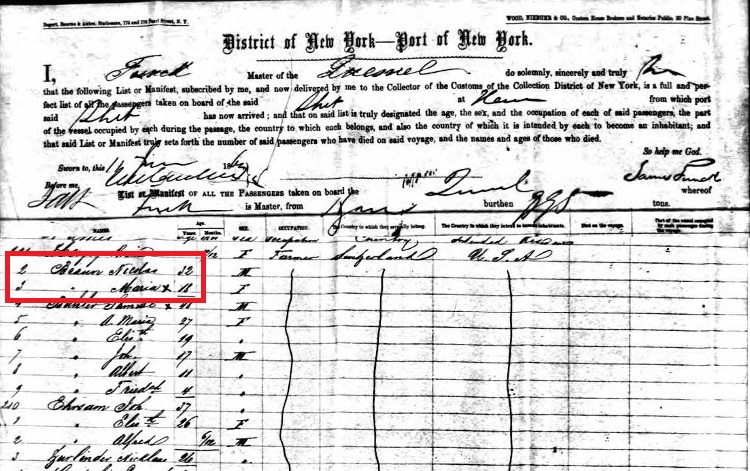
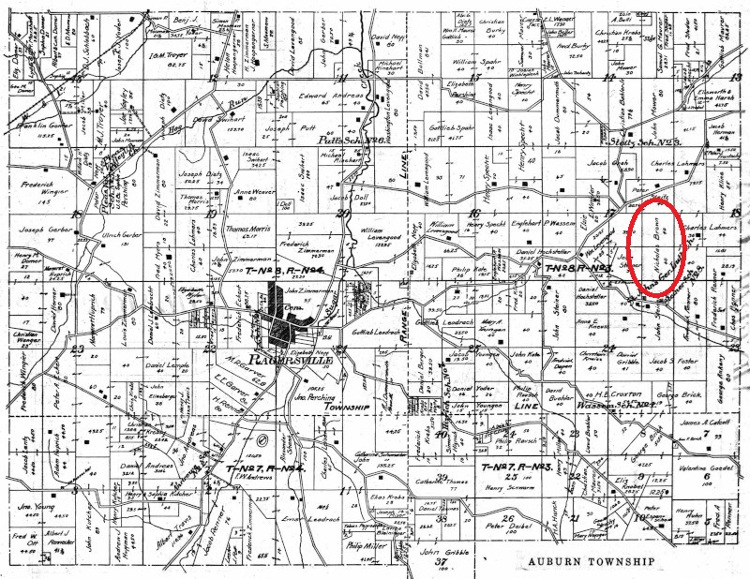
Swiss immigrants Nicholas Brown (1831-1908) and his wife Maria (1843-1926) arrived in the United States with their infant daughter in the summer of 1863. The family moved westward quickly into Ohio, settling in Tuscarawas County by the time their son Frederick J. Brown (1865-1932) was born in 1865. Nicholas and his family lived in Blicktown at first while he worked in the many mines then harvesting ore in and around Tuscarawas County. He earned and saved enough money by 1888 to purchase a small farm in Auburn Township, just east of Ragersville.
Nicholas and Maria raised six children born between 1863 and 1875, but only the youngest ever worked on the family farm. By the time Nicholas acquired his farm, Frederick, often called Fred, was already working in the heavy industries found in the City of New Philadelphia. Somehow, Frederick met the daughter of a Carroll County family named Margaret Cook (1874-1957) and the two married in August of 1891. Tragedy struck the young couple early though when, about a year later, their newborn daughter died.
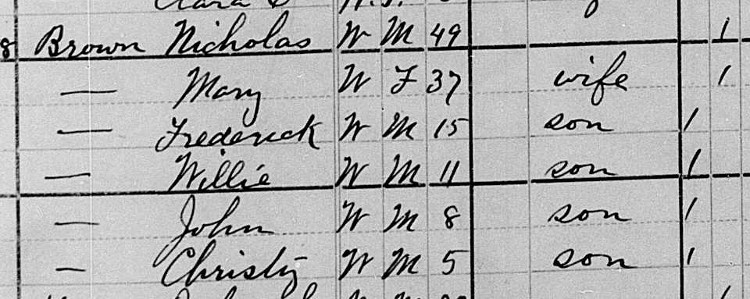
Two years later, in 1894, the couple welcomed a son only to lose another son in infancy five years later in 1899. By the time the 1900 census was taken the Brown family had moved to a small home on South 9th Street in New Philadelphia (modern 6th Street SW). There, two years later, the couple had their fourth child, a daughter. Fred was working now for the American Sheet and Tin Plate Company in New Philadelphia, just a few blocks from their home. The family purchased the slightly larger house on the corner of South 9th and West Front Streets around 1905.
The house the Browns acquired was built only about ten years earlier and was of one of the most common styles of working-class homes. These homes, usually referred to as National folk-architecture, were often designed in simplified Greek revival styles and built with the mass produced materials that were now possible and available thanks to the extensive railroad systems throughout America. There are very few decorative features associated with this style, but the Brown’s did make changes to the home over the nearly fifty years that the family inhabited the house. A significant 1-story addition was added to expand the living space of the home and, at one point, the home had a front porch that ran the full-length of the Front Street façade.
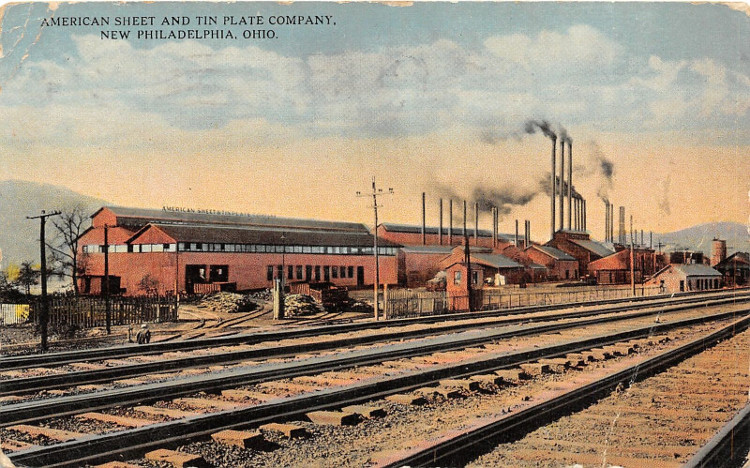
The American Sheet and Tin Plate Company in New Philadelphia, Ohio where Fred Brown worked for his entire life, c. 1910. (Source: ebay.com) 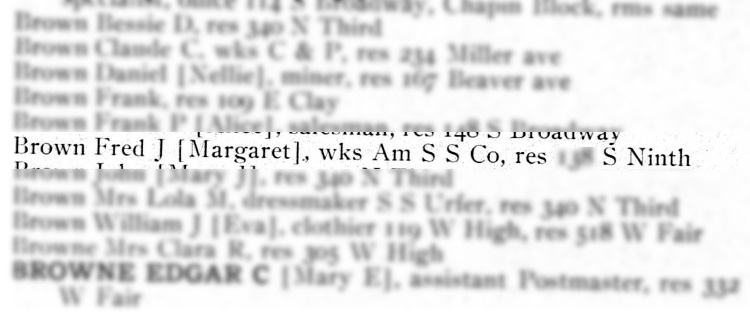
The Brown family recorded in the 1903 New Philadelphia City Directory. They were living just up the street from the home on Front Street at the time. (Source: ancestry.com) 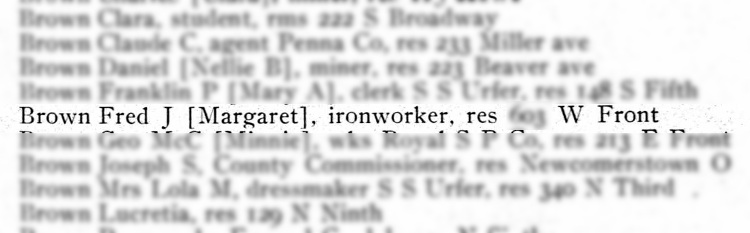
The Brown family recorded in the 1907 New Philadelphia City Directory now living in the home on Front Street. (Source: ancestry.com) 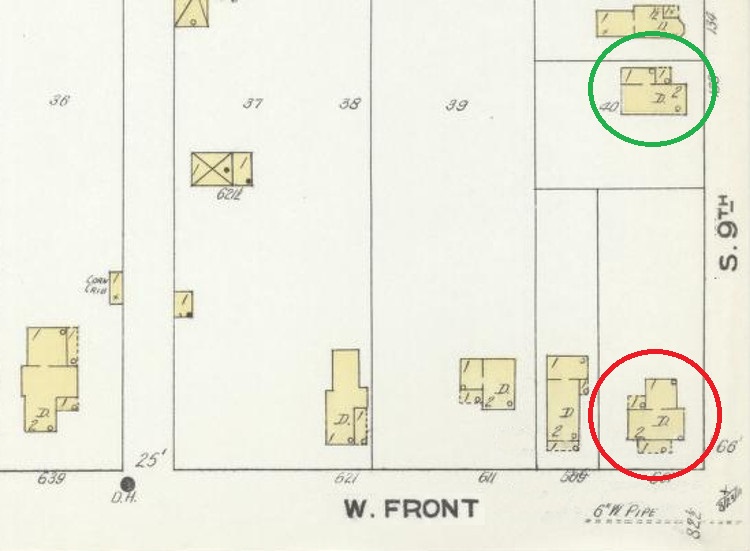
The Brown’s first home (green) and the location of the home on West Front Street (red) on the 1910 Sanborne Map for New Philadelphia, Ohio. (Source: loc.gov)
Nicholas Brown passed away in 1908 and Fred, as executor of his father’s estate, saw to the family farm being leased out to provide income for his mother and the other heirs. Fred then acquired part of the lot next door to the Front Street house where he built a small house for his mother to live in until her death in 1926. The Browns’ son married and moved to Niles, Ohio and, like his father, worked in the steel mills there. The son would die from appendicitis in 1921 at the age of 27, meaning that the Browns had now buried three of their four children. Their daughter meanwhile married a local painter and the couple lived with her parents in the house on Front Street.
After working in the local steel mills for nearly 40 years, Fred stopped working full-time but continued to stay busy. After the death of his mother in 1926, he began renting out the house she had been living in and he also started a home business of making glass name plates. Fred was also active in the local chapter of the Knights of the Maccabees, even being elected to leadership positions with the fraternal organization. Fred Brown died in the summer of 1932 from a heart attack. Margaret Brown continued to live in the home on Front Street until her death in 1957. The couple are buried in East Avenue Cemetery in New Philadelphia, Ohio.
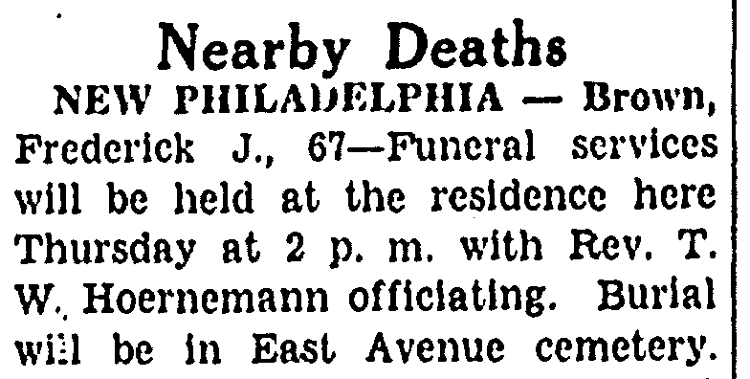
Fred J. Brown’s death reported in the Canton newspaper, July 1932. (Source: genealogybank.com) 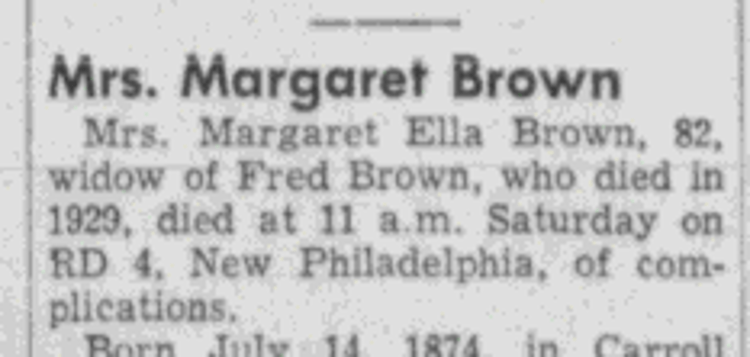
Margaret Brown’s death reported in the Dover newspaper, April 1957. (Source: newspaperarchive.com) 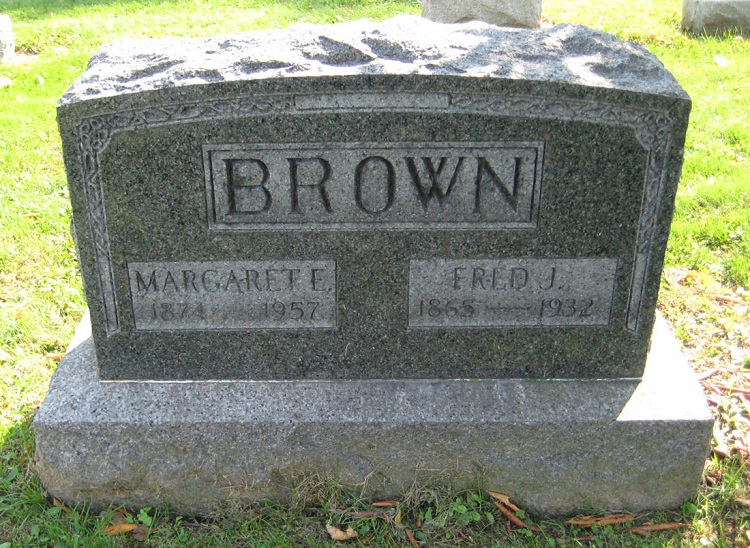
The Brown’s headstone in East Avenue Cemetery, New Philadelphia, 2011. (Source: findagrave.com) 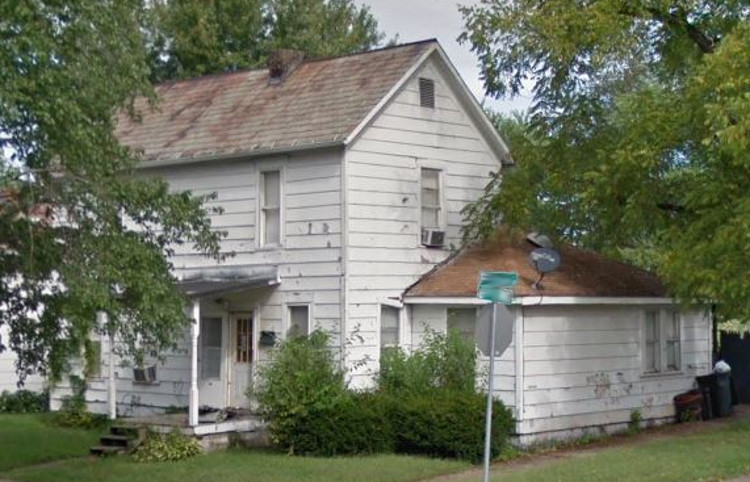
The Brown house on West Front Street, New Philadelphia, 2018. (Source: google.com) 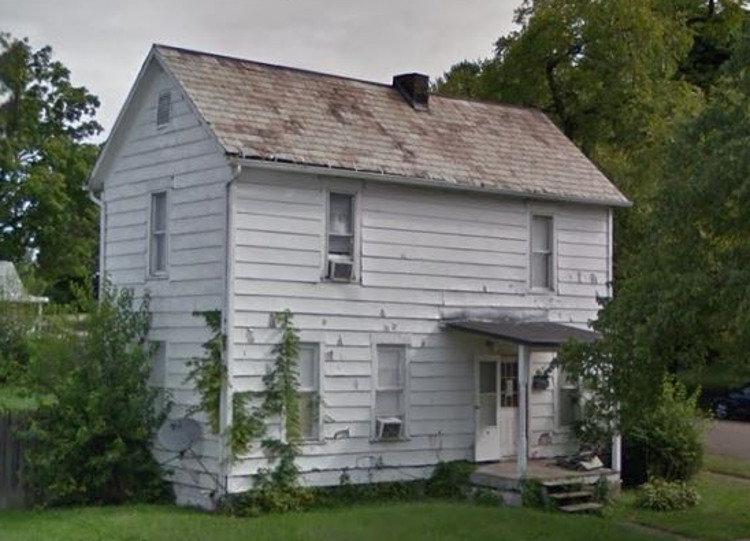
The Brown house on West Front Street, New Philadelphia, 2018. (Source: google.com) 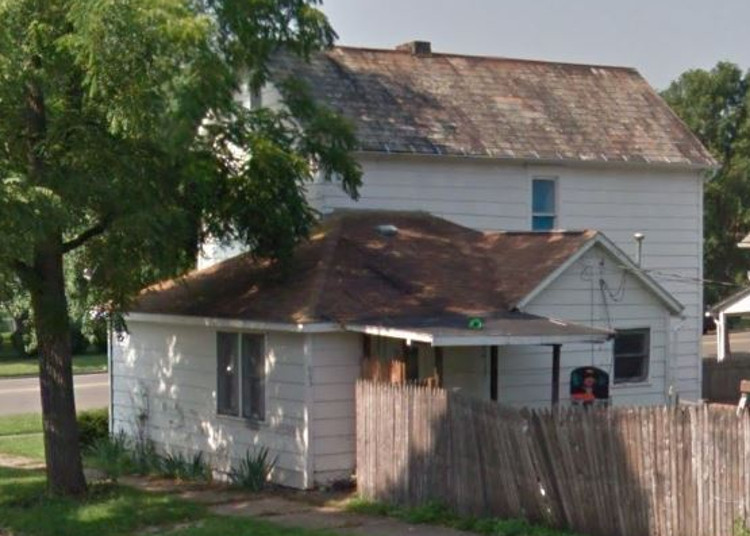
The Brown house on West Front Street, New Philadelphia, 2018. (Source: google.com)
Like my stories?


© Noel B. Poirier, 2023.
 Tuscarawas County Stories